XI
Ways and Means
After weeks and months of meticulous planning and preparation, the day finally arrives. Our arrangements have gone well. It is the second Sunday in July and we find ourselves at long last on a good beat of a renowned sea trout river. We have bought a weekly permit on a popular well run angling club water extending to some five miles of double riverbank, with self-catering accommodation in a nearby cottage, allowing us to fish at any hour of the day or night.
There have been a couple of decent spates through late June into early July, which have refreshed the river and brought a good run of sea trout up from the sea. The river is now dropping back slowly to a perfect night fishing height, running clear at about six inches above summer low level. Reports are coming in of some excellent sea trout caught by club members over the last few nights. The weather is set fair for the coming days, promising some mild nights and good cloud cover to veil a waxing half-moon. Just about perfect conditions for catching sea trout at night.
But we have five miles of river to fish. Where shall we start? We must select a suitable pool or stretch of river to fish tonight, our first on the river. Fortunately, we arrived early and were installed in our cottage by midday, so we have the whole of the afternoon to explore. We have the club map of the fishing pools, which was issued with our permit, and an Ordnance Survey Explorer map, 1:25000 scale, of the local area. As an additional aid, we have a copy of the Google satellite view of the entire beat, printed off some weeks ago. We will concentrate first on the top mile or two of the club water, which seems to be the most accessible. We have the whole week to explore and fish the lower pools.
SEA TROUT TAKING PLACES
After a hurried lunch, we set off in exploration. On our river walk, we will hope to discover where we may safely enter and exit one or two of the better looking pools on this top section. We might look out for well-trodden entry and exit points for clues to the most popular fishing spots, also for popular riverside parking places where the road runs near the river. We need to know where we may wade safely, where we might land a fish etc., but, most importantly, we should try to identify places where the sea trout are likely to take a fly at night. In the absence of an experienced local advisor, this may not be easy.
On small rivers – I am thinking here of rivers like the Cumbrian Esk, Coquet, Cothi, Endrick, Allan, Ugie, Nairn, Dulnain, Liddel and many of the smaller rivers of Wales and the south west of England – it may be possible, even necessary, to concentrate on the main pools, fishing them quietly, thoroughly and methodically from head to tail (often concentrating on the pool tails when truly dark), as these pools may be where the sea trout are to be found at night.
More generally, however, particularly on a medium to large river (for example the Spey, Earn, Dee, Deveron, Nith, Towy, Wear, Lune etc.), I would not concentrate my efforts on the deeper, slower parts of a pool. Nor would I favour the rougher streams we will usually find at the head of a pool (often among the most productive daytime spots for brown trout and salmon but not so much, in my experience, for sea trout at night). Instead, I would hope to find places where the river shallows and/or narrows, causing the flow to quicken, yet with a fairly smooth surface. This kind of water will generally be found towards a pool tail but not only at the tail. The most productive areas may often be found where the stream quickens within a pool, i.e. where a shallower river bed separates two deeper areas within a pool, or on the smoother, swifter glides between pools.
While sea trout might feel over-exposed if lying in such shallow streams during daylight hours, I suspect that, come evening, the nature of the flow in these gentle streams, together with favourable atmospheric conditions, allow the sea trout to optimise their intake of oxygen with the minimum of effort. Secure under the cover of darkness, they are now comfortable, unstressed and uninhibited – in their element, we might say – strong, vital and invigorated, alert and full of beans, particularly if fresh off the tide, and incautious enough at times to chase and take a carefully presented fly. Perhaps they are taking the opportunity for a late evening constitutional, getting in a bit of fun-filled daily exercise, to keep fit for the rigours of spawning ahead and their eventual return to sea later in the year, at the same time keeping their hand in at chasing and catching the occasional prey item.
Whatever the reason, whatever the attraction, sea trout will often be found sporting in these shallow streams in the early part of the night, sometimes well into the night. It might be added that the ideal sea trout stream should lie in close proximity to deeper water, above or below, to which the sea trout might retire at any time during the night for reasons of safety or comfort, and in which they are likely, at times of low water, to spend most of their daylight hours. Most sea trout rivers have a few well known, sometimes famous, holding pools which offer safe resting places, at times for hundreds of fish. While any of the main pools are likely to hold varying numbers of sea trout throughout the summer we cannot rely on sea trout being found at night where they may have been observed during our daylight reconnaissance. As the light fades, they may move from their deeper daytime lies into shallower water, particularly on mild evenings. At nightfall, some may continue their journey to a pool further upstream. But running sea trout may then move in from the pools downstream to take their place in the early part of the night. These vigorous new arrivals will hopefully be in a mood to chase a fly and may also cause a stir among the residents of the pool. The most ready takers are often those bright sea trout arriving fresh in our pools, not long in from the sea. Such fish have provided some of my most memorable nights, as described for example in Chapter 1 (“Four Casts, Four Fish) and Chapter 7 (“An Unforgettable Night”).
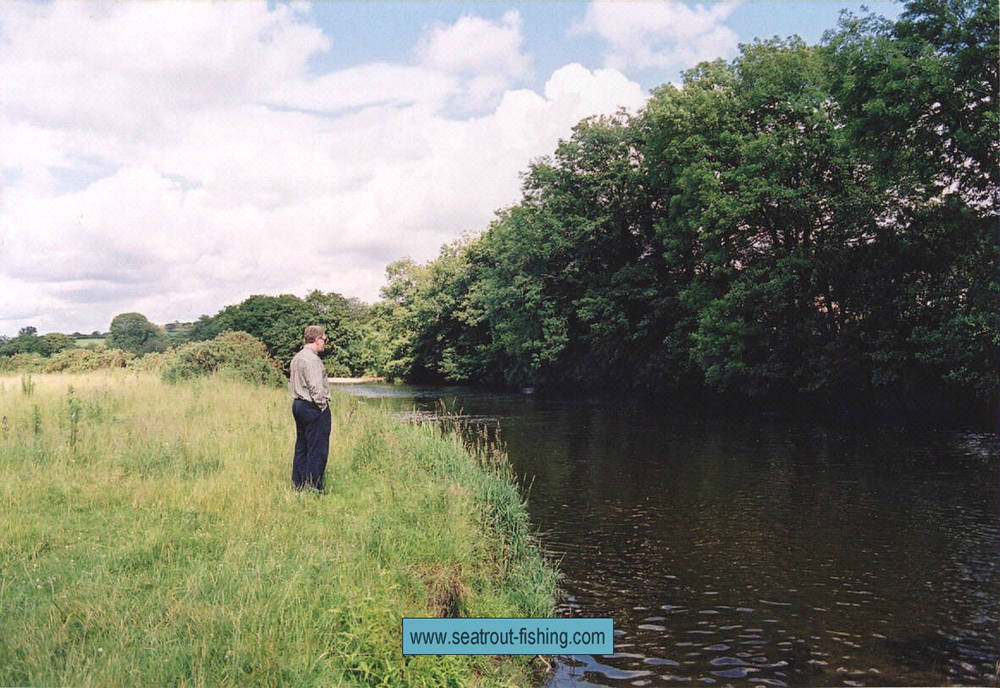
We might look out also for areas of shingle, exposed in times of low water, on one side where the river narrows. Here, sea trout will often lie in the main flow towards the far bank, particularly if there is good tree cover on that bank. Google Earth is a great resource for identifying likely places, such as those shown in the aerial photograph on page 184. Casting a fly from the shingle bank (the lighter areas) to the deeper water under the trees on the far bank will often prove worthwhile.
The shingle banks visible in the photograph are commonly found on the inside of a gentle bend in the river with the heaviest flow on the outside of the bend. In the low flows of summer, these outside bends are often among the few places, apart from the heads and tails of the pools, with any significant current at all. In some straighter sections of the river, the flow may quicken in areas where the river bed shallows fairly uniformly across the width of the river, between two pools or within a single longer pool. These shallow faster (though not rough) streams – ideally situated immediately above or below deeper water offering sanctuary to the sea trout during the daytime or when they become inactive at night – are often worth concentrating on, as are the pool tails, where the flow again quickens over a gradually shallowing river bed.
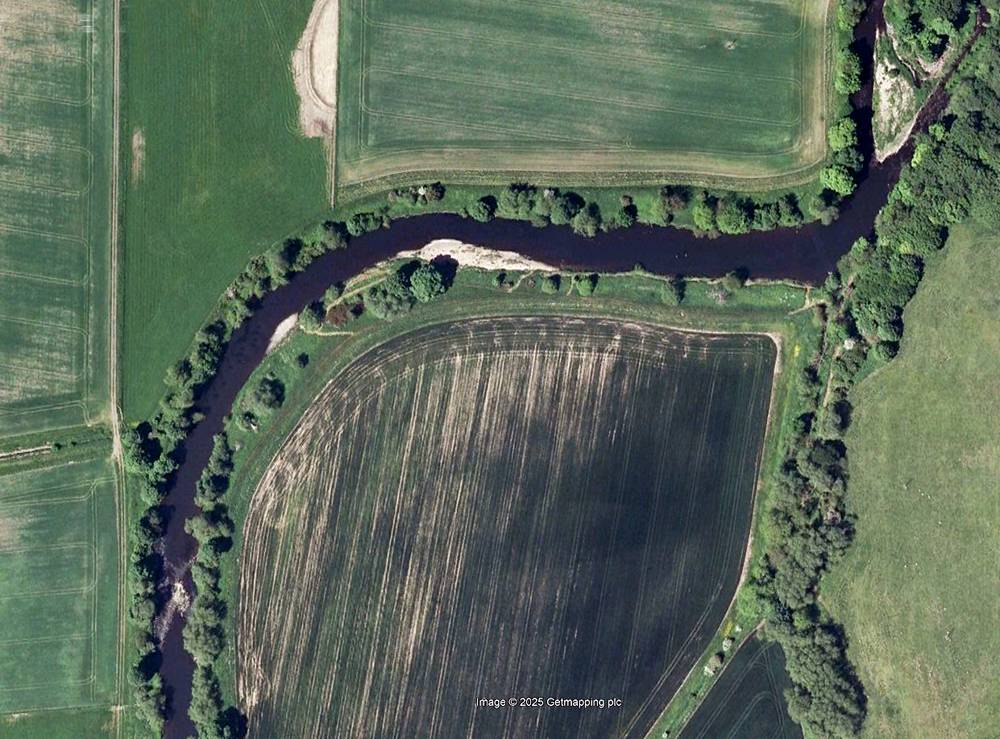
The lighter coloured riverside areas shown on the Google Earth aerial photograph above are banks of shingle, which have been deposited, during repeated spates, on the slower inside of the bend and which are exposed at times of low water. The flow of the river is strongest on the outside of the bend, causing some erosion of that bank. The flow quickens at these points where the river narrows, with the main flow following the deeper channel near the far bank. Sea trout will often lie here. Note the well-trodden paths anglers have taken when entering and exiting the pool.
On mild nights, I have found that sea trout will often move, from the sanctuary of their deeper daytime lies, into such streams and glides, sometimes little more than a foot deep and, more importantly, will be prepared to take a fly in them. Another benefit of the quickening stream, in a river running at low summer level, is that it allows the fly to swing round at a good pace without the need for much, if any, hand lining. Stealth, of course, is essential in such shallow clear streams. To give ourselves a fighting chance, it is vital that we do not begin fishing before dark.
To begin before the riverside greens have turned to grey, though tempting, is likely to put an end to our sport before it has begun. Sea trout are less wary at night than during the day, but they may easily be put off if the angler betrays his presence by careless casting or wading. It is vital that we do not disturb the sea trout pools before the colour has drained from the riverbank foliage. Best to sit and wait until the bats, the moths and the midgies stir, and with them the sea trout! When it is time to begin, the smoother glides and pool tails should initially be avoided, left until it is properly dark. We should seek some background tree cover, stay off the skyline and explore the faster, rougher headstreams first, where there is a chance of picking up a fish preparing to run upstream to the next pool, without disturbing the shoal of fish lying towards the tail of the pool, or about to move into it from the pool below. We should fish as stealthily as we would in daylight, moving slowly and quietly, keeping off the skyline and seeking background cover, especially on bright nights. If there is a moon, we must try not to fish with it at our back.
ESSENTIAL TACKLE
time, we have arrived back at the cottage after a profitable afternoon walk along the river. We have identified two or three pools and glides with some evident potential. We even managed to spy, with the aid of polaroid glasses, a shoal of seven or eight sea trout hovering at ease two thirds of the way down a long pool not far from the top of the beat and are now very much looking forward to our first night on the river. After a leisurely meal, we listen to the evening news on television anxiously awaiting the weather forecast. It is all good. It is to be a mild, dry night with a gentle south westerly breeze, overcast sky and temperatures to drop no lower than 13°C. Perfect! It is nearly time for our first night after the sea trout. We must not overlook any essential pieces of equipment. We have had plenty of time to prepare over the past few weeks and we have made a useful checklist of tackle, clothing and other essentials. Time to get ready. As this will be our first experience of night fishing, we have endeavoured to keep things simple, concentrating on the essentials. So let’s get everything together and go fishing.
Although the weather forecaster has promised a warm dry night, we recall the odd occasion when the forecasters have got it not quite right, so we decide to play it safe. A hot day may be followed by a pleasant evening but the setting of the sun usually signals a fall in temperature. Hopefully, it will fall neither too low nor too quickly tonight, but we should be prepared. Once we start fishing, we are unlikely to be moving around much. We want to be comfortably warm and dry throughout the night, regardless of what the weather brings. We will begin with a shirt and light pullover worn under a lightweight but waterproof wading jacket, with an additional fleece (or woollen jumper) in the fishing bag just in case the night turns chilly later on. The wading jacket will be worn over chest waders, fitted with either tungsten studs or felt soles for good grip on slippery rocks.
The fishing bag (or rucksack) will also hold a flask of tea or coffee and a favourite snack or two, to provide a boost of energy, and fill a break, in the early hours. It will also contain a spare torch, to supplement the head torch we will wear. A second reel, perhaps with a sink tip or intermediate fly line, should go in the bag, along with supporting fly boxes and spools of nylon. Last but by no means least, lest our night’s enjoyment be ruined entirely by hordes of ferocious midgies, insect repellent must never be forgotten. It should be applied liberally on leaving the car. The bag will be left at a convenient poolside location, perhaps hung on a tree or fence post, for collection if moving later to a new pool.
While fishing, we will wear a hat of some description, and, unless we habitually wear spectacles, a pair of clear protective safety glasses. These are especially important if we have little experience of casting a fly at night. We will carry a landing net, which should be conveniently brought into action and operated reliably with one hand. For close on forty years, I have used a Gye net, made by Sharpe’s of Aberdeen, carried on my back. These nets are now available in two diameters of 20 and 24 inches. For most sea trout fishing, the 20 inch net is perfectly adequate, but by all means choose the 24 inch net if you expect to catch a double figure fish. Nets are, of course, available in a variety of designs and a net customarily used for other types of fishing may be adapted for use at night.
One final essential item of equipment for the night fisherman is a good reliable, waterproof torch. It should be emphasised here that the use of a torch on the riverbank is generally frowned upon, particularly if shone directly upon a sea trout pool. The use of a torch should be kept to an absolute minimum, used only for essential tasks like retying a cast or changing a fly. Some night fishermen can manage even those operations by touch, without the need for a torch. When the use of a torch is necessary, it is best to come ashore and direct the torch beam well away from the pool being fished. There is a good range of torches available now which are suitable for night fishing. For many years I used a small LED torch hung around my neck on a cord. It could be held between the teeth for easy light direction.
Some years ago, however, I spotted a headlight, an Energiser Headlight LED X 3, on sale in B&Q for £7.99, which I just had to have. On getting it home, I installed the three AAA batteries supplied and tried it out. A simple switch gives two options … a double white LED or a single red LED. The white light is easily bright enough to light an unfamiliar path to and from the river, while the single red light is sufficiently bright to change a fly, with minimal detriment to night vision, and mercifully less attractive to midgies than the white light. On trying it out, I found the light very effective, easy to operate and as comfortable as I imagine most headlights would be. However, feeling that the headband might become uncomfortable after a few hours fixed on my head, especially if worn under a hat, I tried it around my neck … a bit like an illuminated bow tie … and found it very comfortable and convenient, providing a perfect light for changing a fly, with the option of slipping it up and around the head when walking. With a stated 50 hours of continuous light between battery changes, this proved a very worthwhile purchase. A wide selection of such LED head lights is now available. Next, we come to the main items in our armoury – the rod, reel, line and, ultimately, the fly.
RODS, REELS AND LINES
A sea trout rod will, on occasion, be required to cast fairly large and/or heavy flies, often in adverse weather. Such flies cannot be cast easily on a light line. In addition, our sea trout rod may be called upon to cope with very strong fish, so it should be a fairly strong rod. For general sea trout fishing, I would recommend a rod of ten feet in length, fitted with a short butt extension of up to two inches in length, which keeps the reel away from clothing when fishing and playing fish. My own rods are rated for a number 6 or 7 line, with a smooth, through action, as opposed to a tip action, flexing progressively throughout their length when casting and playing fish. I use them in conjunction with a number eight line. This slight overloading makes it easier to feel what is going on in the dark and loads the rod more efficiently for short to medium casts. For nearly thirty years, I have used a rod built on a ten and a half foot Bruce and Walker Multitrout blank, (since shortened at the butt to ten feet, plus a two inch cork butt extension) rated 6/7. It is still my favourite sea trout rod. On the larger rivers, I also use a rod built on a Harrison 10½ ft 3 piece blank, also rated 6/7. On smaller rivers, or where deep wading is not required, a nine and a half foot rod might be considered.
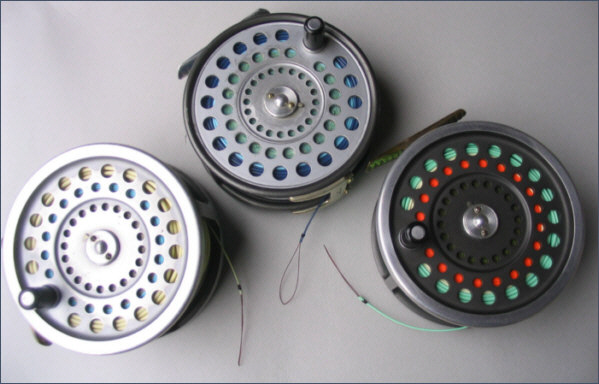
The main requirement of a sea trout reel, for me, is that it will hold a number eight floating line and a hundred yards of backing line. Such a reel is likely to have a diameter of about three and three quarter inches and a spool width of between ¾ inch and one inch.
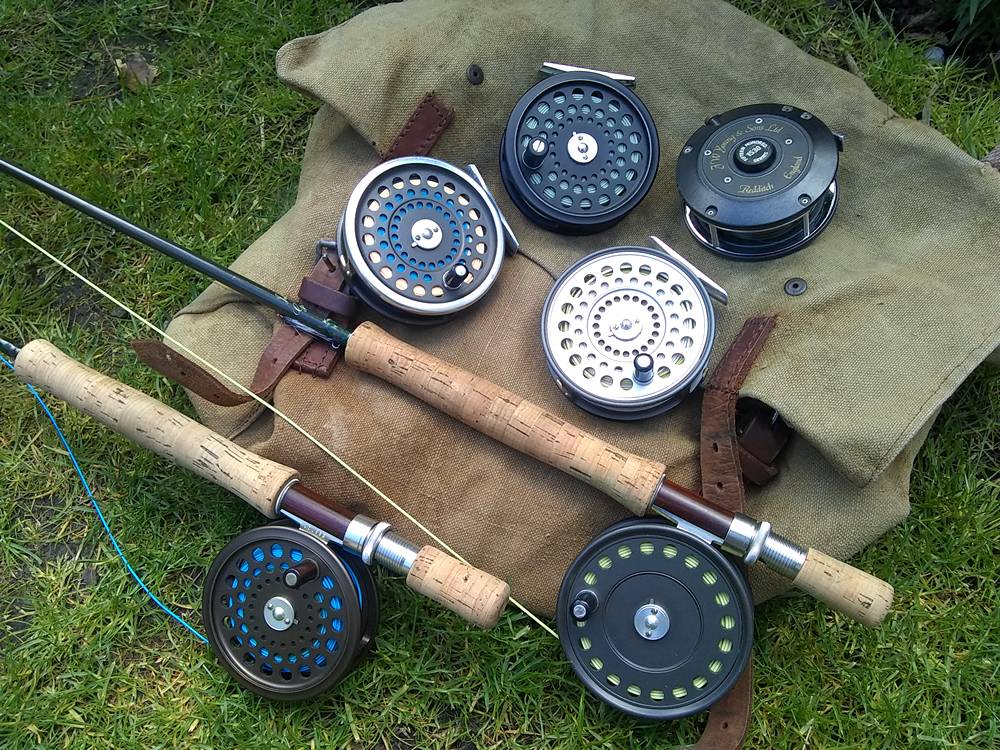
Excellent examples of such sea trout reels are to be found, as shown in the above photograph, in the Hardy Marquis #10 and the St Aidan or, if you can find one, a St John Mk2 (or Mk1 if you wind with the right hand). The more recent Hardy JLH #8/9 and the Ultralite Disc #8/9 are also nice reels. In the days when Hardy reels were beyond what I could afford, my reel of choice was the Young’s 1530 reel, or Daiwa 809 or Shakespeare Beaulite, all basically the same reel and all made to a high engineering standard by J. W. Young of Redditch. To enable the faster retrieval of line, often an asset when a sea trout decides to make a fast run towards the angler, many experienced sea trout fishers prefer a geared “multiplier” reel, such as the Hardy Marquis 8/9 multiplier or the Young’s 1500 series multiplier or Shakespeare Speedex reel, all excellent sea trout reels with diameters of about three and a half inches and with enough capacity to hold a number eight line. Of course, there is a wide variety of rods and reels on the market today, many of which will do the job admirably, if no more efficiently than my ageing favourites, good examples of which occasionally appear on Ebay.
Many sea trout fishers will be familiar with Hugh Falkus’s recommendation of having a range of line densities for varying conditions and times, a floating line for early in the night, particularly in low water conditions, with the option of additional lines with different sinking rates for high water or when the sea trout have “gone down” late in the night. Indeed, he recommended setting up two rods for the night, one with a floating line and the other with a sinking line, so that he could switch between the two, fishing a variety of flies and lures – singles, sunk lures, surface lures – according to conditions as they changed throughout the night. This is a good option, particularly if you have a pool or two to yourself for the night and don’t plan on moving about too much.
Specific requirements will be determined by the characteristics of the river but, on the rivers I have fished, I would say that about eighty percent of my fishing has been done with a floating line, number 8, either double tapered or weight forward. An intermediate line or line with a sinking tip is a useful alternative when the river is running slightly high or for later in the night when temperatures fall. I have rarely used a fast sinking line, although I acknowledge that this omission may, on occasion, have cost me the chance of a fish, particularly late in the night when the fish have gone down into deep water.
In general, I will feel fairly well equipped if I arrive on a sea trout river with a floating line and an intermediate line, plus a few sink tips in a variety of lengths and densities, usually cut from mill end fly lines, which may be easily attached or detached via loop to loop connections to fly line and leader (see Connections in the next section). For much of my sea trout fishing, I always liked the simple practicality of the double tapered line. I found it pleasant to handle, less liable to tangle on bankside vegetation, and its use allowed variable lengths of line to be lifted from the water and recast with no need for a false cast.
I should say, however, that many experienced sea trout fishermen prefer the more modern option of the weight forward line, now available in a wide variety of profiles, and the standard choice for many is an intermediate rather than a floating line. Indeed, in recent seasons I myself have been using a Barrio GT90 WF8 floating line, which matches my ageing rods very well. The GT90 has a long and very gradual rear taper behind the line belly, which allows a longer length of line to be aerialised than with a standard short bellied weight forward line, while the slightly larger diameter of the running line towards the front of the rear taper makes for pleasant handling when retrieving but, at the same time, shoots more easily than the thicker belly of the double tapered line. In short, the GT90 offers the handling properties of the double taper with the line shooting capability of the weight forward line. It is a very easy line to fish comfortably at distances of up to 23 yards, measured from reel to fly, i.e. a standard cast, on a large river like the Spey, would see me retrieving 5 yards of shooting line, leaving 3 yards of fly line between right hand and rod tip, with a further 12 yards of fly line and 3 yards of leader outside the rod tip. The next cast would then be made, with no false casting, shooting the 5 yards of retrieved fly line and landing the fly at 23 yards across the river. Although a further couple of yards might be extended if necessary, very rarely would a cast longer than 23 yards be required at night. Often, a very much shorter cast will suffice.
There are few occasions, with the river running at summer low, when I feel the need for an alternative line. Perhaps if I had the stamina, now, to fish more often through the deepest, darkest, quietest nights, when the sea trout seek refuge in the cool depths of the deepest pools, I would be more likely to appreciate the efficacy of the fast sinking line in disturbing their slumbers. As it is, in my latter years, I tend to make for bed at the same hour as the sea trout. I like to meet them when we are both at our best, a synchrony that seldom occurs much later than two in the morning.
CONNECTIONS
A satisfactory method of connecting our cast, or leader, to a fly line has always seemed somewhat elusive. I have never liked braided loops as a method of connection. For many years, I needle knotted a short length of heavy monofilament to the end of the fly line, formed a loop on the end of this butt section, and looped my leader to it by way of a loop to loop connection. This was, in my view, finer, simpler and more secure than the kind of standard braided loop supplied ready made for connection to fly lines. Yet it still seemed to me to involve too many knots in the link between fly line and fly, each of which might cause unnecessary disturbance on the water surface, something best avoided on the smooth shallow streams we routinely fish at night. So I thought of tying a monofilament nylon loop directly to the end of the fly line rather than on the end of the monofilament butt section, thus shortening the connection and cutting out one of the knots in the chain.
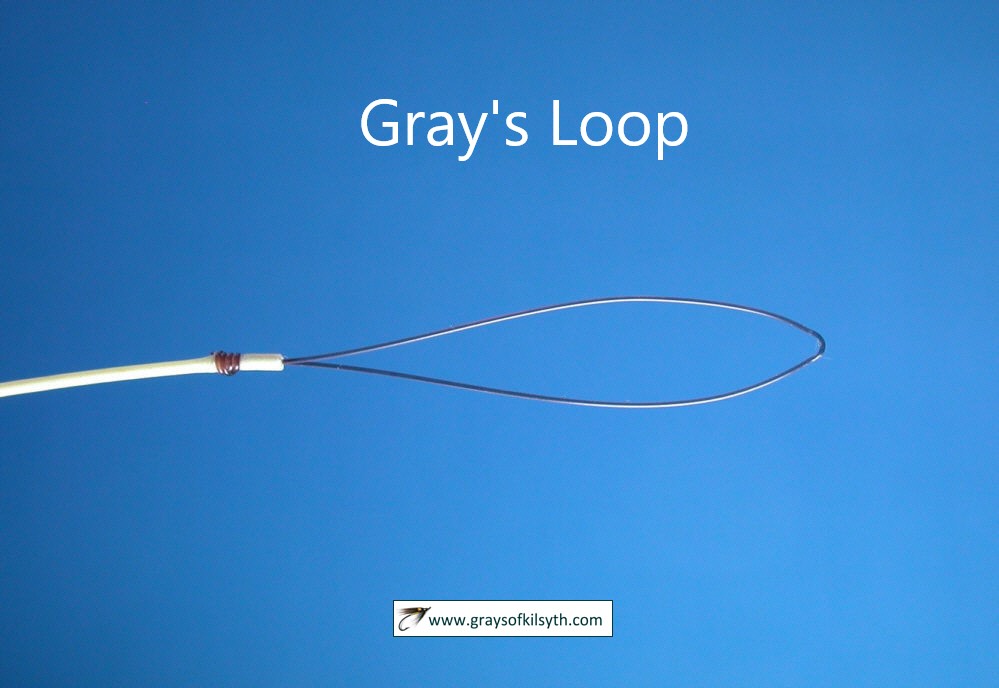
For want of a more imaginative name, I called it Gray’s Loop. The Loop employs a type of simple constriction knot to attach a semi-permanent loop of nylon monofilament to the end of a traditional PVC coated, braided core fly line to facilitate a loop to loop connection with the leader. Such a loop might last a whole season. The tying procedure is similar to that used for the Needle Knot or Nail Knot, but with a doubled length of monofilament nylon. The tying of Gray’s Loop is illustrated on the folowing page:
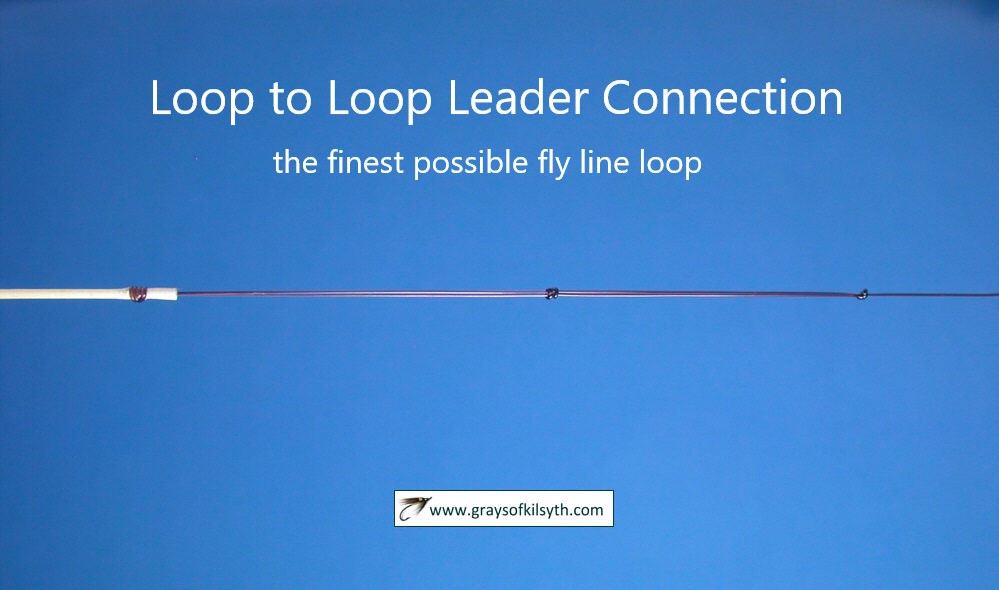
Joined loop-to-loop, as shown, it is the finest fly line-to-leader connection I know, resulting in a minimum of surface disturbance. This knot is not suitable for fly lines with a multistrand or monofilament core. For the knot to grip the fly line securely, the fly line must have a hollow braided core, as in most traditional PVC fly lines.
ON THE RIVER
Home from the sea the rapid run
Home to the redd the journey done
To lie and wait by light of day
To stir and wake as green turns grey
For most night fishing in shallow water, i.e. anything from about one to five feet in depth, I use a floating line, eight weight. To this I would attach, via the loop to loop connection shown above, a cast (leader) of eight to ten feet of 6lb to 10lb Maxima Chameleon nylon, treated with an application of Fuller’s earth mixture to allow it to sink more readily. My standard length of leader would be ten feet, perhaps shortening this to eight feet if fishing in windy conditions. I would tend to use the lighter nylon when using small flies, particularly if adding a second fly on a dropper. If using only one larger fly or Needle Tube Fly, I would normally use a leader of eight or ten pounds breaking strain. For those least experienced in night fishing, I would recommend a single fly or lure. We might begin with a single fly in size 10 or 8 and perhaps change to a longer lure later in the night, maybe a slim stainless steel Needle Tube Fly dressed on a tube of 25mm to 35mm in length.
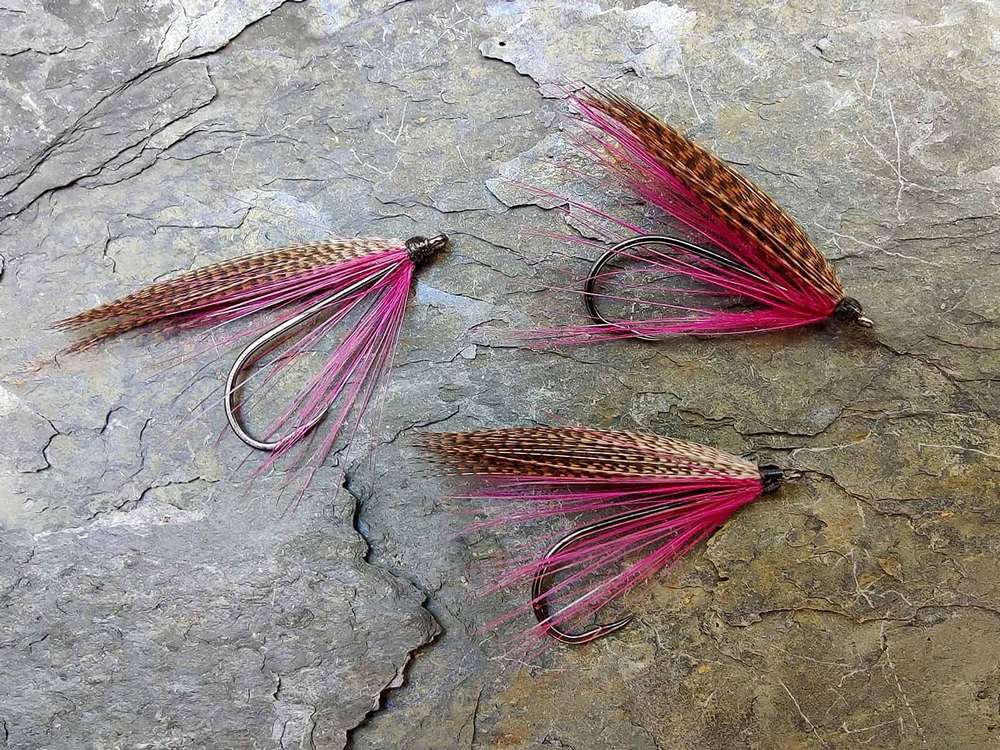
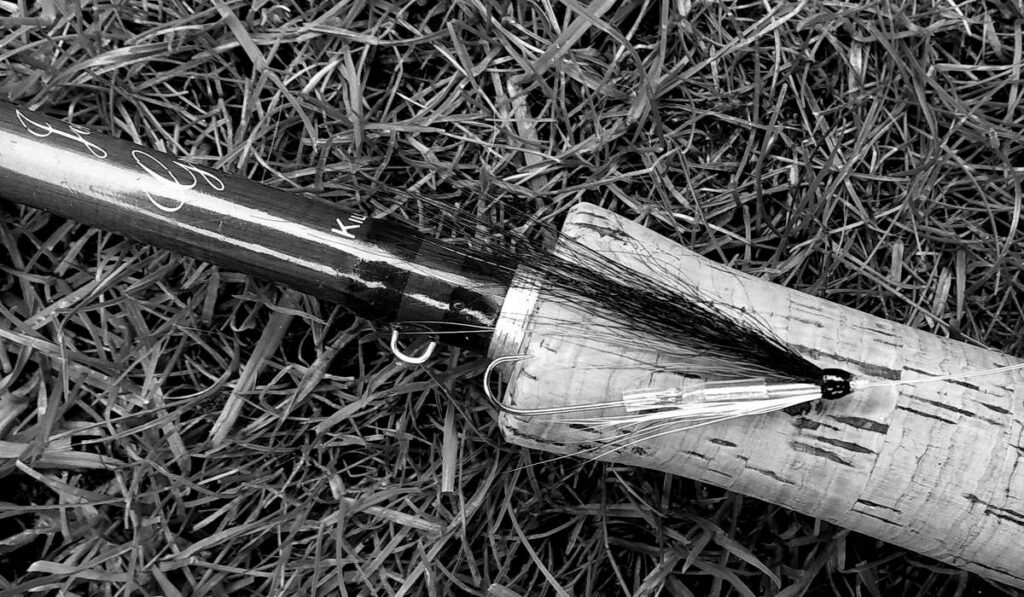
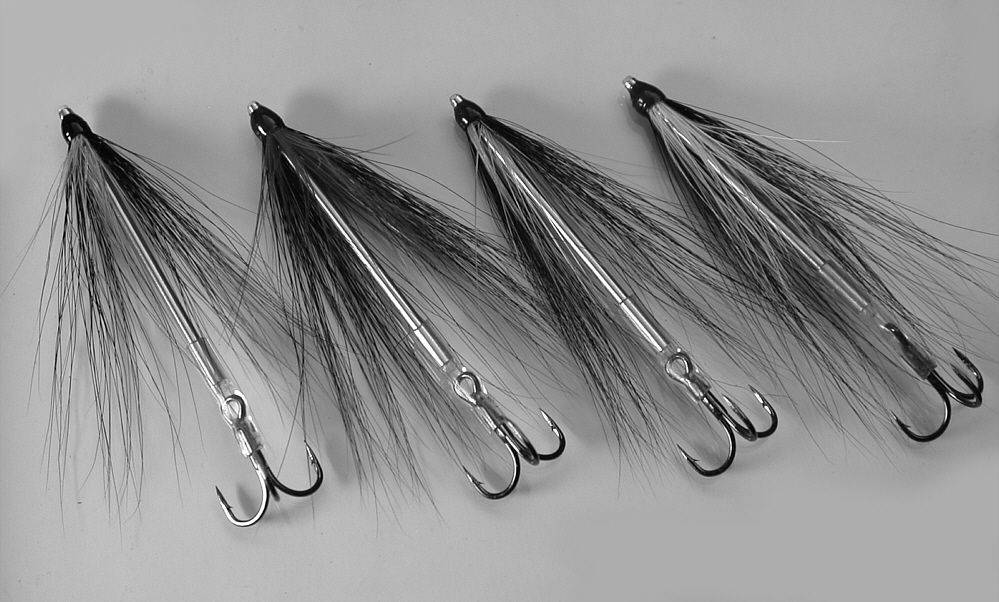
Single, double and treble hooks may be used effectively for sea trout. I have tended to use dressed singles for smaller flies, i.e. flies up to around an inch long, as shown above, while my longer lures have been dressed on needles or Needle Tubes armed with small trebles, usually size 14. More recently, I have been trying singles on my needle tubes, as shown below.
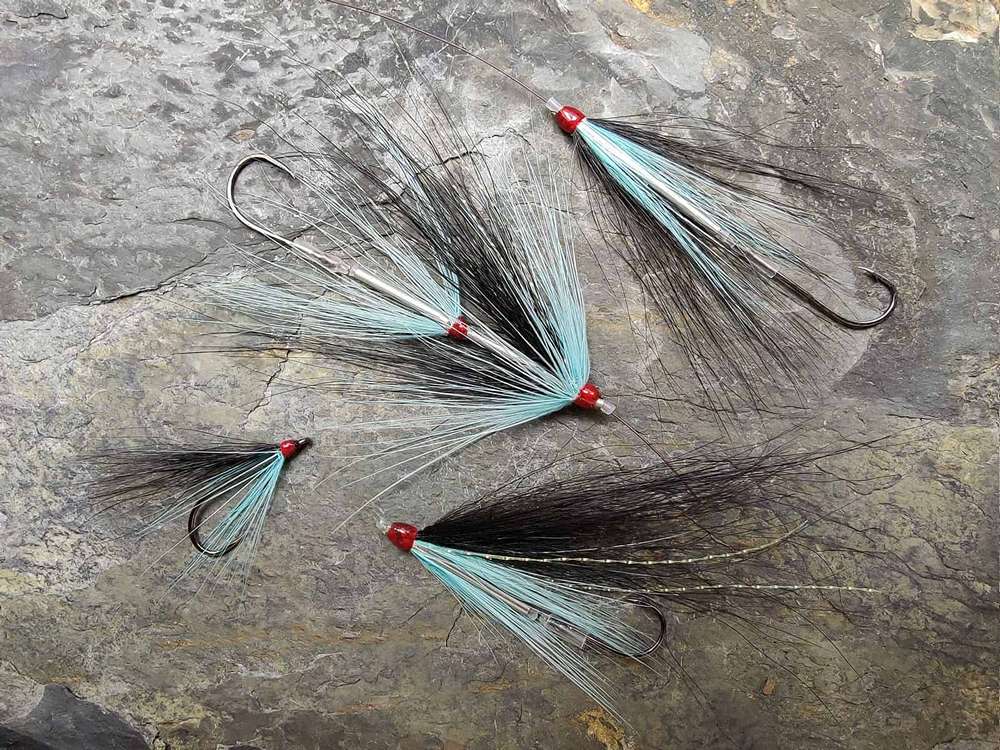
Both singles and small trebles tend to hook fish equally well and both are fairly easily removed when releasing fish. Increasing regulation, however, often now restricts the use of treble hooks in salmon and sea trout fishing. A good option, then, is to arm our sea trout tube flies with single hooks. (see notes on Tinglers in the Flies and Fly Tying chapter).
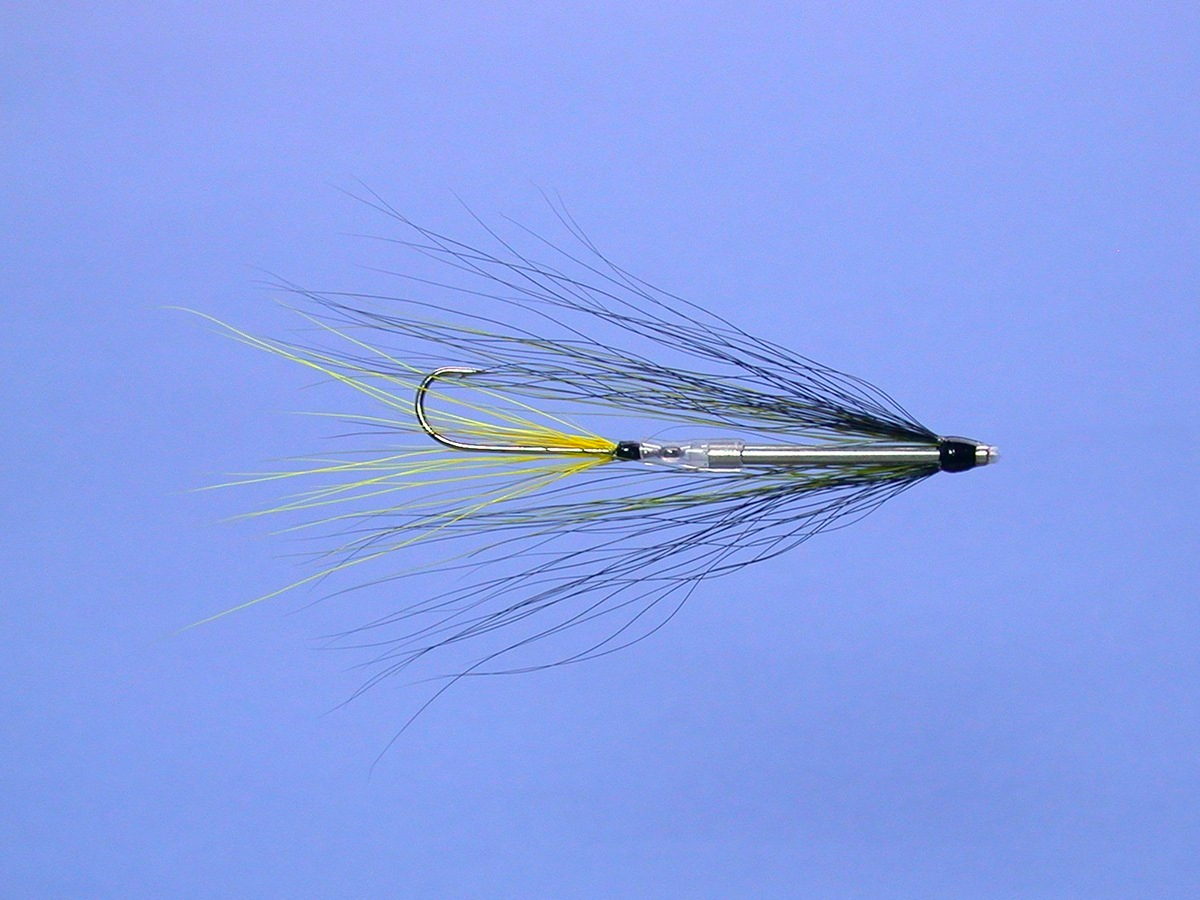
Sea trout may be caught on a great variety of flies, from small singles to long lures of three inches or more. Particular rivers and localities may well have their own special patterns, and anglers’ favourites may differ widely one from the other. It is worth remembering, though, that sea trout cannot distinguish colours at night any more than we can. Once it is truly dark, different colours will appear, both to us and to the sea trout, as varying shades of grey, so we need not worry too much about the colour of our sea trout night flies, except for their tonal qualities. Incorporating a splash of colour in our sea trout flies will, of course, do no harm and, in addition to creating some variation in shade or tone, will provide a useful variety if used in daylight. The night flies in our sea trout boxes should certainly be varied, but not so much in colour as in length, bulk, weight, density, mobility, tonal quality and the degree to which they reflect light. It might be reasonably argued that a simple black fly, or perhaps a black and white fly, dressed on a silver hook or tube, will be as effective as anything for sea trout at night.
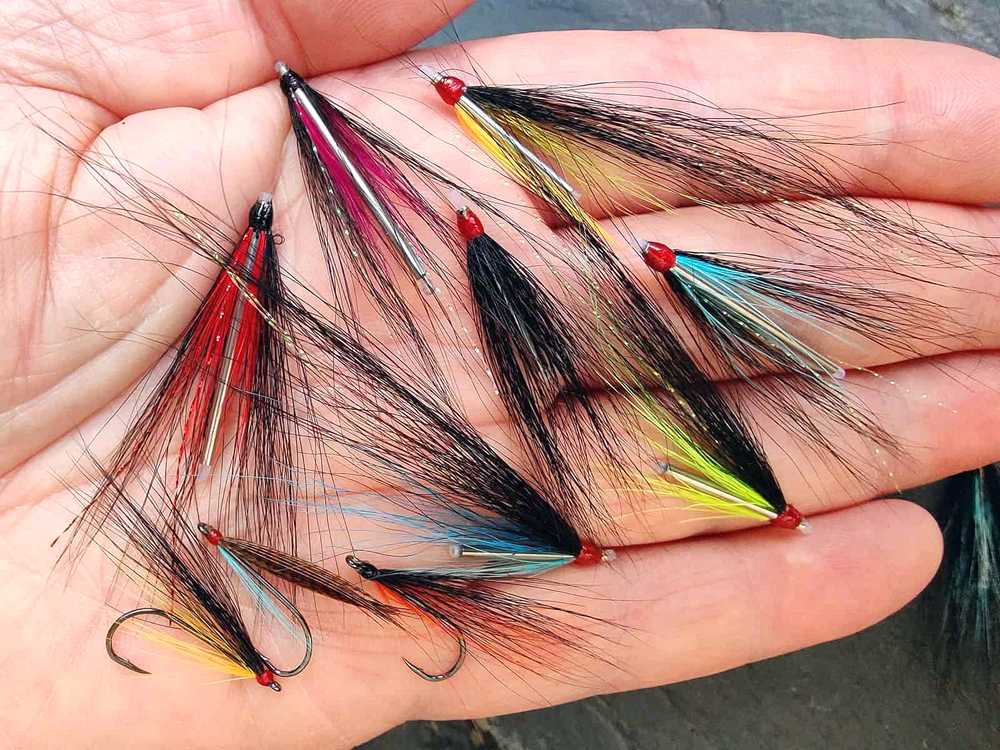
I have no doubt that the size of the fly is very much more important than the colour. As a general rule, I fish smaller flies early in the night and longer flies later when the night is darkest, but this will depend on conditions, too. A higher river or colder night might suit a larger fly.
I like to keep things as simple as possible. I generally fish for sea trout only at night. I rarely fish anything smaller than a size 10 single or longer than two and a half inches, the longer lures dressed on needles or, more likely now, Needle Tubes. For flies up to about an inch long, I tend to use singles. I dislike single hooks which are either very short or very long in the shank, relative to their gape. A short shank hook will not allow the hook point to penetrate so readily, owing to the less acute angle of penetration (for the same reason, I do not like outpoint hooks), while a long shank hook, although hooking more efficiently, owing to the hook point being pulled more directly in line with, and more closely parallel to, the pull of the line, may be prone to loosening during the fight due to excessive leverage.
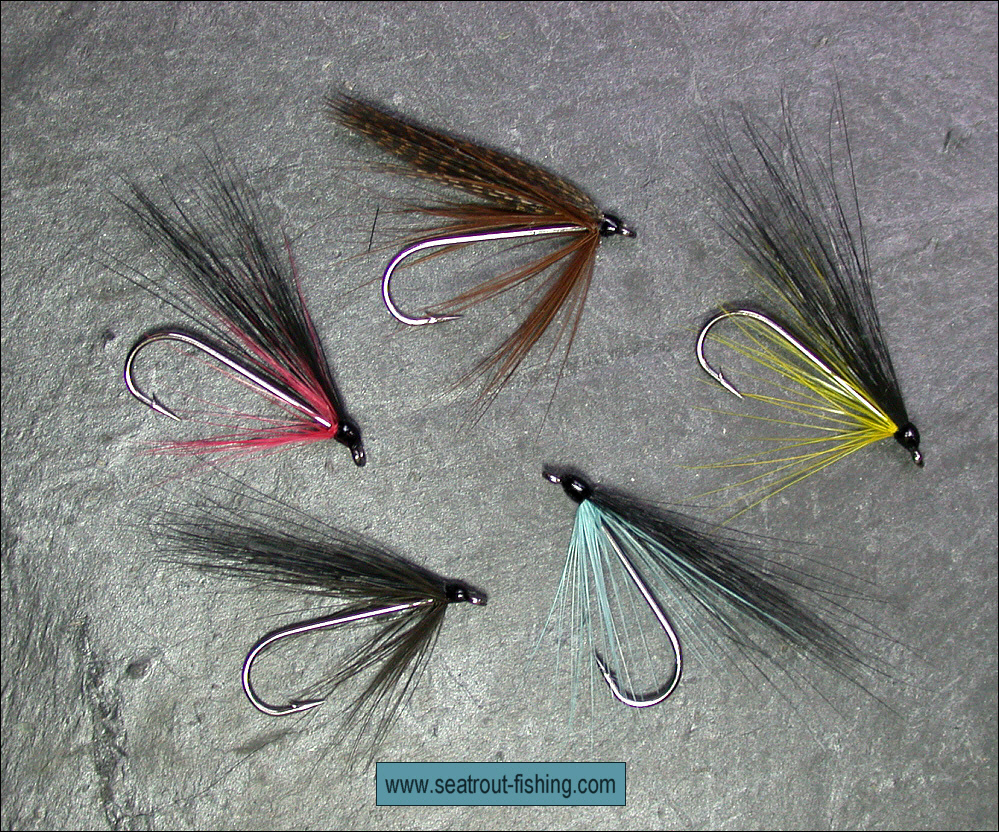
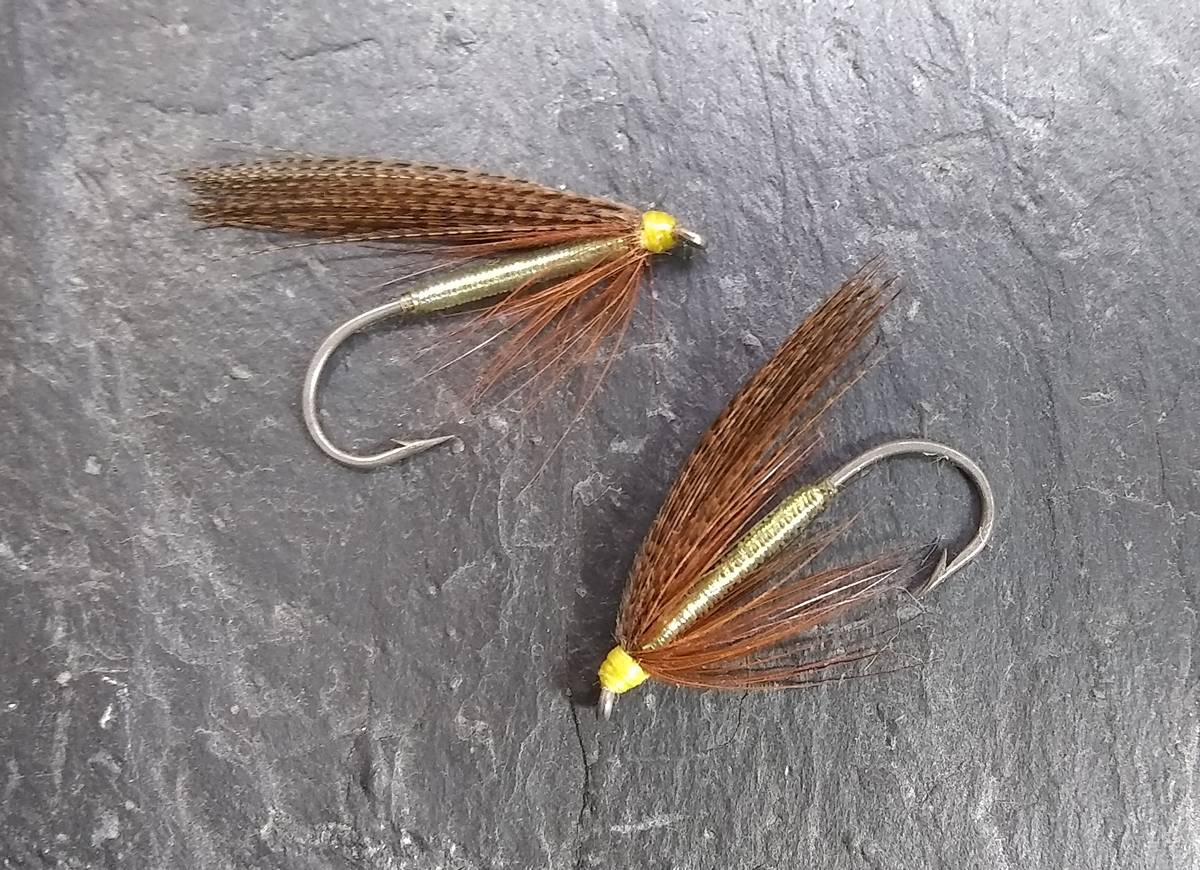
My favourite hooks, which I have found efficient in both hooking and holding sea trout, are the Partridge Captain Hamilton in size 8 and the Partridge Saltwater Perfect, also in size 8. The Saltwater Perfect hook (similar to the Mustad Aberdeen Ultrapoint, 3261NP-BN) is a well-made hook, slightly longer in the shank than a standard hook and with a nice shiny black nickel finish. With no body dressing, it makes for a very simply dressed, fish imitating fly such as those shown opposite, which are very effective despite, or more likely because of, their simplicity. Note that each of the five flies in the photograph has been dressed with a different colour of hackle which are seen at night as varying shades of grey. I have found each combination effective and have no particular preference.
My approach to sea trout fly fishing and fly tying has, I am sure, been influenced very much by some of the ideas and writings of Falkus. He expressed the firm belief that the most effective sea trout lure would be one which, rather than setting out to imitate a creature on which the sea trout had recently preyed, created a tenuous “impression” of such a creature, a tantalising reminder to stimulate an instinctive response. For a fish which was not actively seeking food while in the river, indeed one which had no need for, and little interest in, food, this made a lot of sense to me. A slim, translucent, mobile, sparsely dressed lure, with a bit of glint, seemed to me to be the way to go and this basic objective of creating an impression rather than an imitation has since been reflected in most of my flies, not only for sea trout but also for salmon.
The most effective sea trout lure is likely to be one that represents, however tenuously, something the sea trout is known to have eaten at some point: a slim, silver bodied fly for a small fish, fished at various depths; a bulkier, hackled pattern for a sedge or moth, fished on or very near the surface; or perhaps a shrimp-like fly.
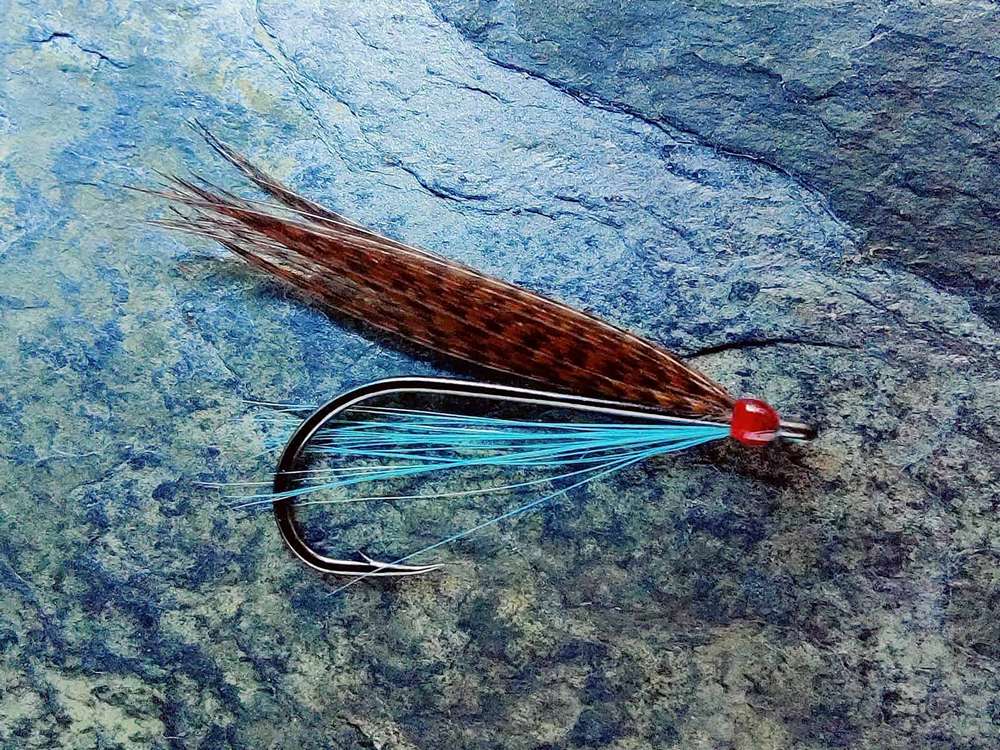
At times, when sea trout are at their most active, it would seem that they are not particularly fussy and will happily take a wide variety of fly types, fished in various ways at various depths. Nevertheless, it would seem logical, most of the time, to offer them a tenuous representation of something which they will recognise as food, behaving in a manner which they might perceive as “normal”. For me this generally means fishing a fly which represents a small fish (slim and silvery) or one which represents an insect of some kind (bushy hackle). Early in the night I may fish two flies, one of each type, perhaps a silver stoat or similar on the tail with the bushier, insect-like fly as the dropper. Often I will hedge my bets and fish an all-purpose pattern which, when tied on a size eight hook, might be taken as either fish, insect or shrimp, for example a fly with a pearl or silver body, brown hackle and mallard wing.
Later in the night, when it is properly dark, more often than not I will cut off the single on the tail and replace it with a Needle Fly or Needle Tube Fly, with an overall length between one and a quarter and two inches, sometimes retaining a single on the dropper, sometimes dispensing with the dropper and fishing the longer lure on its own.
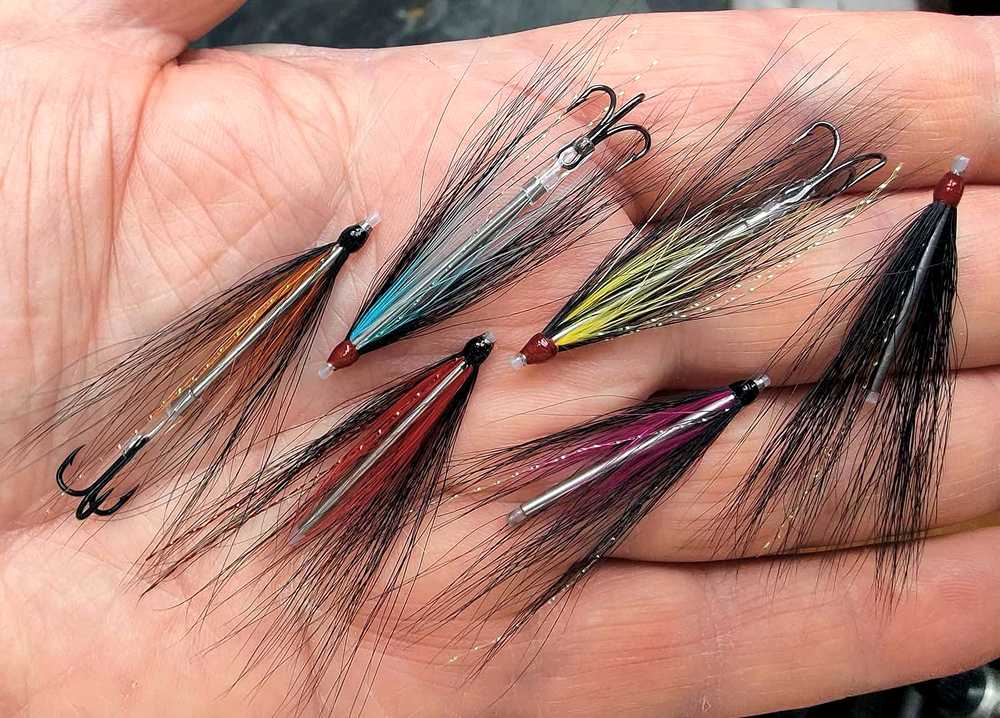
If the night is very dark, I might use a Needle Fly or tube in a larger size, up to perhaps three inches in overall length, clinging to the logic that this type of long slim lure gives the best impression of a small fish or sandeel.
It is often said that sea trout can detect the smallest of flies at night. Indeed, flies as small as size 12 may, at times, be fished effectively through the night, given suitable air and water temperatures, together with adequate light and water clarity. Nevertheless, on very dark nights, even in the clearest of water, a lure with a bit of “presence”, perhaps a heavily dressed tube, might sometimes be needed to attract the attention of the sea trout, or, more to the point, provoke a reaction, particularly in those fish which have “gone down” late in the night.
Lure size will depend, to a great extent, on the river level and strength of flow, water clarity, temperature, degree of darkness, distance from the sea, time of night, time of year etc. A low clear river, for example, fished in the first hour of darkness on a warm night in late July, under a bright half-moon thinly veiled by cloud, may require a size 10 single fly, or even smaller, presented a few inches below the surface on a floating line and cast of fine nylon, although I would rarely go below six pound breaking strain. A high river and a cold or very dark night early in the season, on the other hand, might require a longer lure, fished a little deeper.
In very general terms, all other things being equal, I tend to apply the following simple guidelines: the lower the river height, the smaller the fly; the clearer the water, the smaller the fly; the warmer the water, the smaller the fly; the warmer the air, the smaller the fly; the earlier the hour, the smaller the fly; the brighter the night, the smaller the fly; the later the month, the smaller the fly; the further from the sea, the smaller the fly. I have to say, however, that there is perhaps as much intuition as science in my methodology, which often leaves the sea trout distinctly unimpressed.
In addition to a box of singles, most dressed on size 8 hooks, I now carry a selection of Needle Tube Flies, dressed on tubes of 10 to 40 mm in length, with a total wing length of 1¼ to 3 inches (30 to 75 mm). The colour of the fly is of little importance, as sea trout cannot distinguish colour at night any more than we can. Black and silver is, I think, as good as anything, perhaps with a dash of white or other lighter shade just to provide a little contrast.
Note that the tube flies shown below have been dressed each with a different colour of hackle under a black squirrel tail wing. I believe that sea trout will have just as much difficulty identifying these colours at night as we do, and that they will see the hackles merely in shades of grey. Whether such small differences in tone are to any degree significant is a matter for speculation.
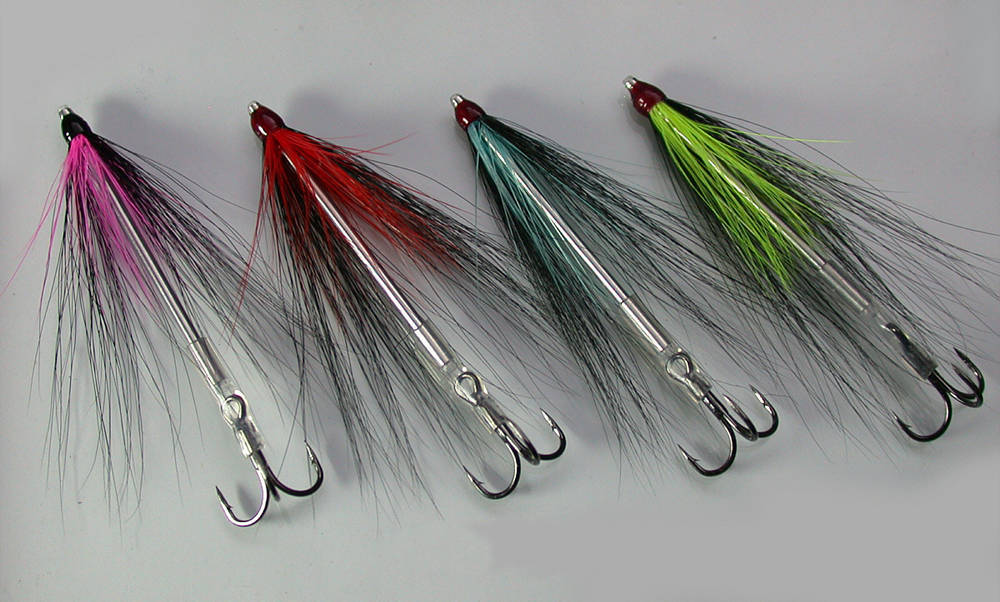
and the same flies as sea trout might see them at night …..
See more on Sea Trout Fly Selection
At the beginning of the night or when moving to a fresh pool, it will be sensible to first carefully search the near water before gradually and stealthily extending line to cover the farther stream. We can then settle to a comfortable rhythm with an easily manageable and familiar length of line, which will allow us to place our fly consistently and delicately in the places we expect the sea trout to be lying. A normal cast, even on our larger sea trout rivers, need be little more than about twenty yards, i.e. a leader of up to 10 feet, 30 to 35 feet of fly line outside rod tip when casting, 10 feet of rod, plus 10 to 15 feet of line retrieved during or at the end of fly’s swing, to be shot again on the forward cast = a cast of over 60 feet (twenty yards). Often a much shorter cast will suffice, especially on our smaller rivers.
Once into our stride, having retrieved the few yards of fly line shot on the previous cast, the next cast should be made, with no false casting, often to a point near the far bank, at an angle varying from 45 to 90 degrees to the flow. We might also try an occasional cast slightly upstream, which will allow our flies to sink a little more deeply before swinging across the stream. We will normally be fishing from the shallow side of the river, casting to sea trout lying in deeper water on the far side, or in midstream. Where there is sufficient flow to work the flies, the line and fly may be allowed simply to swing round to the dangle (the rod angled slightly above the horizontal with the fly line trapped between the rod handle and the index finger of the casting hand) before the few yards of shooting fly line are retrieved and the line recast.
The speed of the fly, and the depth to which it is allowed to sink, may be varied, often to good effect, by casting at varying angles and/or performing a retrieve of varying speeds by pulling in line with the non-casting hand via the index finger of the casting hand, which will be used to trap the line momentarily, to set the hook when a fish takes. The whole pool, stream or glide can be covered in this way by moving, often wading, slowly and carefully downstream, casting as we go, paying particular attention to those shallow streams and pool tails which sea trout find so attractive on mild nights.
When we hook a sea trout, we will have little control over the situation, regardless of his size. A sea trout’s reaction on being hooked is quite variable. He may take off like a torpedo on a long downstream run, often ending with a leap in the air. If the hook holds, things may settle a little, allowing us to regain some line, perhaps a little composure and partial control of events. Or he may begin by leaping in the air, then dash madly in any and all directions, often with more leaping in the air, in a bid to free himself of the hook. The heavier sea trout, in particular, may begin by rolling and slashing on the surface. This is always a worrying manoeuvre, as it often succeeds in ridding themselves of the hook. If the hook holds, an underwater battle may ensue, often featuring a long strong run upstream under the trees on the far bank, perhaps followed by a fast run towards us, or a determined tug o’ war with much angry head shaking. I have found that sea trout, particularly the heavier fish, are less likely to leap clear of the water when the river is running high. All we can do in each scenario is raise the rod and try to keep in some sort of contact. When a sea trout makes a run, let him run. When he stops running, keep up a steady pressure and regain line when possible. Often a sea trout will make a very fast run towards us. We should try to keep up if we can, regaining backing and fly line as quickly as humanly possible, but not so much line that we find ourselves playing a lively sea trout on a very short line under the rod tip. When a sea trout comes too close in the early stages, it will often be necessary to hold the rod high at arm’s length in a bid to keep the length of the leader outside the rod tip, while trying to encourage the fish to take sufficient line to allow us to conduct the fight at a comfortable distance. He should be played out before we allow him anywhere near the net. If we keep our head, he will eventually tire, showing a silver flank on the surface as we draw him steadily over the net.
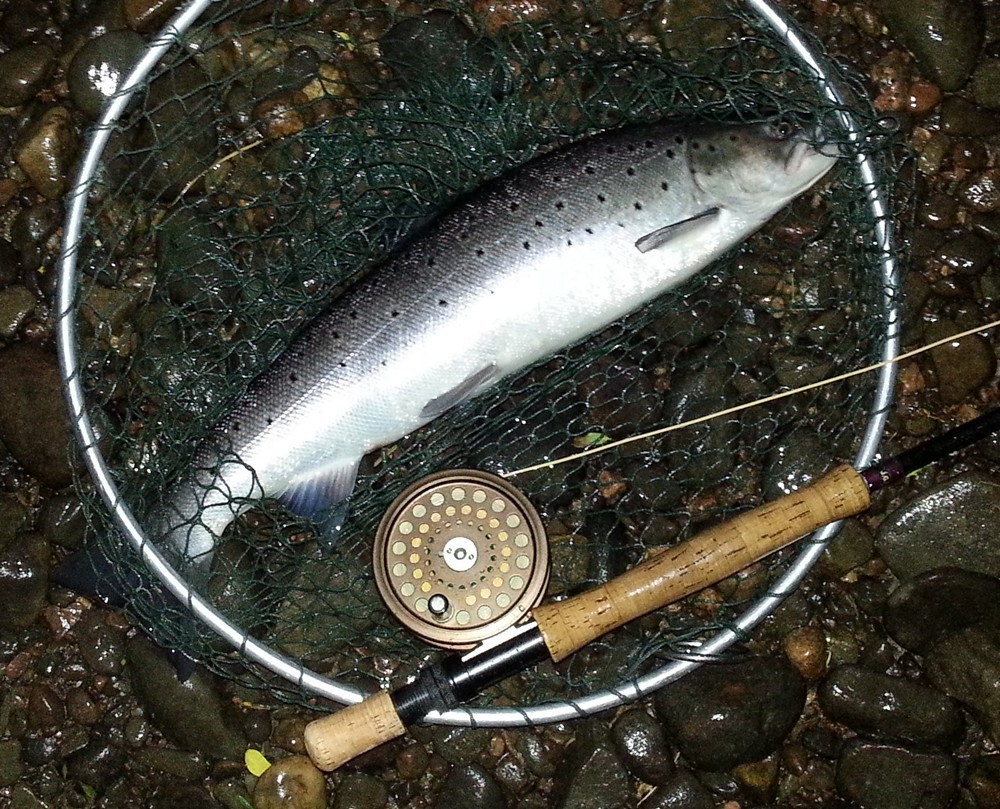
Having considered where and when and how we might seek to catch sea trout, let us now look in a bit more detail at the flies we might present to them, the what if you like.
Chapter XII – Flies and Fly Tying
First edition printed hardback copies of SEA TROUT NIGHTS may be purchased at Coch-y-Bonddu Books