XII
Flies and Fly Tying
Throughout the last century, sea trout fishing was practised on rivers and lochs in the UK and Ireland, on the once famous sea trout lochs of the north west highlands of Scotland, on the great western Irish loughs and on rivers up and down the country, from Sutherland to Cornwall; on the Scottish Islands, on the lochs of Lewis, Harris and the Uists and in the coastal waters of Orkney and Shetland. Fly fishing was the most popular method, drift fishing on the lochs using traditional sea trout flies or dapping with the long rod in a good wind. With a few exceptions, for example in Wales, where the primary game angling species was the sea trout or sewin, sea trout catches on our rivers were largely incidental to salmon fishing. Night river fishing was a relatively minor aspect of the sport, or at least less well publicised than the daytime fishing.
Although a few early writers such as Jeffery Bluett (Sea Trout and Occasional Salmon, 1948) wrote enthusiastically about sea trout night fishing – in Bluett’s case on Devon’s River Tavy – such nocturnal goings on were generally considered inferior to proper daytime sport. The turning point for many was the publication of Sea Trout Fishing by Hugh Falkus in 1962, which inspired a generation to explore the exciting possibilities of night sea trout fly fishing on our salmon and sea trout rivers. That book, together with the later revised and enlarged editions, is still widely regarded as the sea trout fisher’s bible, a must read for those in the grip of the glorious obsession that is night-time sea trout fishing.
Flies for sea trout fishing on the lochs were, for the most part, large versions of trout flies, usually in sizes ten and eight, and very effective they were. R. C. Bridgett, writing in Sea Trout Fishing, 1929, based on opinion gathered from sea trout fishers the length and breadth of Scotland, listed the ten most popular Scottish sea trout flies as follows: Butcher, Peter Ross, Teal & Silver, Dunkeld, Mallard & Claret, Silver Doctor, Grouse & Claret, Pheasant & Yellow, Blae & Blue and Blae & Black.
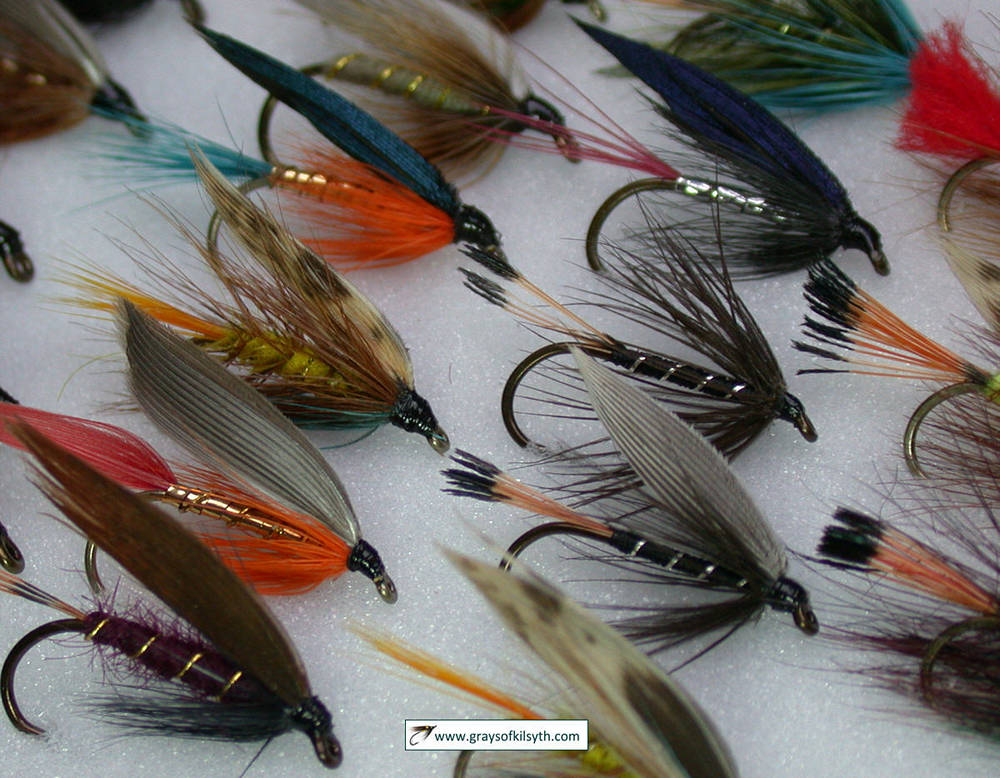
These same flies were often used successfully by those fishing for sea trout on rivers, by day or night. Indeed, few of today’s sea trout fishers would feel unduly deprived if limited to the above sea trout fly selection, perhaps with the addition, for river night fishing, of a Stoat’s Tail or two plus a few longer lures, dressed on wire shanks, needles or tubes (on which more later) for late in the night.
MODERN SEA TROUT FLIES
As the century progressed, increasing numbers of fishermen took to sea trout fishing, many specialising in night fly fishing through the all-too-short summer nights. Sea trout flies evolved, new fly patterns and designs appeared, each for its own purpose or river. As early as 1948, Bluett listed a selection of specialist sea trout flies, some devised by him for night fishing on the Tavy. In addition to tried and trusted patterns such as the Butcher and Mallard and Claret, these included General Eagle’s Fairy, the Martyr, Magpie, Bluett’s Fancy, the Owl and others. To these he added two lures: the Tavy Lure, tied in tandem on two connected single hooks and the Alexandra Lure, dressed on three connected singles. For the most part, his flies were tied short, with no tails and with wings extending no further than the bend of the hook, a departure from the traditional patterns. Bluett’s view was that “these patterns can be relied upon to kill fish in varying conditions of water and weather in rivers of the Tavy type”. All the while, new sea trout flies and tactics were evolving on other rivers along similar lines, e.g. the tandem “Terror” lures as used as early as the 1930s on the Ythan estuary in north east Scotland, while Wales’s rich sea trout tradition has produced many renowned fly patterns.
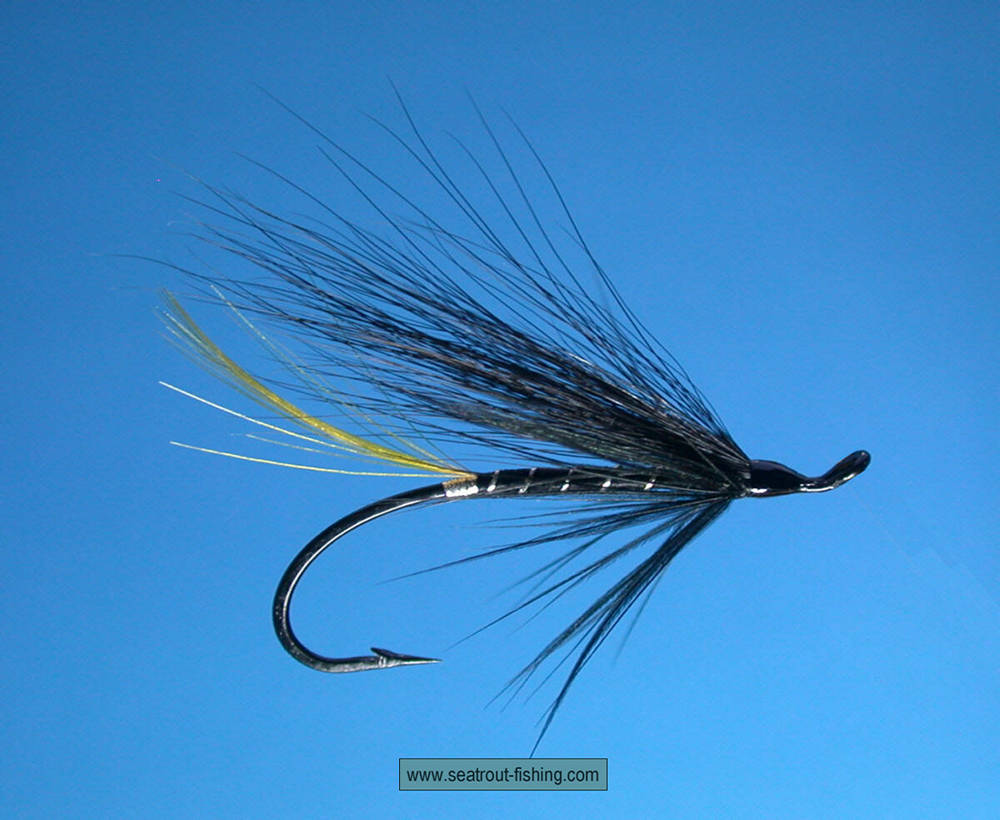
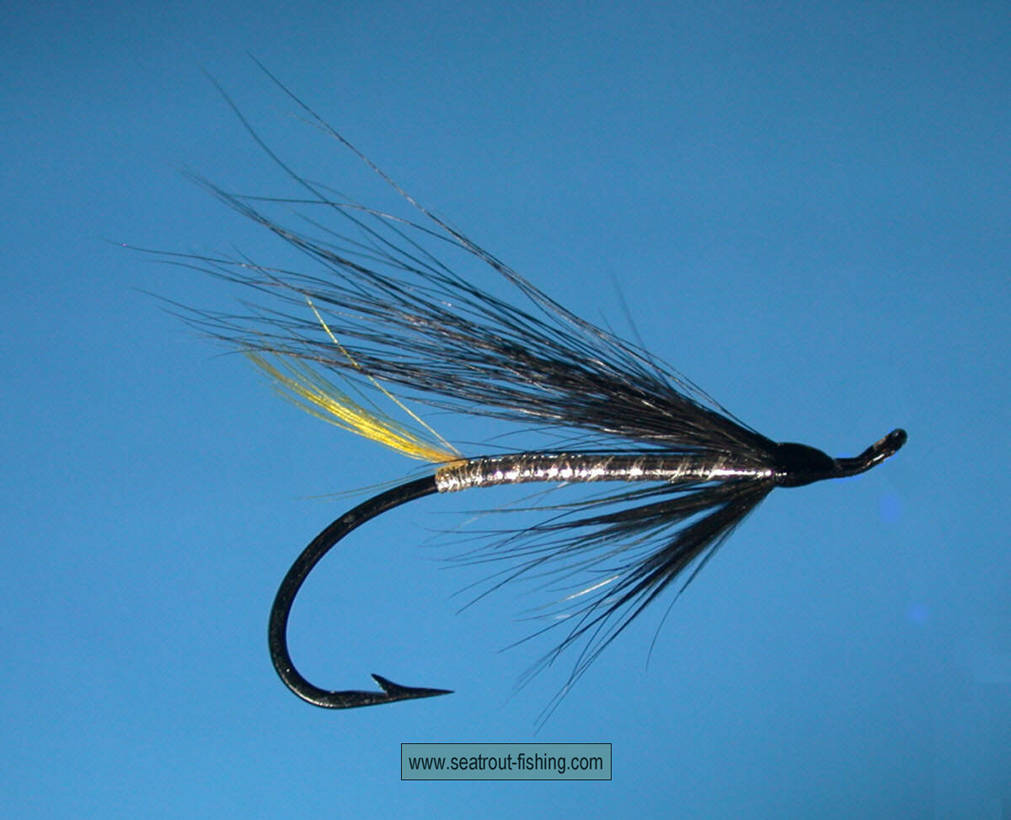
Among the most popular and effective of sea trout flies used in modern times are the Stoat’s Tail and the Silver Stoat, dressed with a silver body, dyed black squirrel tail often being substituted for the stoat.
THE IMPACT OF FALKUS
Although much of what Hugh Falkus wrote in 1962 drew on the earlier writing of Bluett and others, he brought a freshness and structure, a strategy to the whole business of night sea trout fishing, breaking a night’s fishing into stages, each with its own tactics and flies, varying with the changing conditions and behaviour of the sea trout. His knowledge and extensive experience, gained over many nights on his beloved Cumbrian Esk, allied to his undeniable talent as a writer, caught the public imagination, and inspired many trout and salmon fishers to embark on this exciting “new” branch of fly fishing. He introduced a range of sea trout flies and lures, each designed to meet particular conditions during the course of a night’s sea trout fishing. They included the Medicine, the Secret Weapon, the Sunk Lure and the Surface Lure.
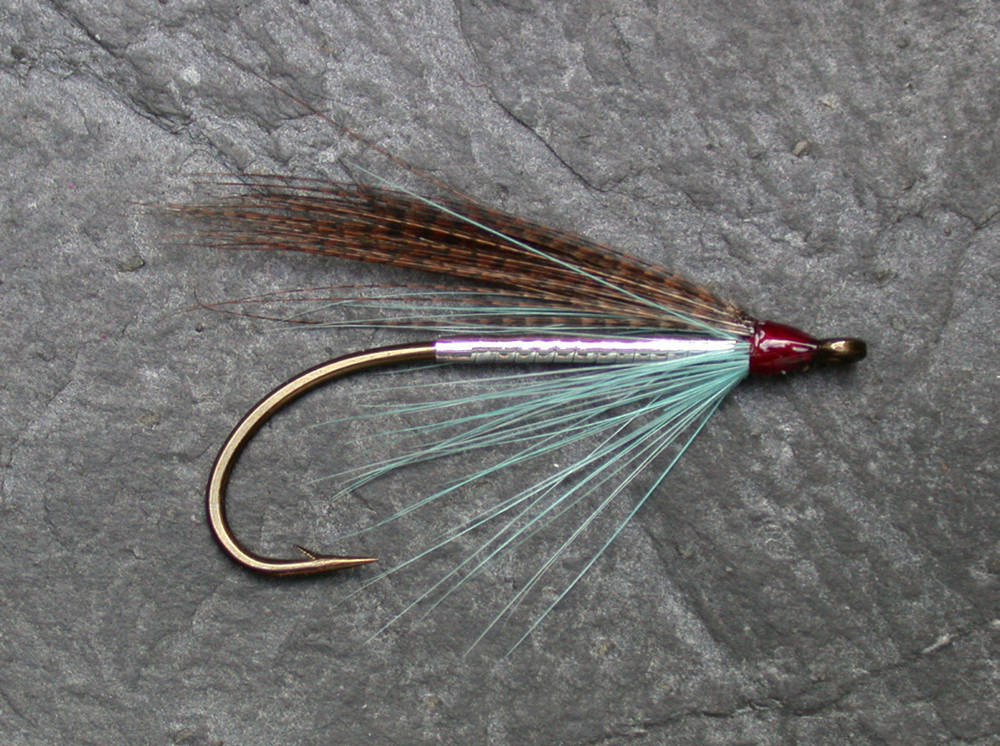
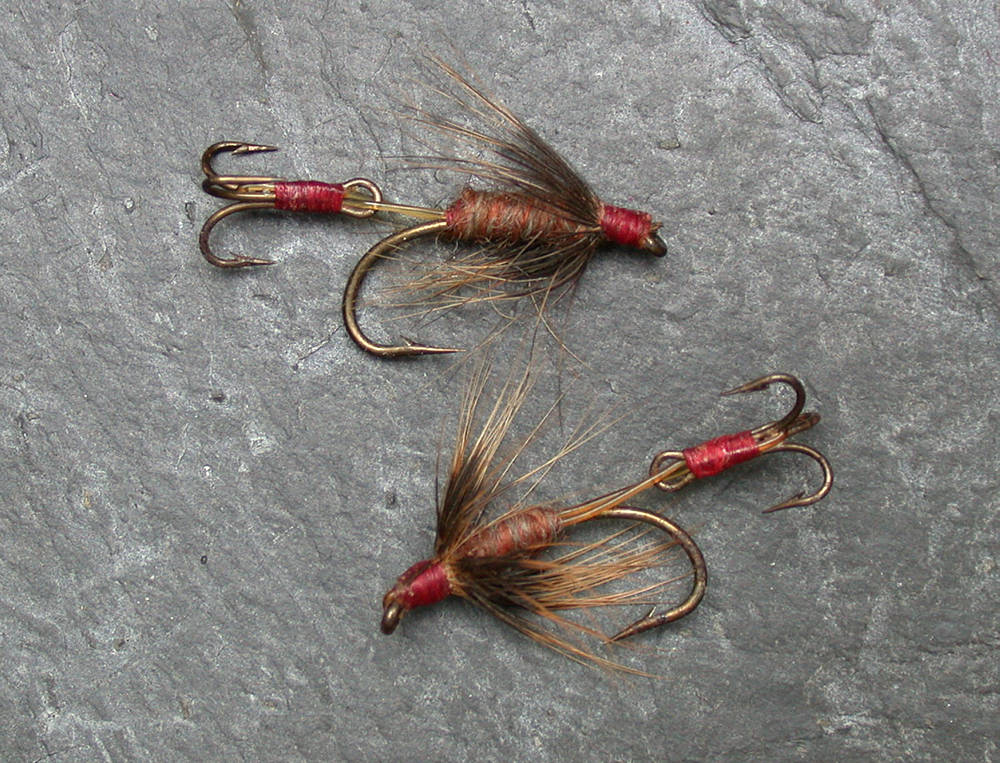
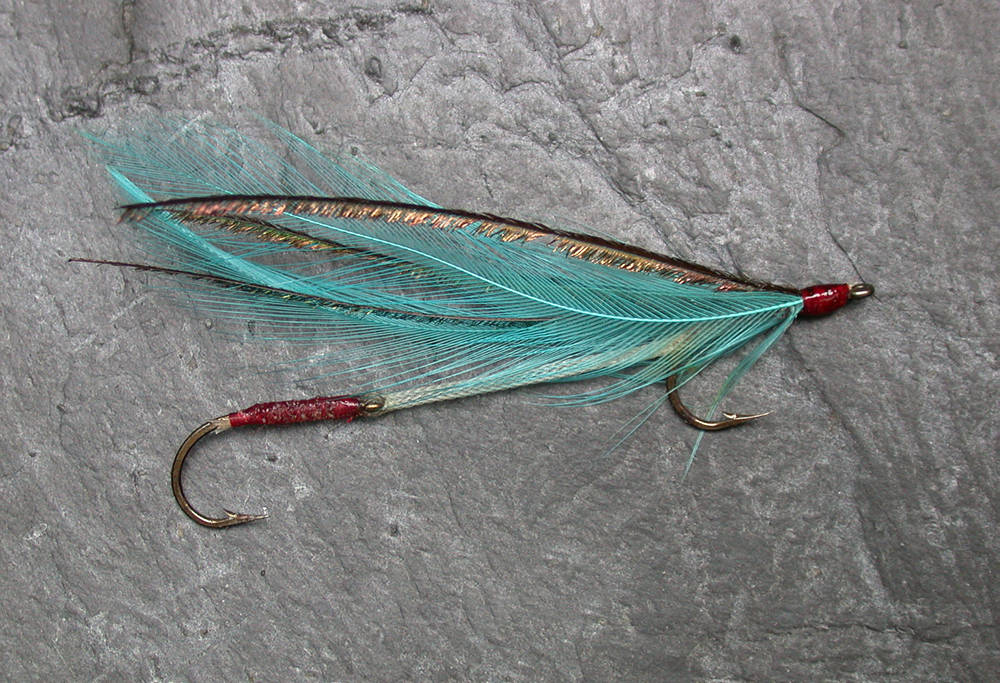
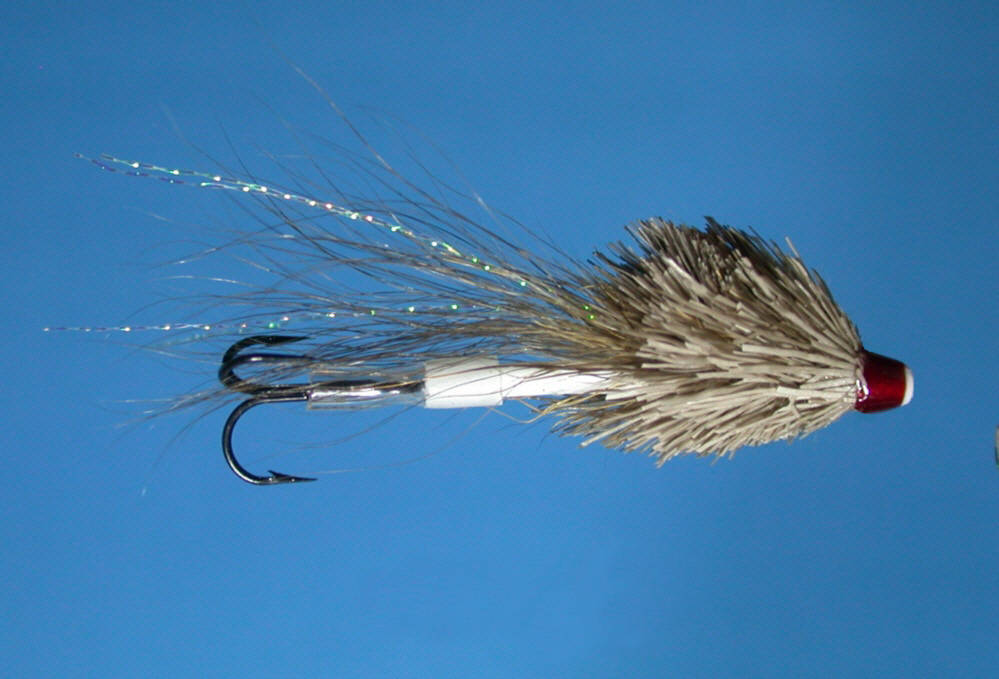
These have since been adopted, in various forms, as a basic starting point around which to build a selection of flies for night sea trout fishing throughout the summer season. With the exception of the secret weapon, now largely redundant given the decline in the use of maggots, which are now banned on many sea trout rivers, these flies/lures, or others designed for the same job, will be found in most sea trout fly boxes. There will be the single hooked flies, in varying sizes up to about size 4.
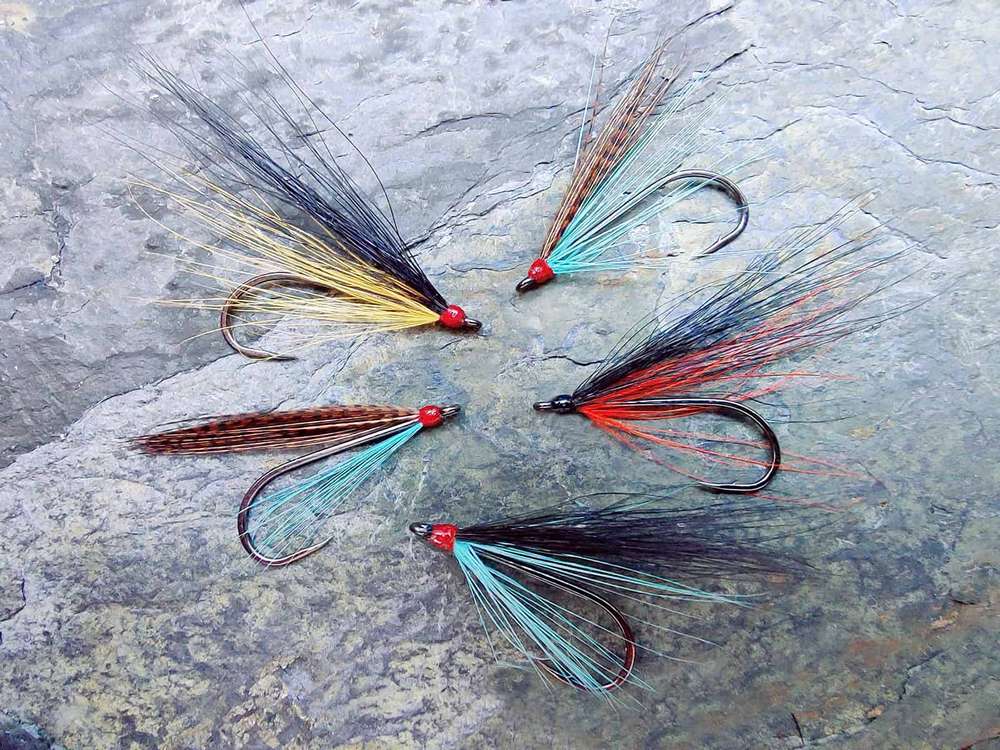
Anything longer will often now be dressed on tubes, needles, wire shanks or as variants of the sunk lure, often employing a body of nylon monofilament, braid or fine wire with a treble hook at the tail end, as in the snake lure. The surface or wake lure, in its various forms, often features prominently, on some rivers more than others. The cork and balsa of Falkus’s time are often now replaced with foam or deer hair in their construction to create a range of floating lures, from the simple Muddler Minnow through to larger lures often employing a trailing treble hook, such as the Jambo.
THE SEA TROUT FLIES OF WALES
The sea trout, or sewin, rivers of Wales have produced many a famous sea trout fly. Rivers such as the Towy, Teifi, Dovey and Conway have seen a multitude of sea trout patterns devised for use on their particular river, many as popular today as they ever were. Many famous sea trout patterns emerged, some for use, like the traditional Scottish patterns, primarily during the daytime. These include the Dai Ben, Harry Tom, Tywi Topper, Teifi Terror and Conway Silver, many illustrated in Successful Sea Trout Angling by Graeme Harris and Moc Morgan, first published in 1989.
A great many patterns were devised for general night fishing on the rivers of Wales, sub surface lures dressed on single hooks most commonly in sizes 10 to 4, predominantly with squirrel hair wings, either natural grey or dyed black, with bodies of silver tinsel or black floss with a silver ribbing.
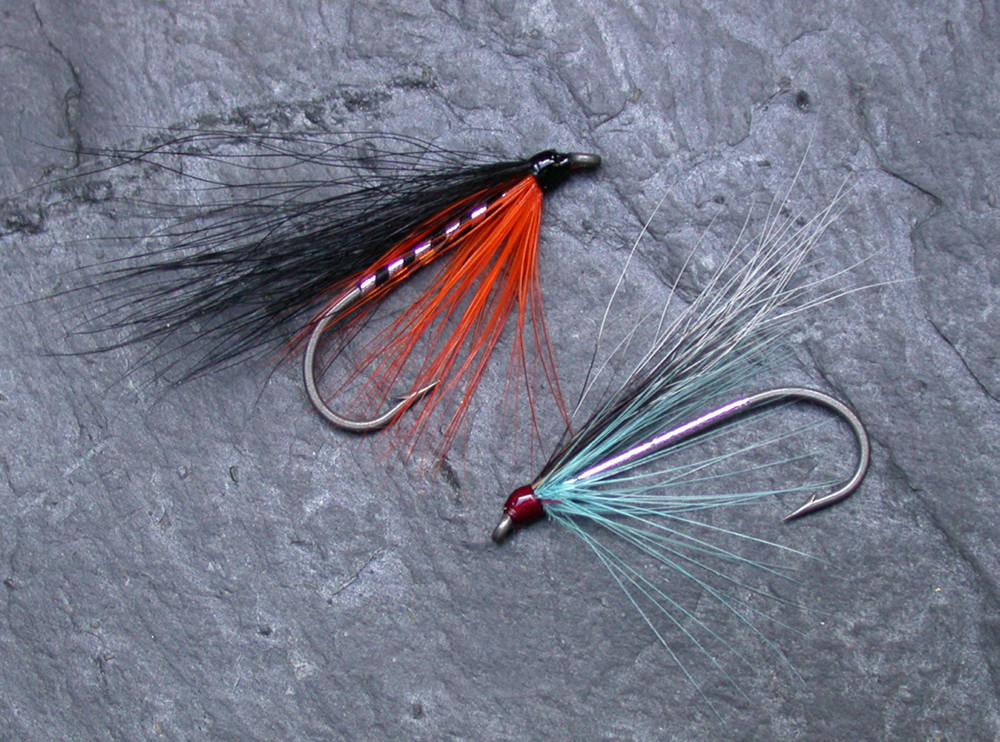
This kind of fly was, and still is, among the most used, and most effective, of our sea trout flies. Welsh flies of note include the Haslam, Dovey Black and Orange, Conway Red and Moc’s Cert.
Mention might also be made of the “Marchog” or “Knight” series of lures, large lures dressed on size 2 main hook, and incorporating a flying treble to enhance hooking capability, especially when the sea trout are “coming short”. More recently, John Graham’s Jambo lure has gained widespread favour and something of a reputation as a wake lure while, today, many talented and innovative Welsh sewin fishers continue to create new designs and patterns, combining the best of the old and the new.
COLOUR IN OUR SEA TROUT NIGHT FLIES
Today’s sea trout fisher has a great many flies to choose from, or he may dress his own to taste and to meet the specific requirements of his own fishing. It is worth noting, however, that, if the fly is to be used in the generally more productive hours of darkness, it is debatable whether colour matters at all. As I understand it, sea trout (and brown trout and salmon) have generally poorer vision than we do. Our vision is many times better at resolving detailed images than a sea trout’s. It is thought that a trout’s eye can detect relative size, overall shape and, in daytime, general colour pattern but even at its sharpest focus, which is no more than a few inches from its nose, viewed objects are likely to appear slightly blurred. Their eyes have evolved to give maximum resolution when looking upwards, a useful adaptation for a predominantly surface feeding fish.
The trout’s vision excels in two particular areas. The first is the ability to recognise contrast. Anything which stands out against the underwater background or light is easily seen, for example stripes, bars, circles and spots. The second is the ability to detect movement. Even small and rapid movements are likely to provoke an instant response. All of this would seem to validate the impressionistic, rather than the imitative, approach to fly tying. Rather than precise imitation in our sea trout flies, we might concentrate more usefully on overall shape and size, while incorporating contrasting and mobile materials where possible.
In daytime, the trout’s eye is generally as adept at detecting colour as our own. The retina has cones, which detect colour, and rods, which operate only in monochrome but are very sensitive. During the day, the sensitive rods are withdrawn, shielded from the bright light, while the cones are prominent, to give optimum colour vision. At night, the cones are withdrawn and the rods are exposed to the maximum. Even in the brightest moonlight, the sea trout will not see colour, only shades of grey. We might also assume that the lower the light levels, the less acute will be the sea trout’s vision. At the darkest periods of the night, the desired reaction might be provoked by nothing less than a large mobile fly, presented at close quarters, or alternatively one which deliberately creates a bit of a disturbance on the surface, like a wake lure.
As sea trout are no more capable of distinguishing colour at night than we are, the use of colour in our night flies is largely meaningless. Colours will be seen simply as varying shades of grey and it might be reasonably argued that coloured fly tying materials, hair and hackles are superfluous, except perhaps for their value in creating slight tonal variation. Flies predominantly black in colour, or perhaps in varying combinations of black and white, with a silver body or silver ribbed black body, will generally be as effective as any other. Still, the use of colour in our sea trout flies can do no harm and, in addition to providing a bit of useful variation in flies intended for both night and daytime use, offers an opportunity for close season creativity on the part of the fly tier.
SEA TROUT TUBE FLIES
For those of us who fish for sea trout, the tube fly must rank highly among the very best of fly fishing innovations. Tube flies have gained a fair degree of momentum in recent years, not only for sea trout fishing but for salmon, steelhead and other predatory species, both in fresh and saltwater. The tube fly has, of course, been around in various forms for a long time and has been put to good use in a variety of situations, whether for early spring salmon fishing, where the weight of a long heavy copper slipstream tube helped to get the fly down in high, cold water; for low water summer salmon, where a light mobile fly dressed on short plastic tube might be the order of the day; or for late night summer sea trout fishing, where a long sparsely dressed aluminium tube might be required to search the depths of a sea trout pool. Slow sinking plastic tubes have also found their uses in sea trout night fishing where they might be fished at varying speeds in or just under the surface on mild nights when the sea trout were up and active, or allowed so sink slowly on an intermediate line to search out the deep lying sea trout when things have gone quiet late on a summer’s night.
The tube fly offers some important advantages over lures dressed more conventionally on hooks or on wire shanks. Firstly, a tube may be selected of a particular length, weight, material and diameter to suit virtually any fishing situation. Secondly, a tube may be armed with a variety of hooks, be they single, double or treble, barbed or barbless, of which there are a wide range now made specifically for the purpose. The chosen hook may be allowed to swing freely behind the tube or it may be fixed in position by means of a flexible silicone hook link, reducing the likelihood of the hook hold working loose through leverage. In the event that the hook should become damaged, it is easily replaced, thus extending the useful life of the tube fly. Until recent years, however, the choice of tubes available for fly tying was fairly limited and, for sea trout fishing especially, where I have always looked to present my quarry with a slim, sparse, impressionistic offering, seemed to me to be generally rather bulky. This drove me, in the late nineteen nineties, to experiment with alternative options leading, in the first instance, to the development of the Needle Fly, as mentioned in the earlier chapter on the River Earn, and subsequently to the Needle Tube Fly.
THE NEEDLE FLY
Picture the scene ….. a night in late July. It’s one o’clock in the morning. and you are alone by a favourite fishing pool. The river has gone quiet. You would be inclined to doubt that there were any sea trout in the river if it weren’t for the brace of two pounders in the bass at your side. You tip them out on to the grass for another look. They shine silver in the moonlight, fresh from the tide. They were taken well before midnight on a size 8 Butcher, fished on a floating line. Since then, nothing. Time for a change, for something bigger, to be fished deeper, perhaps on an intermediate line. Something long and slim and not too heavy.
A look in your fly boxes reveals a variety of fishing lures, tied over the years for just this purpose. A box of tube flies in all shapes, sizes and materials; a selection of Waddingtons; rows of beautiful tandem lures, sparsely dressed in the Falkus style; a few Marchogs with their long trailing trebles. Each, in its own way, ingenious. Each undoubtedly effective as a sea trout fishing lure. Yet none of them quite perfect.
The conventional tube fly, though simple in design, has a relatively bulky body, particularly the commercially available plastic versions, while thinner plastic tubing has a tendency to bend if used in longer lengths. The Waddington lure can be tied on various gauges and lengths of wire but the attachment of the treble hook can be problematical, while the fly may have to be discarded, or, at the very least, partially retied if the treble is damaged. Sunk lures have the advantage of being very slim, light and well balanced. However, whether tied using singles, doubles, trebles or a combination, all involve considerable time and care in their construction and, when damaged, will likely have to be discarded.
I sought, therefore, in 1998, to devise a sea trout fishing lure which would overcome the shortcomings of these earlier designs while retaining some of their best features. Such a lure would ideally have the following characteristics:
- It should be simple to construct, in a variety of sizes and weights, using inexpensive and readily available materials.
- It should be easy to attach to the line or to change at night.
- The hook should be easily replaced if damaged, without the loss of the lure itself.
- It should be generally light in weight, even in large sizes, so that it can be easily cast and fished effectively on both floating and sunk fly lines.
- It should have a slim profile to give the impression of a small fish.
- The lure should always swim in line with the leader.
The result, after much experimentation, was the Needle Fly. As the name suggests, the Needle Fly is simply a fly or, more accurately, a lure, tied on a standard needle, in the same way as a tube fly is tied on a tube.
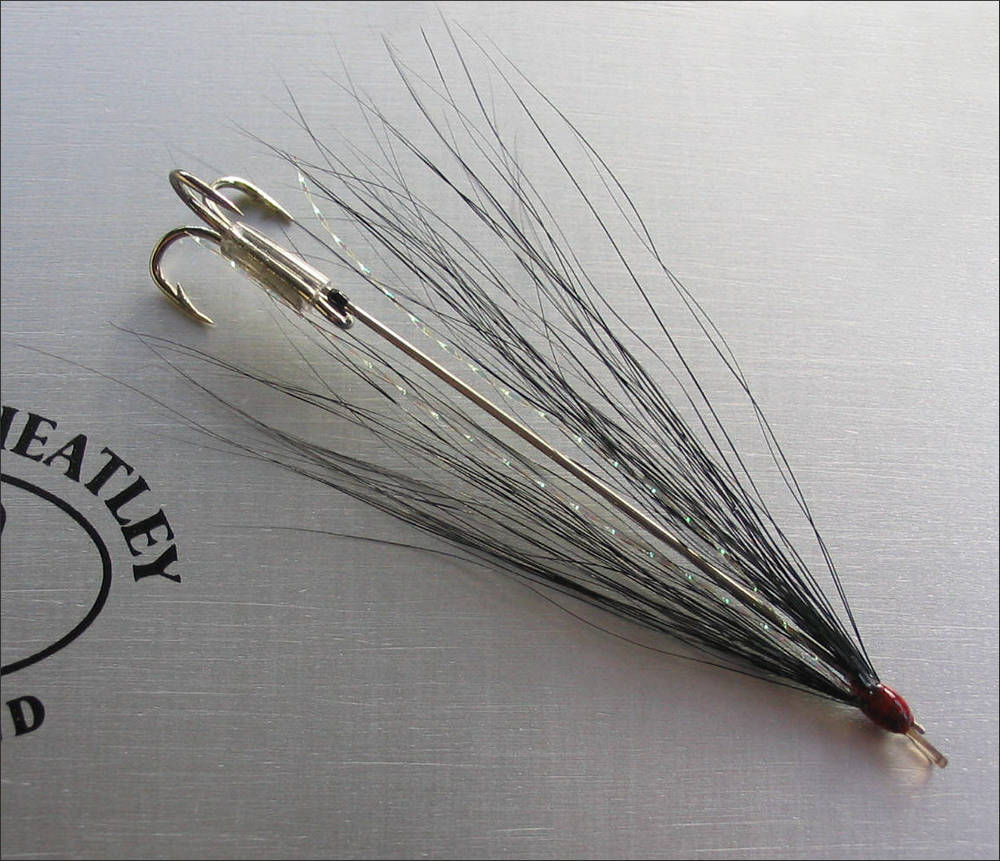
The second, and equally important, component is a treble hook whose shank is covered by a tightly fitting rubber or plastic sleeve, which secures the point of the needle during fishing. Single and double hooks are not suitable, as the plastic sleeve tends to slip back round the bend of the hooks while fishing. As with a tube fly, the leader is tied directly to the treble hook and not to the “eye” of the fly, which, in the case of the Needle Fly, is formed by a small loop of strong nylon (e.g. 30 to 35lb monofilament).
For use with needles between one and two inches in length, treble hooks ranging from size 16 to 10 are most suitable. To adapt the treble hook, a sleeve of plastic or rubber is fitted over the shank of the hook. This sleeve will secure the point of the needle while fishing. It is important, therefore, that the sleeve is chosen carefully to match the diameter of the hook shank. This sleeve must be strong and tight fitting, with enough elasticity to grip the needle firmly. If the sleeve fits loosely or is too soft, the needle may slip out of the sleeve while casting.
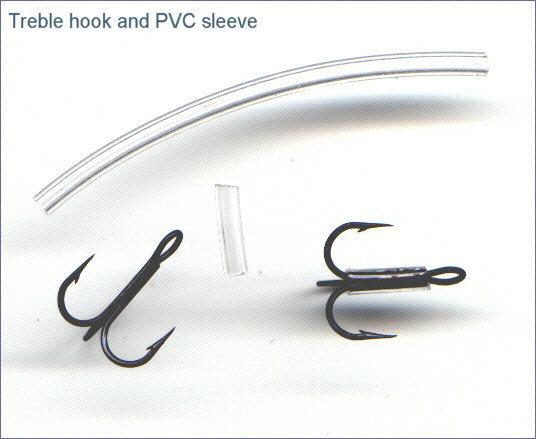
Since my first experiments with the Needle Fly in 1998, I have tried all the kinds of tubing I could lay my hands on. Early versions made use of the plastic sleeving from electric cable. I then experimented with heat shrink sleeves, neoprene sleeves, carp rig tubing, silicone rubber and even combinations of the above. None were entirely satisfactory. The electric cable sleeving, like most examples of the carp rig tubing, was a bit hard and inflexible. The heat shrink was also a bit hard and not very durable, even when used in double layers. Silicone rubber, as used on floats, was too soft and, although it is possible to buy silicone tubing with a thicker wall, it does not grip the needle well. Neoprene tubing was a bit bulky and available in limited sizes. The most suitable type of tubing I have been able to find to date is clear PVC tubing, as used for laboratory and medical applications. The most useful sizes I have tried are as follows:
PVC tubing, bore 1.0 mm/wall 0.5 mm (suitable for fine wire treble hooks up to size 12)
PVC tubing, bore 1.5 mm/wall 0.5 mm (suitable for size 10 and 8 treble hooks)
The second component is a needle, adapted by the addition of:
- loop of strong nylon (about 30 – 35lb b. s.) which forms the “eye” of the Needle Fly. (Note that, as with a tube fly, the line is not tied to this loop but to the treble hook itself)
- a small stop of tying thread (varnished) applied 1cm from the point of the needle. This stop prevents the needle from slipping through the sleeve while casting.
There follows a step-by-step sequence of how to make a Needle Fly. The dressing and colours may, of course, be varied to taste and circumstance.
TYING A NEEDLE FLY
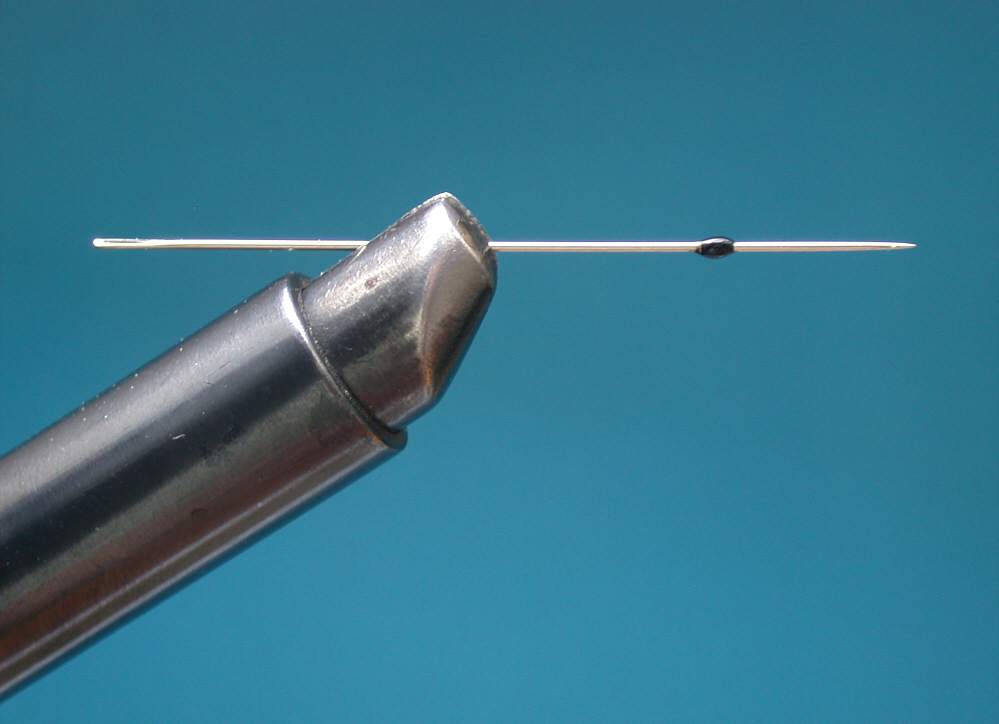
Step 1: Secure needle in vice and tie a short “stop” or bump of thread one centimetre from the needle point. Apply two coats of varnish to the stop and allow to dry.
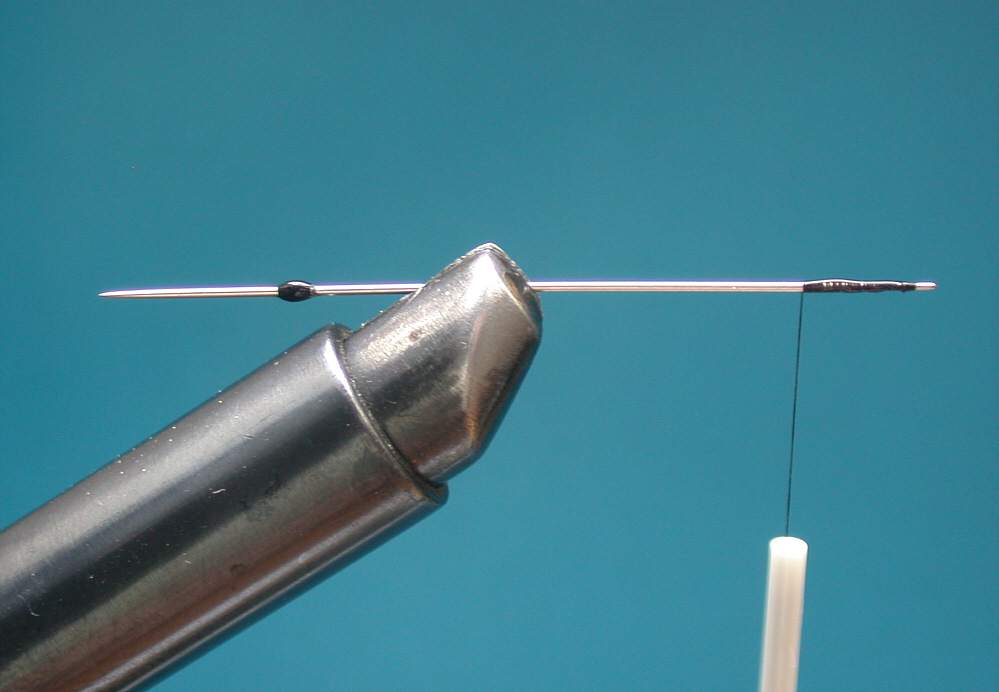
Step 2: Reverse the needle and lay a bed of tying thread at the head and varnish.
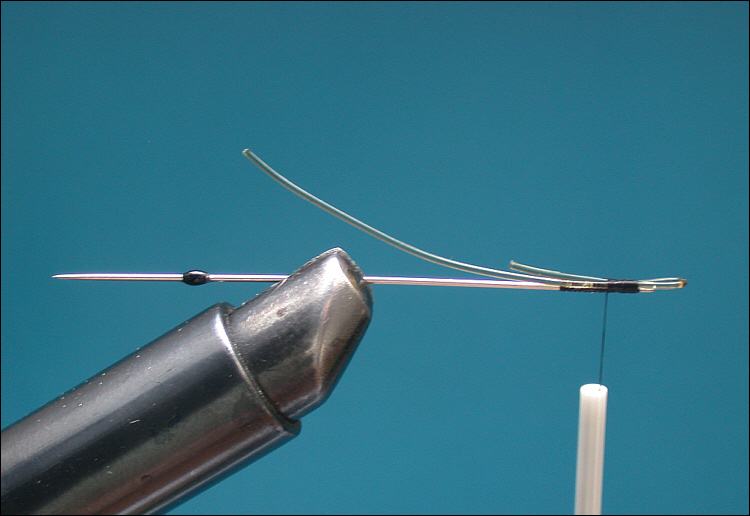
Step 3: Tie in a loop of nylon (30 to 35lb).
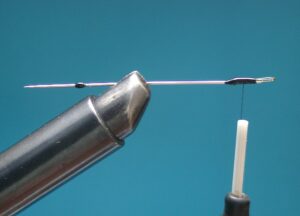
Step 4: Trim the ends of the nylon, secure with a layer of thread and varnish.
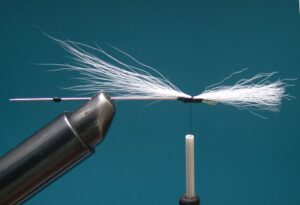
Step 5: Tie in a bunch of white Arctic fox hair.
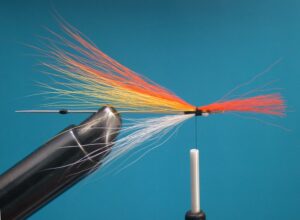
Step 6: Turn needle upside down in vice and tie in a slightly longer bunch of yellow Arctic fox hair followed by a bunch of orange Arctic fox hair.
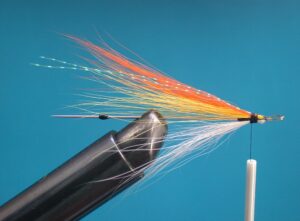
Step 7: Add a few strands of Krystal Flash to taste.
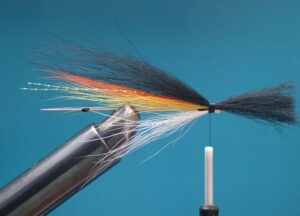
Step 8: Tie in a slightly longer bunch of black Arctic fox hair. Trim the ends of the hair, form a neat head and apply two coats of varnish.
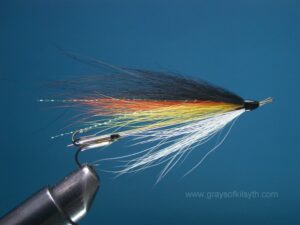
Step 9: Cover the shank of a suitable treble hook with a short length of tight fitting PVC tubing, which allows the needle to be secured to the hook.
Attaching the Needle Fly to the leader
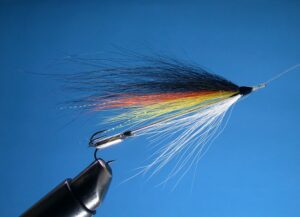
To attach the hook to leader, slip the leader through the nylon loop at the head of the Needle Fly, tie on the adapted treble hook and push the point of the needle into the PVC sheath on the treble hook as far as the thread stop, so that the nylon leader lies along the underside of the fly with the needle on the top side of the treble hook. The thread stop should sit neatly into the eye of the treble. I like to store the adapted hooks and needle flies separately in a foam lined box until needed.
[Note on Safety: Fishing hooks and needles may cause injury. The construction of the Needle Fly, as in all fly tying, involves the risk of minor injuries from hook and needle points etc. It is essential that you wear a safe and effective form of eye protection, such as safety glasses, when handling and using needles and fishing hooks, as needles and some hooks are brittle and may break when bent. It is also important to wear effective head and eye protection when fly fishing.]
Note that a needle is more easily inserted in the sleeve than a straight piece of wire. A further benefit is that a silver needle needs no body dressing. Needles are available in a great variety of lengths and weights. I have found the most useful are those described as “Betweens”, “Sharps” and “Long Darners”. The gauge, or thickness of the needle is described by a number and for any given number, the Betweens are the shortest, followed by the Sharps, while the Long Darners are the longest. We can think of Betweens as “short Shank needles”, Sharps as “standard shank needles” and Long Darners as “long shank needles”. The table below shows the relative gauges and lengths of the three types.
NEEDLE TYPES AND SIZES
| Type | Size | Diameter inches | Diameter mms | Length |
| BETWEEN | 6 | 0.027 inches | 0.69 mm | 1 ¼ inches |
| SHARP | 6 | 0.027 inches | 0.69 mm | 1 ½ inches |
| LONG DARNER | 9 | 0.024 inches | 0.61 mm | 2 inches |
| LONG DARNER | 7 | 0.027 inches | 0.69 mm | 2 ¼ inches |
I would say, in conclusion, that the most crucial component of the Needle Fly is the tubing used for the treble sleeve. It should be strong and durable but with enough flexibility/elasticity to grip the needle firmly. It is most important, in construction, to match the diameter and wall thickness of the tubing to an appropriate size and weight of treble hook, both of which must then be matched to an appropriate length and diameter of needle. For example, let’s say you begin with a size 8 treble made from a heavy wire. A narrow tube with a diameter of 1mm will not fit over the eye of the hook. You will need tubing with a 1.5 mm bore. If you begin with a fine wire size 14 treble, the 1.5 mm bore tubing will be much too large. But even when you have found a type and size of tubing to match the size and weight of the treble hook, you must also match this to a needle of appropriate diameter. A very thick needle will be difficult to insert in the sleeve and will possibly overstretch the sleeve. Too thin a needle might not be gripped firmly enough by the sleeve.
I have found that the Needle Fly is at its best, as a lure for sea trout, in lengths between 1¼ inches and 2 inches. Needles are available in different gauges, as well as different lengths. The finest are labelled Sharps, while the slightly heavier gauge are called Betweens. Long Darners, which are fairly thin for their length, may be used for the longest lures. By using the three types, it is possible to vary the weight, as well as the length, of the fly. In tying your own needle flies, I would recommend you start with a Sharp needle of around 1.5 inches long and match it to a size 12 fine wire treble hook, with a smooth medium length shank, matched to a suitable sleeve with a bore of around 1mm. You can experiment from there.
I had at first hoped that I might get away with a simple needle, held in place on the treble by a tightly fitting sleeve. However, in order to prevent the needle slipping through the sleeve when casting (when it is subject to considerable force), I decided I needed a stop of some kind, fixed on to the needle. I have tried blobs of glue, short lengths of very fine heat shrink etc. but have now settled on a small but tight wrapping of tying thread coated with a drop of varnish. Do not tie the stop too near the end of the needle. To ensure a good grip, the point of the needle should, when assembled, be at the rear end of the sleeve or even protruding slightly. For this same reason, it is unwise to use a treble hook with too short a shank.
In the following decade, the Needle Fly accounted for the majority of my sea trout, on the Rivers Earn, Border Esk and Spey. Ever seeking improvements and new options for my sea trout lures, my attention turned subsequently to the possibilities offered by tubes. Given the undoubted merits of the tube fly referred to earlier, I wondered if it would be possible to make a really slim tube fly which would do the same job as a Needle Fly.
THE NEEDLE TUBE FLY
Night fishing for sea trout is rarely successful with the river running much above summer level. In a high, coloured river, the only chance of a fish will be during daylight hours. Consequently, our sea trout night fishing is done with the river running at, or slightly above, summer level. In such flows, heavy flies, such as those tied on brass or copper tubes, are rarely needed and not the sort of thing that can be cast safely in the dark using a single handed rod. Lighter tube flies, however, such as those tied on plastic and aluminium tubes, often fished on slow sinking lines, have long been favourites among sea trout fishers and they are an indispensable part of the night fisher’s armoury, although they can be a bit bulky and do not always sink readily to the required depth.
Could there be a place for a medium weight tube, somewhere between the heavyweight brass and copper tubes and the lighter plastic and aluminium? In the quest for that slim, tenuous, impressionistic lure, would it be possible to find a material which might be adapted to the construction of an extremely slim, medium weight tube fly, to be dressed in varying lengths, which might be effective in all heights of water, for both day and night sea trout fishing, something with similar properties to a Needle Fly.
In collaboration with Dave Wallbridge, who fished the Dovey and shared my keen interest in sea trout night fishing, I began to explore the possibilities of adapting fine stainless steel tubes, hypodermic needle tubing in fact, which is made in a whole range of diameters and weights, with outside diameters down to less than 1.0 mm. We decided on 19 gauge hypodermic tubing, with an outside diameter of 1.1 mm and an inside diameter which would accommodate the heaviest of nylon likely to be used in sea trout, or salmon, fishing.
We found a source in Coopers of Birmingham and purchased a few metres, more than enough for experimental purposes. It was originally hoped that the stainless steel micro tube could be used on its own to produce a simple ultra-slim tube. It was found, however, that, no matter how carefully deburred, the sharp edges of the tube ends cut into the nylon leader while fishing. So how might this problem be overcome? The fine bore of the slimmest of these tubes precluded the use of a conventional internal plastic liner, so how might the sharp ends of the stainless steel tube be prevented from coming into contact with the nylon leader? Our solution was to cover the whole tube with heat shrink tubing, being careful to leave a short extension of heat shrink at both ends to shield the nylon leader from the sharp tube edges, as in the accompanying photographs. This worked very well.
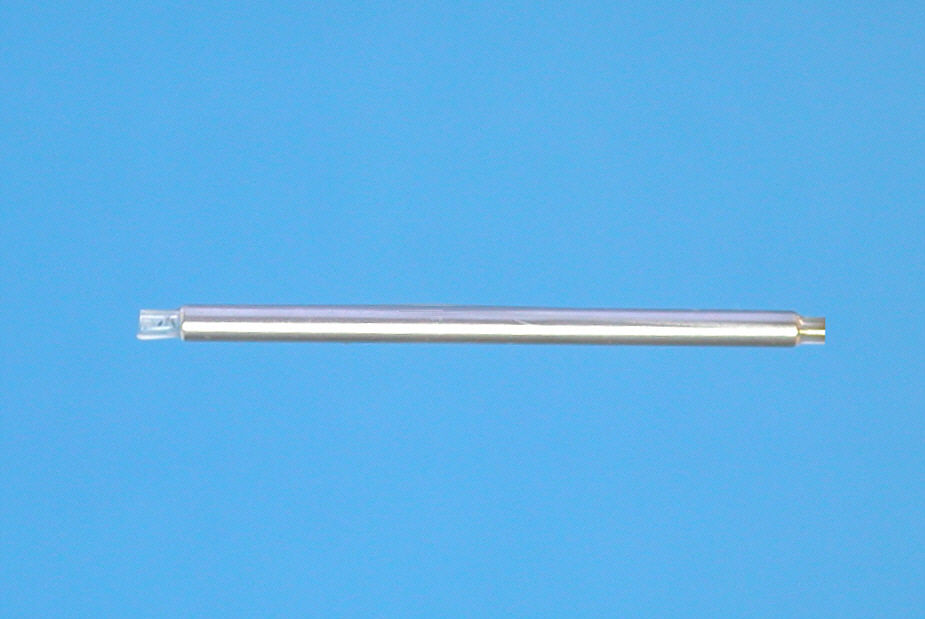
The shrinking process is most simply done as follows. The stainless steel tube is first cut to the desired length and carefully deburred (a rotary tool, such as that made by Dremel, with the appropriate accessories, is ideal for both cutting and deburring). A darning needle (a size 9 “Long Darner”, diameter 0.61 mm, is about right for a 19 gauge tube) is secured in a fly tying vice. The stainless steel microtube is then slid on to the darning needle and a length of heat shrink tubing fitted over the steel tube with a millimetre or two of heat shrink tubing extending beyond each end of the steel tube. The flame of a lighter is then played under the heat shrink tubing for a second or two, until it shrinks on to the metal tube, being careful not to burn or melt the tubing in the process.
When the tube has cooled and hardened, it can be slid off the needle. We used what we believe to be the finest heat shrink tubing generally available, shrinking from 1.2mm to a diameter of 0.6mm and available from R.S. Components (www.rswww.com) code number 288-5156. This tubing is particularly suitable. Heat shrink tubing from other sources can vary quite a bit in chemical and physical properties. Some, for example, are softer than others and not quite so useful.
In line with common practice in the use of conventional tube flies, an additional short extension of silicone rubber of a suitable diameter can be slid over the rear end of the finished microtube fly to provide a secure but flexible hold on the treble hook. Clear silicone tubing, with a bore of 1 mm and a wall thickness of 0.5 mm, as used in the example shown, is perfect for the job.
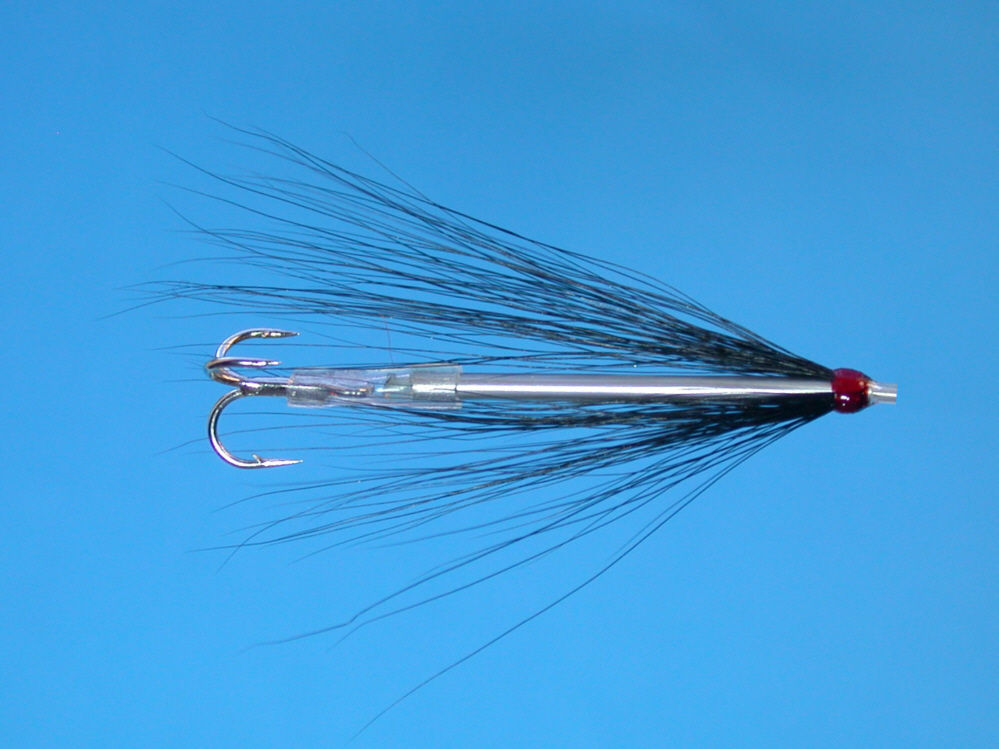
Our microtube fly (we might call it the Needle Tube Mark 1), with an outside diameter little more than 1 mm, was extremely effective and I have no hesitation in commending it to anyone wishing to make a simple, slim tube fly for sea trout night fishing, or indeed for salmon or steelhead fishing. [To facilitate the dressing of the tube fly, the tier will find that the heat shrink tubing, on shrinking, tends to stick to the darning needle sufficiently to allow the dressing of the fly before removing the tube from the needle; or the tube may be slid up to the eye of the needle which helps to prevent the tube spinning on the needle. Alternatively the tube may be held in a dedicated tube or pin vice].
Following our success with the microtube, I wondered if it might be possible to make a more conventional type of tube, using a similar slim stainless steel hypodermic needle tube but lined internally in the more usual way with a plastic liner. More experiments followed, leading ultimately to the development of the plastic lined Needle Tube in 2008.
Reverting to the traditional lining method would not, of course, produce quite such slim tubes as the original microtubes but the resulting Needle Tubes, with an outside diameter of 1.5 mm, came pretty close. Being made from polished stainless steel, as used in the making of hypodermic needles, they sink more readily than plastic or aluminium tube flies but fish a little higher, and more attractively, than the heavier copper and brass tubes. Being very slim and light in weight, Needle Tube Flies can be easily, and more safely, cast on a single handed rod.
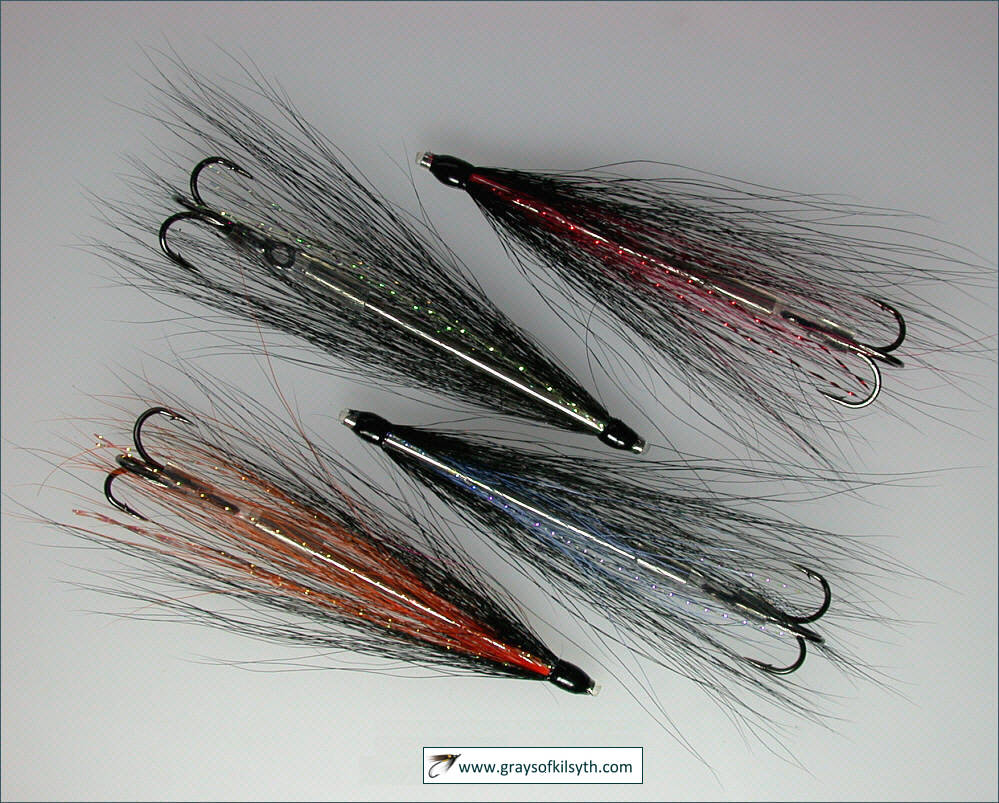
Needle Tubes, of either type, may be dressed very simply in a variety of lengths and weights to create a good range of sea-trout lures to suit virtually all river conditions the night fly fisher is likely to meet. They might also be dressed, in a variety of lengths and styles, to create effective lures for salmon, steelhead or indeed other predatory species such as bass, pike and many saltwater species. The longer Needle Tube Flies offer a viable alternative to the Waddington shank, allowing a long slim lure to be created which will fish at about the same depth as the Waddington lure, with a similar slim profile but with the simplicity and practicality of the tube fly. An important benefit is that the hook is more easily changed on the Needle Tube Fly. I have also found tubes to be much more easily dressed than Waddington or snake lures.
The Waddington lure was devised by Richard Waddington in the middle of last century. In “Salmon Fishing”, published in 1947, he writes, “My ideal salmon fly, however, is quite revolutionary. The shank will remain a steel bar – though were it not for the weight I should prefer something pliable like a heavy nylon strand. This will be linked with a plain loop to a small triangle. The fly will not be dressed in the normal way. The body will be the same but the wing will disappear to be replaced by plenty of hackle dressed all round the fly so that whichever way it is turned it will have the same appearance.
I surmise that this fly will look more natural in the water; that the small triangle is less obvious than a large hook and that once the fish is hooked it will give a better hold. The link in the shank will obviate much of the strain and movement in the hook.”
The “Waddington” later became popular with those fly tiers seeking to create a long bodied, medium weight salmon fly but with a slimmer profile than flies dressed on conventional tubes (copper, brass, aluminium or plastic), which had a typical diameter of about 3 mm. It became a favourite, too, of many night sea trout fishers. However, while the Waddington lure does have a slim profile and allows the use of a relatively small treble hook, it has two disadvantages. Firstly, it is not so easily dressed as a tube fly and, secondly, the treble hook is not so easily replaced when damaged.
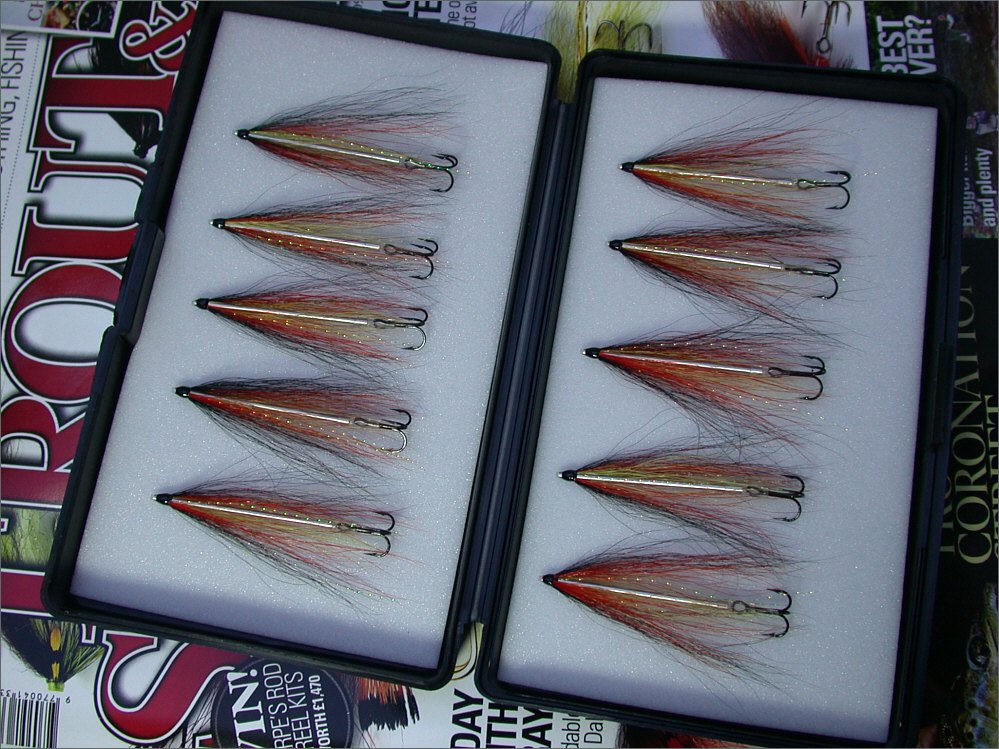
The Needle Tube Fly offers, I think, the best of both worlds. Made from ultra slim stainless steel tubing, with an outside diameter of 1.5 mm or less, Needle Tubes can be tied in various lengths and offer distinct advantages over the Waddington lure, presenting an additional option for those who like tube flies for sea trout, salmon and steelhead fishing:
- They are as slim as a Waddington shank and much slimmer than conventional tube flies. (Only a Needle Fly, dressed on a sewing needle, has a slimmer body)
- Made from stainless steel, the Needle Tube is comparable in weight to a Waddington lure, while being lighter than a copper or brass tube but heavier than an aluminium or plastic tube.
- The Needle Tube, held in a suitable tube fly vice, is more easily dressed than a Waddington shank.
- The polished stainless steel Needle Tube may be left undressed to create a simply dressed, slim, silver bodied lure or it can be dressed in the traditional manner.
- The hook – treble, double or single, barbed or barbless – can be easily changed when damaged or to suit circumstances.
- A silicone hook link holds the hook securely in place while offering great flexibility and minimum “leverage”.
The Needle Tube Fly, then, offers the slimness of the Waddington lure with the simplicity and convenience of the tube. Needle Tubes in longer lengths are ideally suited to the tying of extremely slim sea trout lures, a simple alternative to the sea trout snake lure, as illustrated below.
Tying a Simple Sea Trout Needle Tube Fly
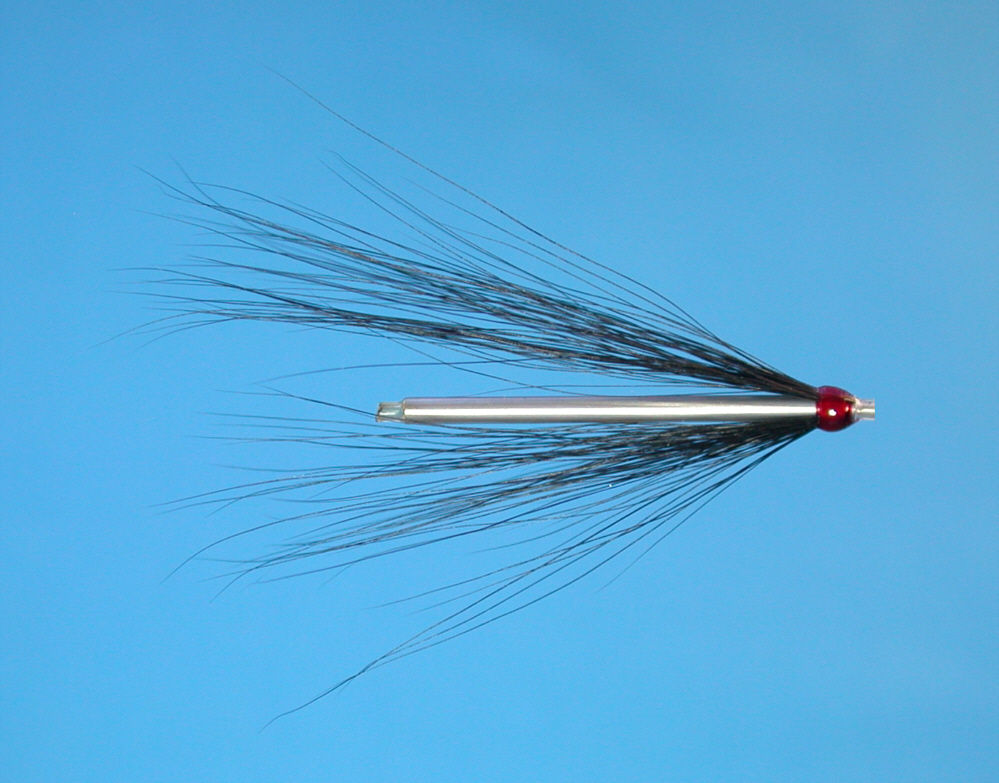
Below is an example of a simple but very effective sea trout tube fly. For night fishing, colours are largely unimportant and may be varied to taste. Some contrast in tone may be provided by combining a dark and light shade, e.g. black and white, or black and yellow, perhaps with a little added reflective material such as Krystal Flash to catch what little light may be available.
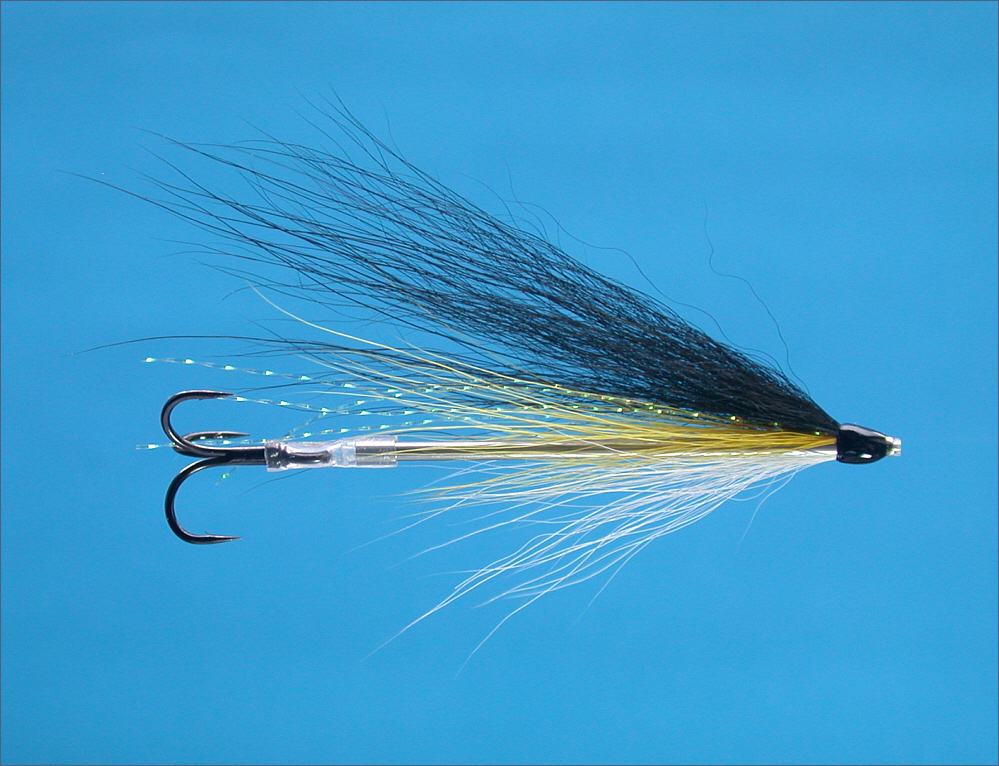
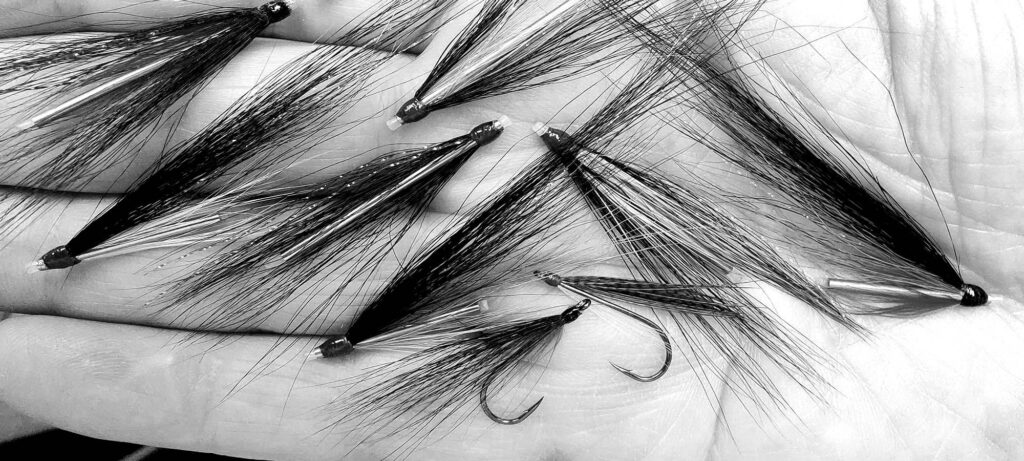
Needle Tube Flies may be armed with single, double or treble hooks, barbed or barbless, according to circumstance, regulation and preference. A small selection of needle tube flies, dressed in a variety of styles, is shown below.
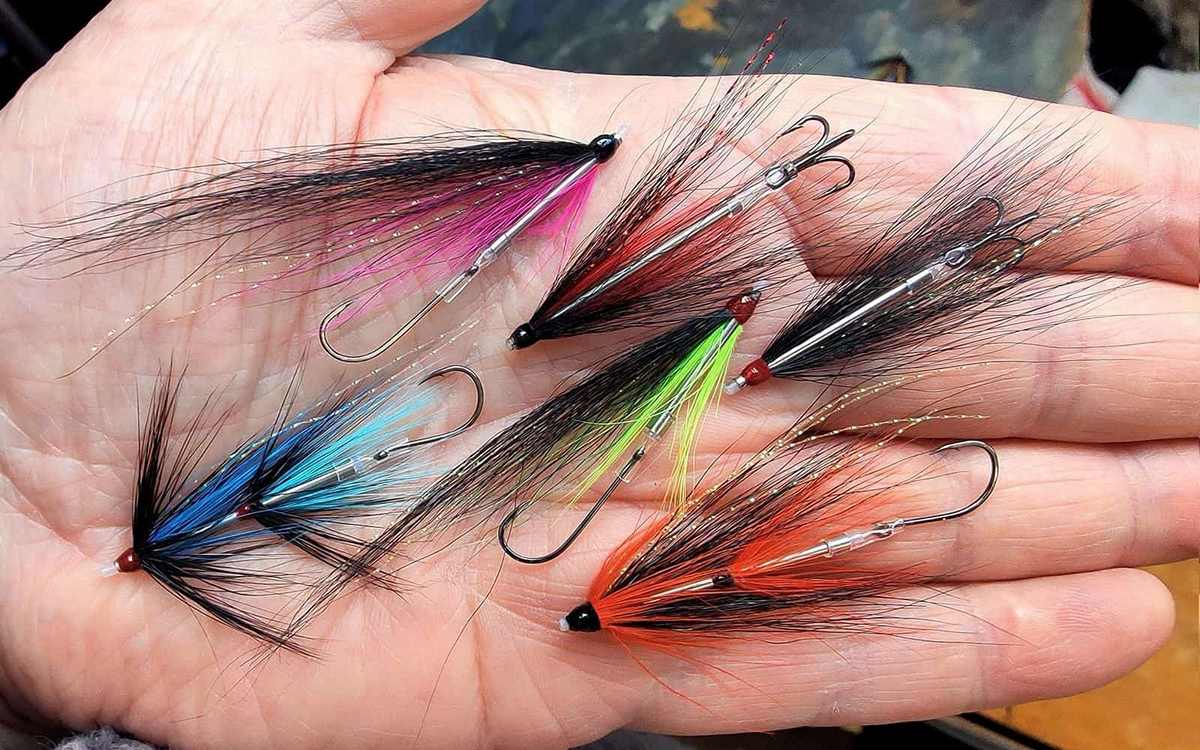
We will look next at the tying of The Tingler, a simple tube fly for sea trout night fishing, employing a single hook, which may be dressed for added attraction or to increase the length of the lure while adding minimal weight to the rear end of the tube fly.
THE TINGLER
Over the years it has been fairly standard practice to arm our sea trout tube flies with treble hooks. While we generally dress our smaller sea trout flies on single hooks, a small treble just looks right on the end of a long slim tube fly. The small treble hooks and holds on to fish pretty well, although perhaps no more efficiently than the fly dressed on a single hook. I would think that I have probably lost as many sea trout hooked on trebles as on single hooked flies.
Regardless of the relative merits of trebles versus singles or doubles, the growing focus on catch and release, allied to increasing restrictions on fishing methods and tackle, has seen a move away from the use of treble hooks on our game fishing rivers. Indeed, we are now seeing a ban on the use of treble hooks on many fisheries, forcing many of us to seek alternatives to the old favourites. Fortunately, there are other options and alternatives to treble hooks are readily available. Single hooks, designed specifically for use with tubes, are now made by many of the major manufacturers, and, with conservation in mind, are being increasingly widely adopted by today’s salmon fishermen. Sea trout fishers may perhaps be less enthusiastic and I suspect that most of us still have a liking for a small treble on our night time tube flies. But, given the increased regulation of fishing methods, baits and hooks, we may all have to move with the times. I have made the first steps in the move away from trebles by the more frequent use of single hooks on my night sea trout tube flies and I describe here the kind of lure I have been using increasingly over the past season or two, with promising results. I call it the “Tingler”. It is not by any means new, being essentially a slim tube fly armed with a light weight single hook, hence the name.
The single hook may be left undressed or may be dressed as in several of the examples illustrated. The Tingler is intended primarily for sea trout at night but the principle and dressing may be adapted for any predatory fish. I think that a sparsely dressed tube, combined with the flared dressing on the single tail hook, creates a very fishy impression in the water. A great benefit of the Tingler shown here is that it is extremely simple to dress, ideal for anyone new to fly tying.
DRESSING THE TINGLER
A simple Tingler is shown below followed by a brief summary of the tying steps.
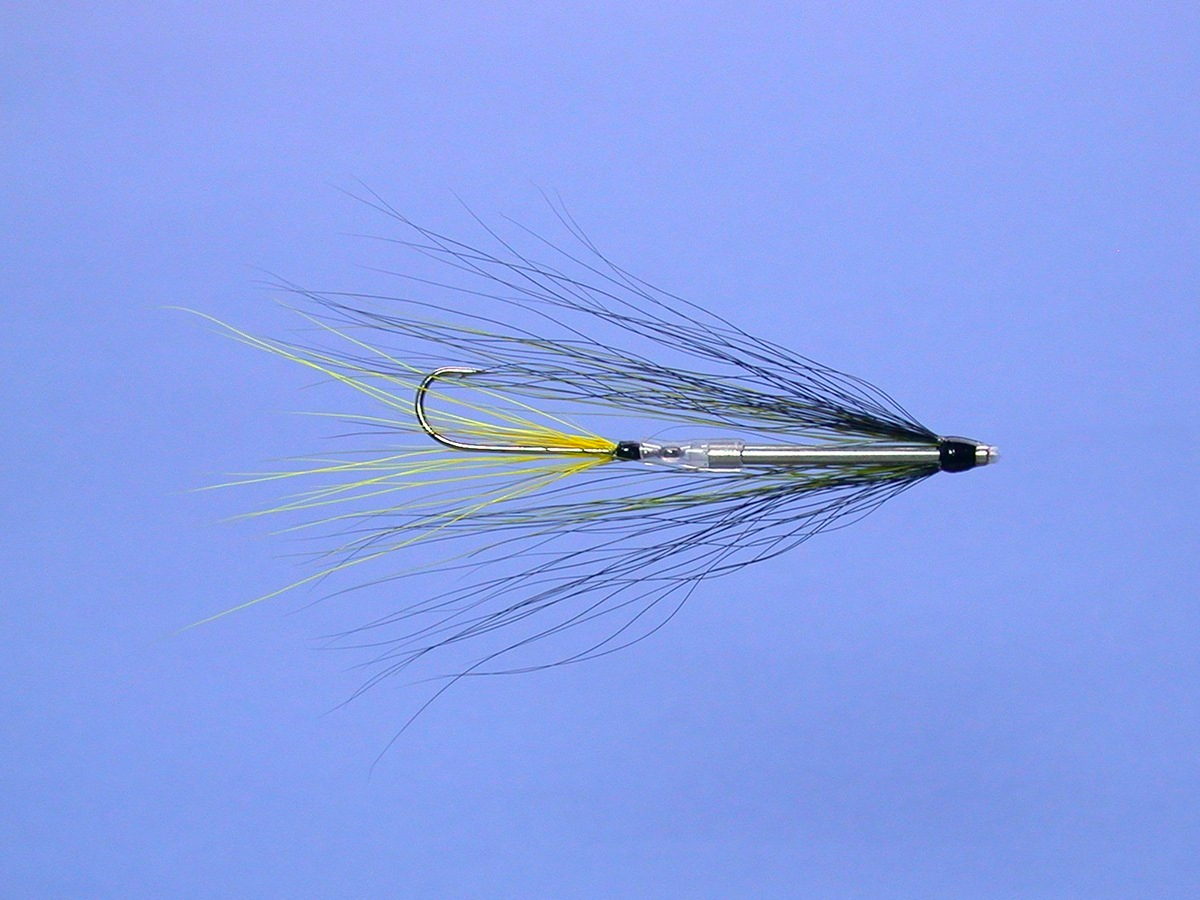
Tying Sequence
- Lay a short bed of tying thread at the head of the tube and tie in a sparse bunch of hair top and bottom. Form a neat head and apply two or three coats of varnish.
- Repeat the dressing on a suitable straight-eyed single hook, taking care to leave a short length of the hook undressed at the front to insert into the silicone sleeve on the rear of the tube fly.
- Attach the dressed single hook (point uppermost) as you would for a standard tube fly.
- An undressed hook may be used in place of the dressed hook where a simpler and shorter lightweight lure is required.
I have used here a Partridge Saltwater Perfect hook, size 8. A similar alternative is the Mustad 3261NP-BN. There are many other excellent, yet inexpensive, straight eyed single hooks available which are suitable for use on our sea trout tubes, many of them sold as carp hooks or coarse specimen hooks, by manufacturers such as Kamasan, Drennan and others.
The Tingler lure illustrated is a very simple tube fly, two inches in overall length, dressed with nothing more than squirrel hair on both tube and hook, possibly as effective as anything for sea trout at night. Various colours can, of course, be used, in addition to various flashy materials, but it should be remembered that sea trout cannot see colour at night any more than we can. Colours will be seen merely as shades of grey. The use of colour in our night flies can, I dare say, do no harm, and may offer some advantage in creating a degree of contrast and variation in tone in a lure, which may help to provoke a response from the fish and, if creating colourful night flies gives us as anglers a bit of confidence, and provides some distraction and purpose to us as fly tiers over the long winter months, then why not! A splash of colour can also be a useful addition to flies intended for use in daytime.
Simplicity is key, I think, both in dressing and fishing this kind of lure for sea trout at night. To paraphrase Falkus, the aim is to create a slim, tenuous “impression” of a bait fish, rather than an imitation; a tantalising reminder of their time spent chasing sandeels in the shallow tidal sea pools; an illusion to provoke an instinctive reaction to the sudden appearance above of something they might recognise as prey. This deception is most successfully achieved by a long, slim, sparsely dressed lure, the sparser the better. A slim stainless steel tube is easily transformed into such a lure. The novice with no experience in the art of fly tying will find that he can very easily create an effective sea trout lure, such as that shown above, with little more than a sparse bunch of black hair.
I have found the slim, stainless steel Needle Tube Fly very effective for sea trout. Heavier than aluminium but lighter than copper or brass, it is easily cast on a single handed rod. The sparsity of the dressing allows the tube to sink easily through the surface film and helps prevent the lure skating in the quickening flow of the pool tails, but not too deeply in the shallow streams and glides favoured by sea trout on a mild night. I will happily fish through the night with various lengths of Needle Tube, from 10 mm to 40 mm in length, depending on conditions.
Lure size, as noted earlier, may depend to an extent on the river level, temperature, degree of darkness, distance from the sea, time of night, time of year etc.. A high river and a cold or very dark night, for example, might dictate a longer lure, while early on a mild summer night, with the river running low and clear, single flies in size eight or ten might be a good option. On most fishing nights, once it is properly dark, the Tinglers illustrated here are the kind of lure I would use with confidence, often now armed with either a dressed or undressed single hook, replacing the small trebles I have used for many years on my sea trout Needle Tube Flies.
THE UPTURNED HOOK
Note that the upturned single hook adds to the balance and stability of the fly, owing to the fact that a single (or double) undressed hook will tend to swim naturally with hook points upwards. This may be simply demonstrated by threading a length of fine thread through the eye of any single or double hook and pulling it through a bath of water.
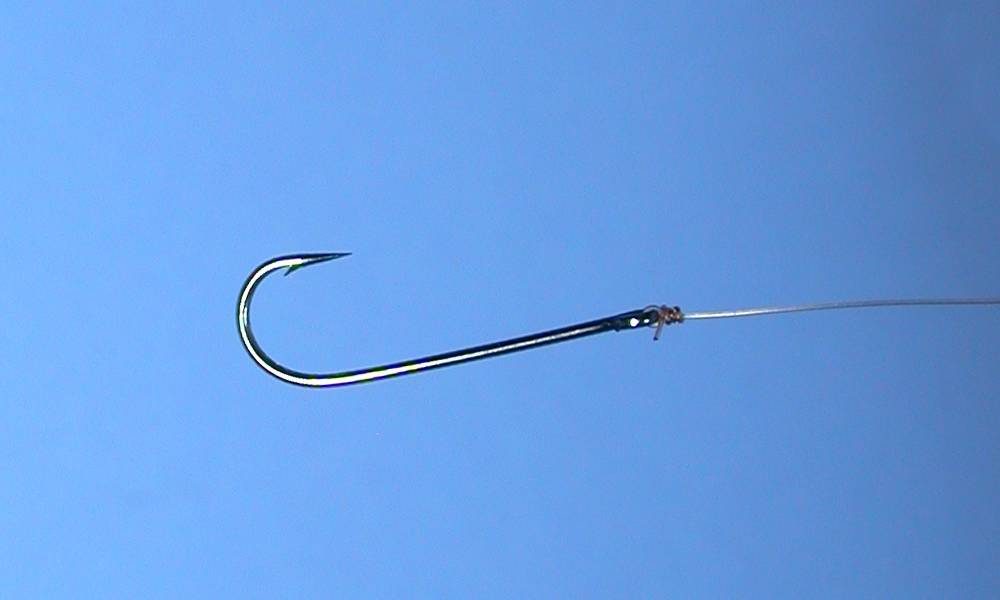
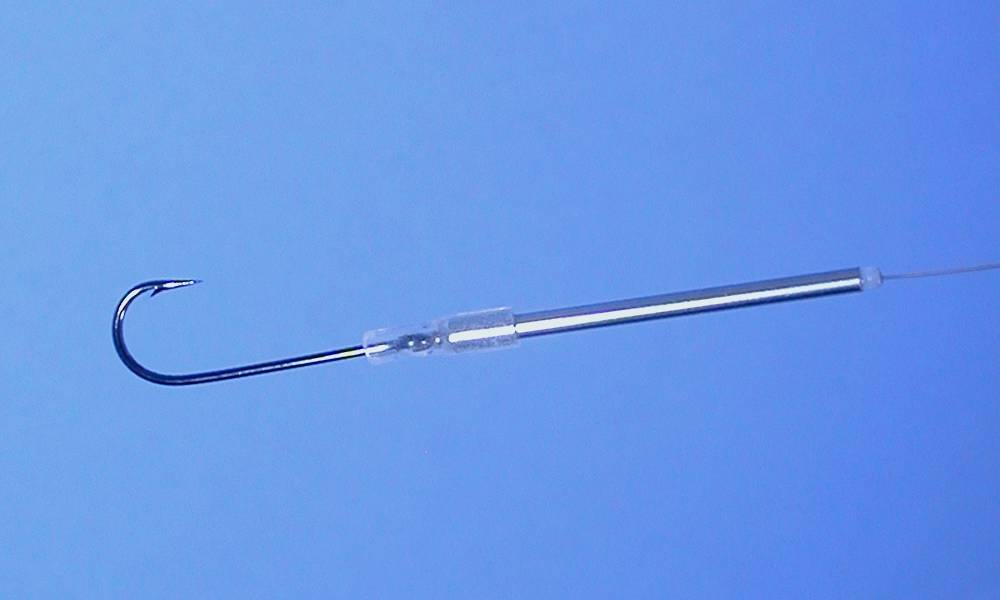
These photographs show how an undressed single hook, or single hook attached to an undressed tube, will swim when pulled through the water. It seems sensible, therefore, to set our single (and double) tube fly hooks with points uppermost, thus aiding, rather than opposing, the natural orientation of the hooks, with the following potential benefits:
- Improved stability of the tube fly
- An upturned hook may be more easily hidden among the hair of the wing and therefore less conspicuous to a fish
- An upturned hook may be less easily damaged on a rocky river bed or caught up on riverbed weed
- An upturned hook, shielded by the wing, may reduce the likelihood of hooking leaves while fishing in the autumn.
It might be reasonably argued that it is but a small step to extend the above logic more generally to the tying of our single and double hooked flies, which, if dressed with the hook points uppermost, will swim more naturally and with greater stability than those more conventionally dressed with hook points on the underside.
It is a common misconception that the downturned hook points on conventionally dressed single and double flies act as a kind of keel, giving stability to the fly. In fact, a fly dressed with the hook points facing downwards only maintains this position while fishing owing to the buoyancy of the wing keeping it upright. Any imbalance in the dressing of such a fly, particularly on a heavy hook, is likely to see it swimming on its side or even upside down, in line with the natural tendency of the hook to swim hook points up.
The most stable fly will be one dressed on an upturned single or double hook, i.e. hook point up, with the bulk of the dressing applied on top, i.e. on the same side as the hook point, which will ensure that the fly/lure swims hook point upwards, with no need for added weight or specially designed hooks.
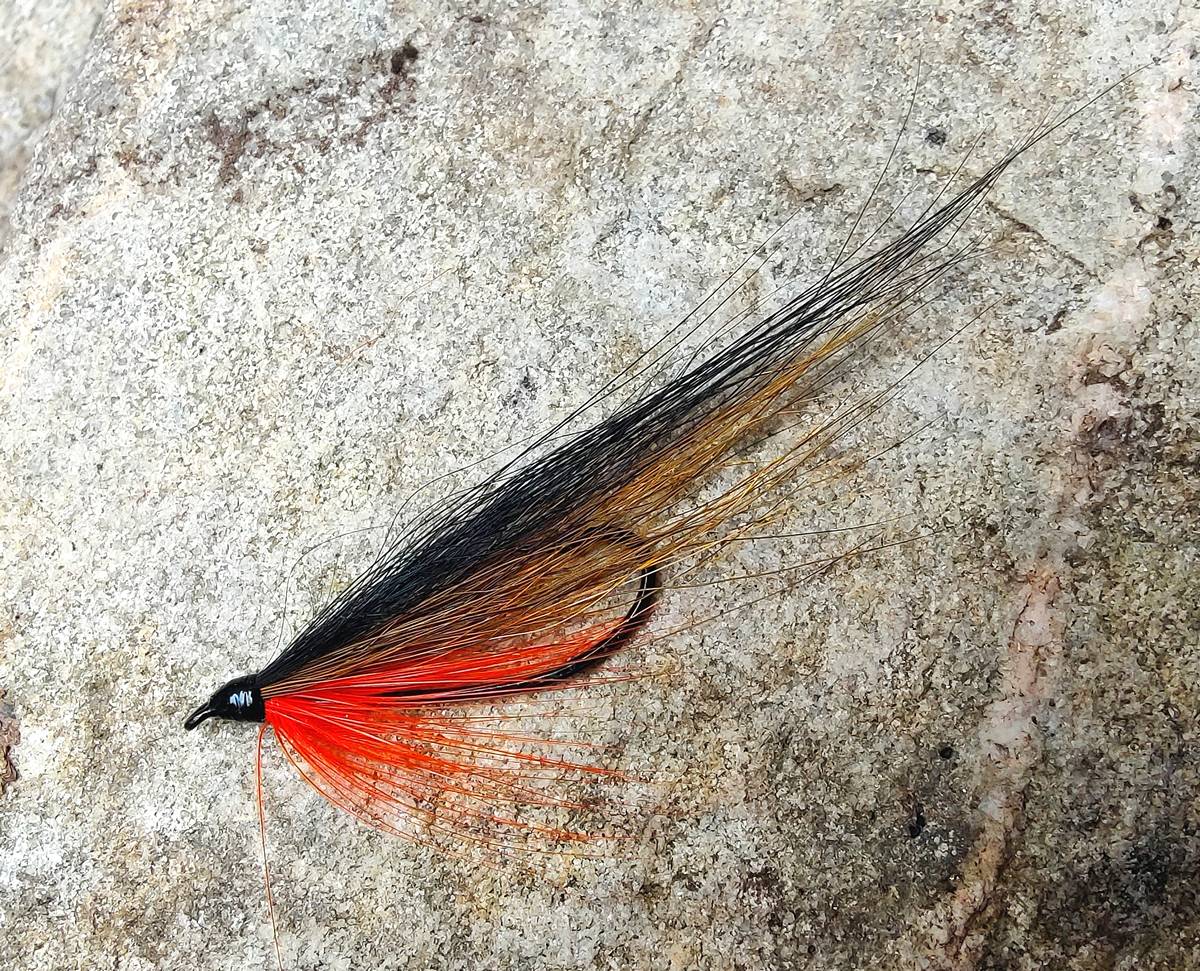
The “Hookup” shown in the photograph may look unusual, and may not be to everyone’s taste, but it will be more stable in the water than a conventional fly.
THE ADVANTAGES OF SINGLE HOOKS
The use of a single hook on a tube fly may offer the following advantages:
- With the growing awareness of the need to conserve fragile sea trout stocks, the single hook makes it easier to release fish quickly and without harm.
- The use of a long shank, straight-eyed single hook, either dressed or undressed, allows the length of the lure to be extended without increasing the weight significantly.
- The use of a lighter single at the tail end of the tube allows the lure to swim, possibly more attractively, on a more even keel, with the bulk of the weight towards the front of the lure. In addition, a shorter and therefore lighter tube may be used (where a weighty lure is not required) in conjunction with a long shank single, which may be more easily cast, on a light single handed rod, than a long tube with small treble hook.
- A variety of lightly dressed single hooks, in various materials, densities and shades, may add some mobility and vitality to the tube fly and variously dressed single hooks can be readily interchanged with various tube dressings to create a wide range of colour/shade/shape options. For example, four tubes and four dressed single hooks, all with different dressings, give a possible 16 variations of fly, 20 if we include the possible use of an undressed single hook.
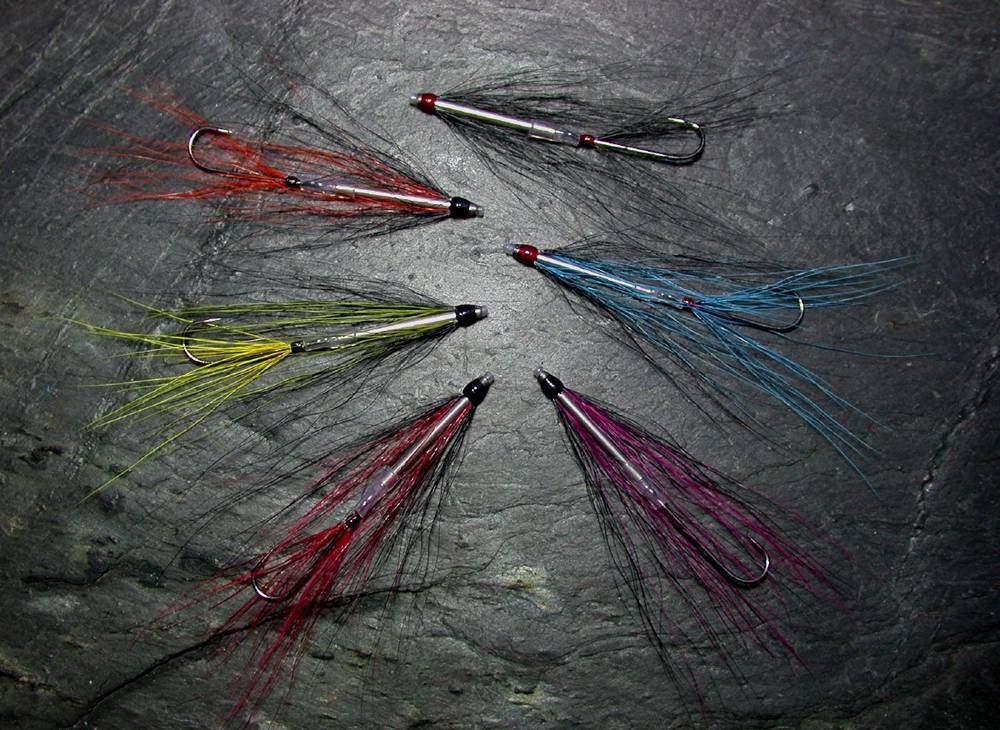
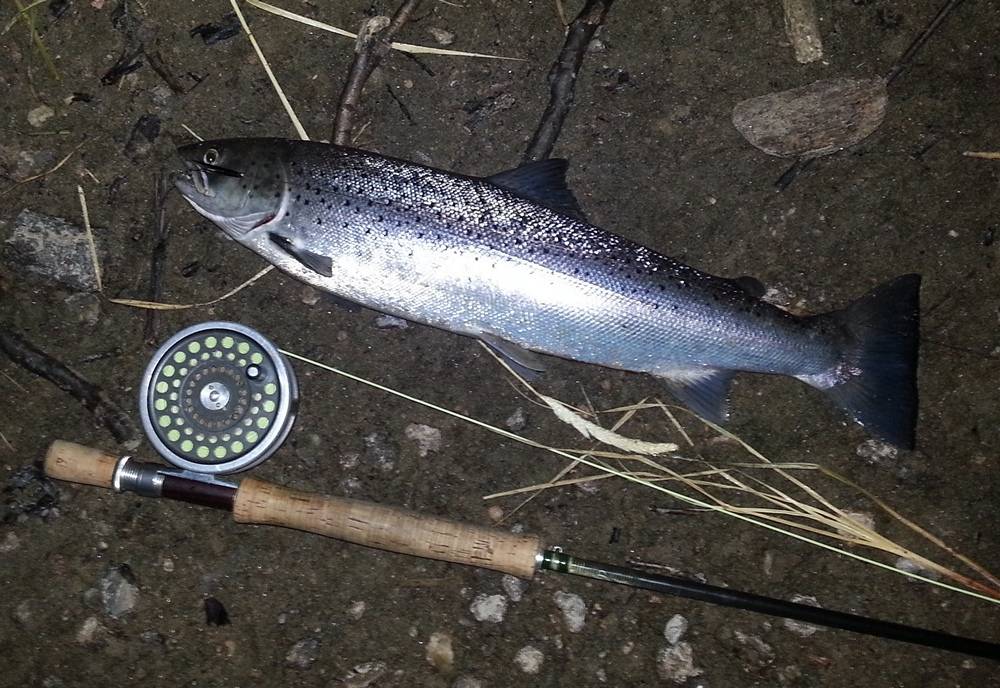
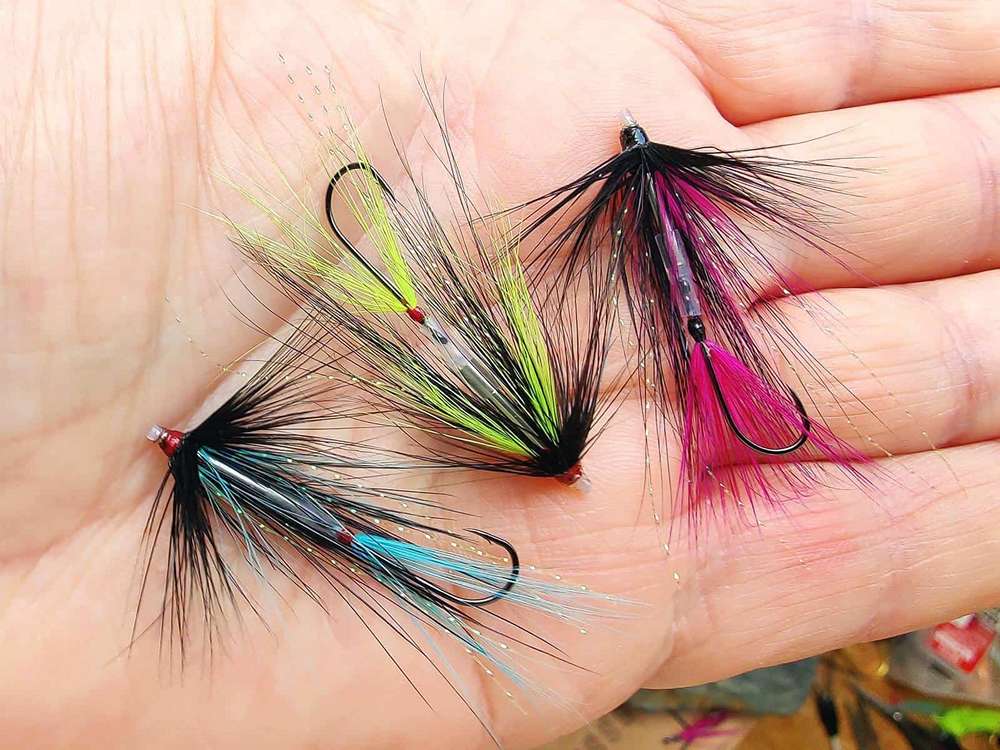
Tinglers may of course be dressed in a wide variety of styles, for sea trout, salmon, steelhead and other predatory species. A few more Tinglers are shown below, dressed in a different style compared to the above examples, which I have found effective, for both salmon and sea trout, dressed on a slim Needle Tube.
Read more about Tinglers
THE SURFACE LURE
While on the subject of flies, no list of sea trout lures would be complete without mention of the surface, or wake, lure, which, in one form or another, can be extremely effective at times on some rivers, particularly, it would seem, in Wales. The sea trout are attracted, not so much by the lure itself, but by the wake made by the lure on the surface. The floating lure, which may be fashioned out of virtually anything that floats – foam or deer hair for example, even bits of cork or wood – is cast out into the darkness and either hand-lined in or allowed to swing round on the current, creating that all important wake, which the sea trout may sometimes find irresistible, particularly, it is said, on very dark nights. I should say that I have had limited success with such lures myself. Perhaps our Scottish sea trout are overly suspicious of such outlandish contraptions!
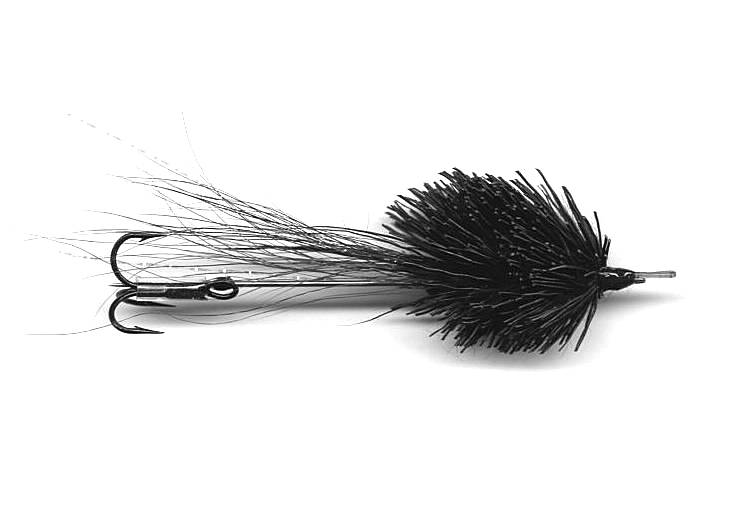
Nevertheless, the surface lure in various forms, from a simple muddler minnow to a more buoyant lure fashioned from cork or foam, is a useful, many would say indispensable, addition to our sea trout armoury, with the potential to provoke a reaction from sea trout, perhaps late in the night, when other lures are ignored or not easily seen by deep lying fish. If I add to these a selection of simply dressed singles, with either mallard or squirrel tail wing as described earlier, in sizes from 10 to 6 and a box of Needle Tube Flies, dressed in varying lengths and degrees of sparseness, I will feel well enough equipped for a night on the river.
N.B. I would like to express my thanks to Andrew Flitcroft, editor of Trout & Salmon magazine, for his kind permission to include in this book extracts from various articles published in that esteemed journal over the years.
THE QUICKENING STREAM
As we enter the third decade of the third millennium, it would seem that our sea trout, like our salmon, are currently going through particularly difficult times. They face a multitude of threats, in both their marine and river habitats, more so now perhaps than ever before. The odds appear to be stacked heavily against them. The natural hazards they face, as all wild creatures do, have been compounded greatly in recent decades by human disinterest and neglect.
Yet hope springs eternal in the fisher’s breast. There have been periods in the past when our sea trout have come through hard times and we must hope that, given half a chance, their resilience will triumph once more and we might see again an upturn in their fortunes. If there is a cycle of ups and downs in those fortunes, then we are surely now at a very low point in the curve.
Fewer sea trout naturally make for more challenging fishing and every hard-won sea trout caught today is all the more precious for it. Expectations of succeeding generations of sea trout fishers may, sadly, have to be revised and modified accordingly. Careful planning, however, along with clever, or fortunate, timing, can still put us in a position where we have a fair chance, given suitable conditions, of hooking a fish or two. Of course, success in sea trout fishing depends on a whole host of factors coming together at the right time in the right place and few of these are within our control. We are likely to experience many blank nights, no matter what we do.
Many a time I have wondered whether, in all the years I have spent in search of sea trout, I have really learned much at all about them, but then an occasional successful night, when things fall unaccountably into place, goes a long way towards restoring that all important illusion of competence.
My sea trout catches have seldom been remarkable but I reckon I have been well enough rewarded for “good attendance”. If we stick at it, we will catch fish. But even on those quiet nights, when we would swear that there are no sea trout within a mile of us, there is no place on earth more special than a sea trout river on a summer night.
The years flow ever more swiftly by and, as I write, another short sea trout season is about to begin. When the sun sinks behind the hills I will head for the river and, as green turns grey, I will hope to find a sea trout in the quickening stream.
First edition printed hardback copies of SEA TROUT NIGHTS may be purchased at Coch-y-Bonddu Books