I
On Endrick Water
Half a century has passed since I caught that first shining sea trout on a once famous West Highland river. It made an indelible impression, heralding what would become a lifelong obsession with night fishing. Of course, life has a habit of getting in the way of such obsessions and youthful enthusiasm often must give way, for a time at least, to more sensible preoccupations. So it was that I probably missed the best of the sea trout years, through those golden olden days and nights on our Scottish rivers and lochs, when threats to our wild sea trout still lay unimagined beyond the horizon.
But the time came, in 1983, when tales reached me of large sea trout that might be caught through late summer nights on the little River Endrick, also known as Endrick Water, which ran into Loch Lomond. I had just given up a teaching career to open a new tackle shop in Kilsyth. An incidental, and very valuable, benefit of this move was that I found myself ideally placed to obtain inside information on the best fishing available in the local area, and indeed further afield. It has to be remembered that, in those pre-internet days, information about fishing was less easily obtained than it is today, and mainly spread by word of mouth. Precious details of the sea trout fishing on the Endrick would be passed on, in hushed tones, to the privileged few. The long suppressed obsession could no longer be resisted.
My first taste, in September 1983, of what this little Loch Lomond tributary had to offer was no less than fantastic. On that memorable early autumn evening, I purchased a day ticket to fish the “horseshoe bend”, just upstream of the Pots of Gartness, a waterfall famous for its sightings of leaping autumn salmon and sea trout.
On arrival, it was evident from the number of cars parked at the road-end that I would not have the river to myself. This is always a hopeful sign, though, and I was further encouraged by my first sight of the river, which was running off nicely after earlier rain. I made my way down through the field to find that the river was indeed busy, with the likeliest looking pools occupied and heavily fished by all methods, although very few fish had been taken. I was in no hurry, being content to bide my time until after dark, by which time I hoped to have my choice of the pools available. So, leisurely but carefully, I set about assembling my rod – a light nine footer which I had built on a two-piece fibreglass blank supplied by McHardy’s of Carlisle in the mid-seventies – floating fly line and a cast of two sea trout flies, a Bloody Butcher and Teal and Silver, both in size 8.
To the casual observer, the River Endrick was deceptive. A pleasant little trout stream, one might think – a stream which, in places, a fit man could leap over. To the inexperienced eye, there was little to betray the presence of the large numbers of late-summer salmon and sea trout that would make their way upstream from Loch Lomond on their annual spawning run.
Quite a few fishers persevered until well after dark and I was pleased to see one or two sea trout taken on the fly, fish around the two-pound mark. The odd fish was also seen or heard running through. It was near midnight when I got started in earnest on what I considered the best looking pool – a small “pot” really, being no more than fifteen yards long and seven or eight yards at its widest point. I fished quietly and steadily, hardly moving, gently casting my team of flies, adorned with two or three maggots, again and again over the same small piece of water. Nothing! Not a touch! What was wrong? Conditions seemed ideal – a mild, dark night with the river fining down to what seemed a perfect height. Had the sea trout run out of the pool? Had there been too much activity earlier in the evening for the fish to settle? Would a fresh run of fish move into the pool? I was now well and truly alone on the river.
Almost one o’clock. I cast again. The line stopped. There was no mistaking it. A light but definite pull on the line prompted me to lift the rod. It immediately bent double under a heavy weight. The peace of the night was shattered as a good sea trout exploded on the surface. There were no long screaming runs. The fish didn’t attempt to leave the pool but it was a strong fish, which took a good five minutes to subdue on the light rod in the pitch darkness. I eventually drew the beaten fish on to the shelving sandy bank, a real beauty of three pounds plus, my first Endrick sea trout. Despite all this disturbance, there then followed an incredible two hours of fishing and at three o’clock in the morning, I sat down on the bank beside that small pool. On the grass at my side lay four seatrout, none under three pounds in weight and the biggest touching five pounds.
This spectacular introduction to the sea trout of the Endrick proved to be the long awaited spark that would reignite the flame, beginning an Endrick affair that would keep me from my bed during many a summer night over the next decade. I joined the Loch Lomond Angling Improvement Association the following year. Membership of this historic club gave me access to several miles of fishing on the River Leven, the whole of Loch Lomond and, most importantly, to the larger part of Endrick Water, with its potentially fabulous sea trout fishing.
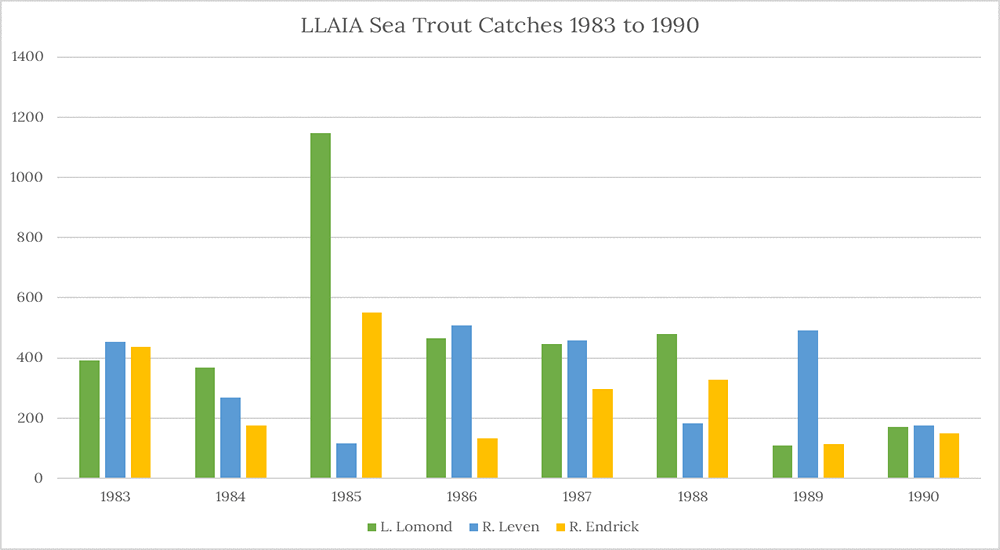
Despite excellent catches on Loch Lomond in 1985, catches of sea trout on the loch and on the Rivers Leven and Endrick throughout the eighties were lower than in earlier decades, with a particularly poor year in 1990.
1984, my first year as an association member, was more exploratory than productive. I sought the solitude of the less popular pools, in the rather vain hope of instant success. Only later, after becoming better acquainted with the river, did I realise that there were very few pools that were consistently productive at night. Consequently, in my first year, despite many nocturnal hours by the river, there was little to record. I tried a variety of pools in the many miles of fishing between Fintry and Gartness with very limited success. Indeed, catches were registered from only three pools. The Wheel, where I fished most often, yielded three fish; the Cement Wall at Gartness, two; and Coolies Lynn, one. All sea trout were in the two to three pound range and all were taken, at night, during the months of August and September, on fly and maggot fished on a floating line. I had merely scratched the surface.
During 1985, my second year in the association, I continued to explore the river, not in any really constructive or organised way, finding new pools where the odd fish might be caught on favourable nights. I was intent on exploring the river on my own, seeking out the quieter, less popular pools and avoiding the busier pools, clearly indicated by the number of cars parked by the roadside on favourable nights. But the less popular pools on association water are less popular for a good reason – they are generally less productive. I did catch a few fish but my success was modest in comparison to what might be achieved on the best night pools, and I had many a blank night.
Trial and error, however, along with bits and pieces of information gained from customers and riverside conversation with fellow association members, eventually focussed my attention on the better known pools, such as Netherton, Coolies Lynn, the Oak Tree, Meetings Lynn and Drumtian. The location of these pools is shown on the map below.
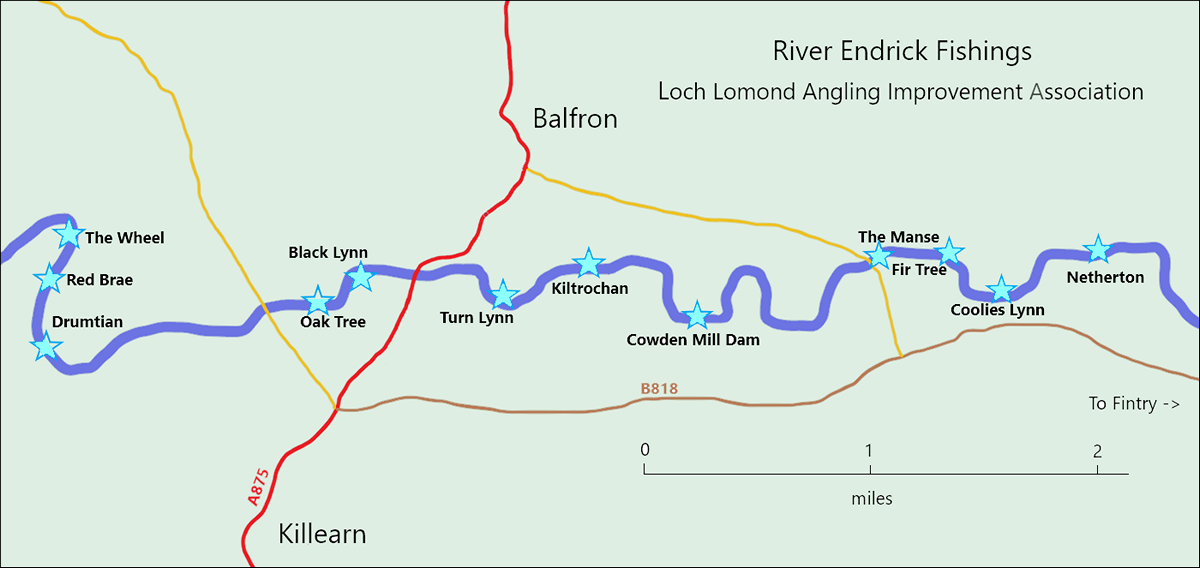
NOTE ON MAPS: Throughout Part One of this book, I have included maps showing the location of the main pools on the various association waters of the respective rivers. These might be viewed in conjunction with Ordnance Survey maps and Google map and satellite images online to gain a more complete picture of the nature of the various beats, access points etc.
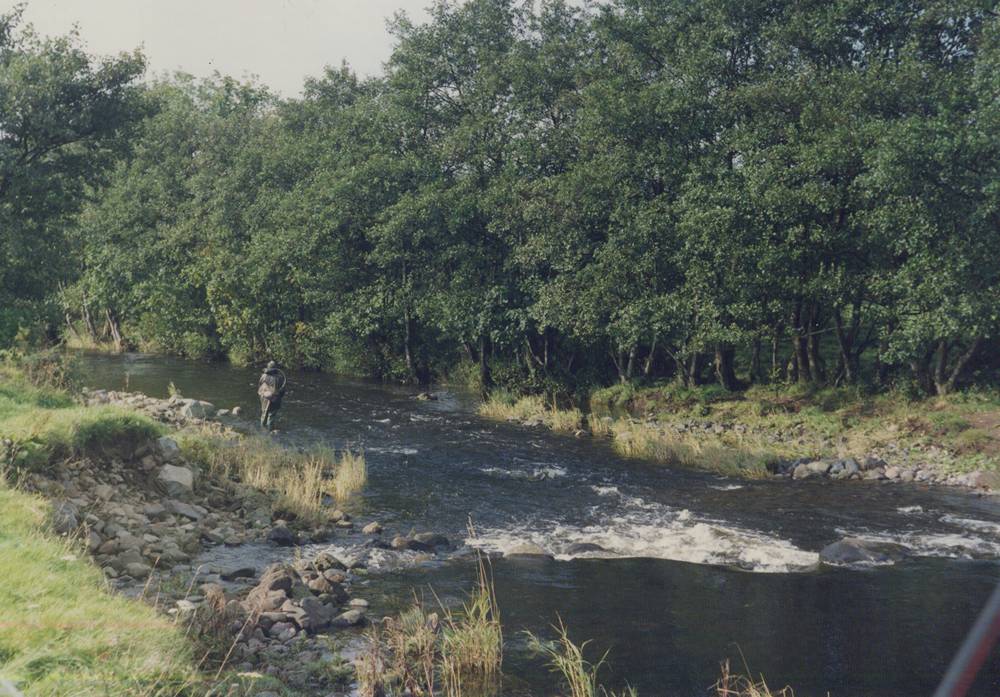
My diary shows that, in early July, I had two sea trout of 1¼lb each at Netherton, taken just after dark on a floating line with the river above summer level but dropping. The successful pattern was a Mallard and Claret, size eight, with two or three maggots on the bend of the hook. I should say at this point that the night fishing on the Endrick was mainly done with maggots attached to the fly. The reason for this was that the main sea trout pools, at summer level, had very little flow. Much of the fishing was done on very slow, almost dead water, where it was difficult to give life to a fly. I gave the conventional fly, without maggots, a try now and again. I even heard of fishers having some success with it but I cannot recall, in ten years of fishing on the Endrick, having caught a sea trout in the hours of true darkness with a bare fly. I simply stuck with what worked – the method tried, tested and proven over decades.
Looking back, I believe that, had I persevered, I might have caught fish on an unadorned fly presented in a variety of ways, sizes, places and depths. It may not have taken as many fish as the fly and maggot but it would have been a simpler, and more pleasant, way of fishing. But the desire to catch fish in those early years left little room for experiment. My approach to sea trout fishing would be very different a few years later.
My diary of 1985 also records the following successes:
Mid July, Drumtian – Afternoon (grilse, 4½lb); Mid July, Drumtian – 11 p.m. to 1 a.m. (sea trout, 3lb); Late July, Oak Tree – 11 p.m. (sea trout, 1½lb); August 19th, Coolies Lynn – 7.30 a.m. (sea trout, 5lb 6oz); August 25th, Coolies – 11 p.m. to 1 a.m. (sea trout, 3lb 13oz); August 26th, Drumtian – 10 p.m. to 1 a.m. (sea trout, 1½lb)
More and more often though, as the season progressed, the name “Cowden Mill Dam” would crop up. The Dam, as it was referred to, had been built by association members in the nineteen sixties, creating a holding pool of around a hundred yards in length and twenty yards wide, with a maximum depth of perhaps six to eight feet at the lower end near the dam. Enclosed by trees on both sides, it provided sanctuary for the shoals of large sea trout which, every year, made their way up from Loch Lomond. But it was not until the late summer of 1985 that I was to fish the Dam for the first time.
Prior to 1985, although the association had access to both banks, it was only ever fished from the left bank. Throughout the short season, often not properly underway until August, the regulars would assemble at the damside and while away the time in fishing talk until the fall of darkness. One by one, in order of arrival, they would then wade slowly and quietly down the edge of the pool, pausing only to unhook a fish. Fantastic catches were made in those days, through the sixties, seventies and even into the eighties, though with less regularity then than in the old days.
In September 1985, due to a disagreement between the association and the riparian owner, we lost the Claylands fishing, comprising the left bank of the Dam along with about two miles of good water immediately downstream. A heavy blow, which would result in the loss of many members, prompt a re-examination of the running of the association and ultimately rock its very foundations. To allow new access to the Dam, the trees on the right bank were immediately cleared and fishing continued more or less as before. The clearing of the trees seemed to have little effect on the fish and, fortunately, the new owners of the lease on the left bank rarely fished at night. They did, however, fish during the day in high water and, unlike the association members, did not restrict themselves to fly fishing. Understandably, this led to some ill feeling and tempers would flare from time to time.
It was, in fact, on the night following the clearing of the right bank that I first fished the Dam. I recall it well. Half a dozen members had gathered to sample the “new” fishing. It was not going to be easy, as the branches from the felled trees and bushes littered the riverbank, both in and out of the water. All we could do was choose a gap in the debris, clear a space as best we could and get on with it, fishing from the one spot. The river was falling and clearing nicely after a small spate and, as I recall, I managed to land two nice fish, of one and a half and three pounds. Not at all bad under the circumstances. For close on a decade, I was to become one of the regulars on the Dam.
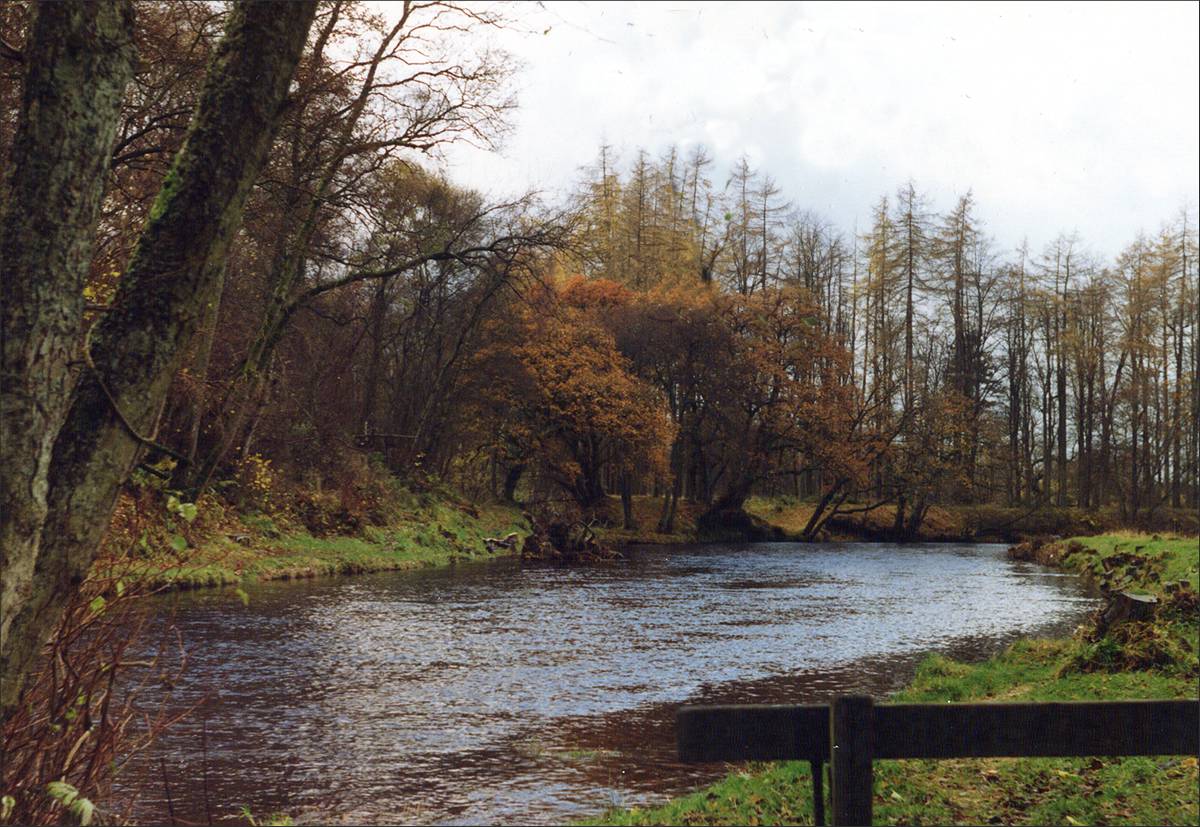
That September was marvellous. River levels permitting, I would fish usually four or five nights a week, sometimes arriving early, well before dark, to head the inevitable queue of fishers, or perhaps delaying my arrival until 11 or 12, by which time the queue would hopefully have diminished. Either way, I would normally fish for four or five hours. One “run” down the pool would take about two hours, fishing the fly and maggot as slowly as possible down the length of the pool. The Dam was fishable on most nights, the exception being when it was high and coloured after a late summer spate, when the focus would switch to morning and evening daylight forays targeting both sea trout and salmon with a variety of shrimp flies.
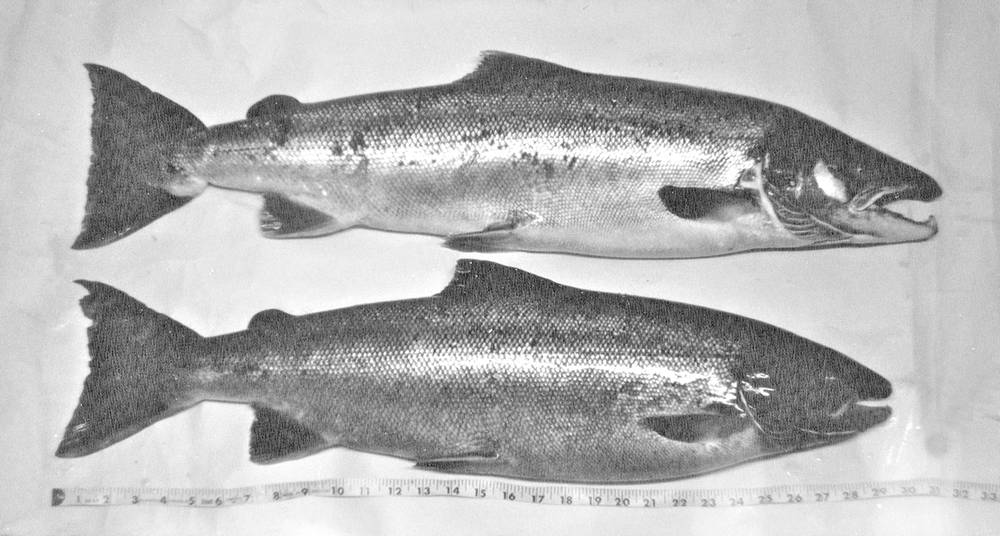
During the hours of darkness, if the river was highish, but clear with a fairly good flow, I would fish a sink tip line and two size eight flies tipped with maggots. In low water, it might be necessary to fish a single size ten fly on a short leader and floating line, to avoid snagging on the riverbed. I usually caught my fair share of the fish. One Monday morning, i.e. midnight till dawn, using a sink tip line and long shank size eight flies tipped with maggots, I caught seven sea trout weighing 26lb. The following night the river had dropped back to normal level and I had nine sea trout for 27lb on the floating line…. needless to say, my best two consecutive nights ever! Another exceptional night on the Dam yielded the brace of fish shown above. There were many other good, though less spectacular, nights that year and I finished the season with 49 sea trout, a total I have yet to equal.
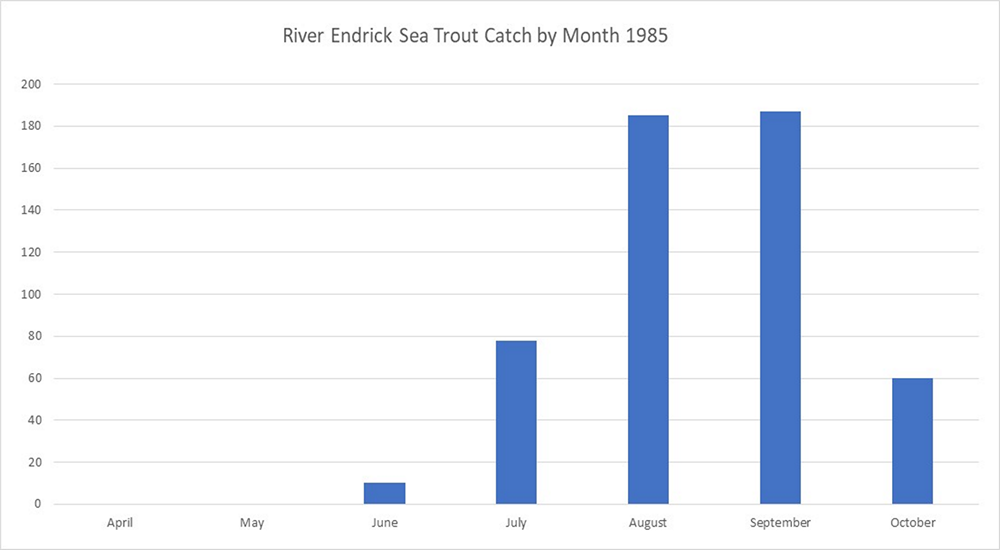
The sea trout runs, and conditions of weather and water, on the Endrick were quite variable in subsequent seasons. Often the weather would dictate when the sea trout might first make an appearance in the main pools such as Cowden Mill Dam. A good year, with one or two good spates in the early summer, might see a worthwhile stock of resident fish in July but, more often, the main run of sea trout would not reach the Endrick until August.
The 1986 season on the Endrick started quite late. A dry July, with one or two spates near the end of the month and into August, saw only the odd fish in the main pools before mid-August. On the night of Tuesday 12th August, I fished from 10 p.m. until 2 a.m.:
A dry, calm night, fairly mild with occasional cloud cover and no moon. The river very low and clear, with hardly any flow in the Dam. A few fish showed in the Dam but no takers. I moved up to Coolies Lynn. Very quiet here too with no fish moving, but I had one fish at a quarter to two on a size 8 Mallard and Pheasant Tail plus three or four maggots. A fairly fresh hen fish of 2½lb. I fished until two o’clock.
Again, on Thursday 14th August:
Heavy rain during Wednesday morning had raised the level, which had since dropped back and cleared, low enough for the floating line. I fished from 11 p.m. till 3.30 a.m. A mild night with rain from midnight on. A good number of fish in the Dam but few showing. The river level gradually rose but remained clear. A total of eight fish were caught, including one of seven or eight pounds to Frank. I had two before midnight, one at 3½ pounds on a size ten Black and Silver spider, the other at 2½ pounds on a size 8 Pheasant Tail spider, both fresh fish.
Such diary entries were fairly typical. A good night would result in a few sea trout, with an average weight approaching three pounds. However, despite my most diligent efforts and long dark hours spent on the river, there were also quite a few blank nights. Just occasionally, though, perseverance would pay off, as on the night of Sunday 17th August:
Very heavy rain through Friday night into Saturday morning resulted in a heavy spate on Saturday and I heard later that several salmon had been caught on the Endrick during Saturday afternoon. A dry weekend allowed the river level to drop throughout Sunday, offering the prospect of good night fishing conditions on the Sunday night. Fishing on Sundays for migratory fish was, of course, prohibited – a Scottish anachronism in need of urgent revision – but midnight often found me at the head of the Dam waiting impatiently to make my first cast of the night. I arrived well before midnight, to find three fellow fishers had beaten me to it. It was a lovely mild, calm night, with the sky clouding over steadily to hide a low full moon.
The river was running clear but with a bit of flow. A floating line seemed right. By way of experiment, I had added a few drops of coarse fishermen’s “Nuttract” bait flavouring to my maggots. Whether this attracted the sea trout or not, I have no way of telling, but I certainly had a good night. I fished my usual two spiders, one size 8 Pheasant Tail on the dropper and one size 10 Black and Silver on the tail, with a few flavoured maggots on the bend of the hook. Now this is not fly fishing, I know, and not an easy way of fishing, as the maggots needed to be changed, by torchlight, every half dozen casts – a delicate business as the maggots must be hooked very lightly on fine hooks with small barbs to retain a lively action – and cast very gently (no pun intended!), but, as mentioned earlier, effective in the slow flowing pools of the Endrick.
The sea trout were taking very lightly. Perhaps it was a night made for Falkus’s secret weapon, but I managed to take six fish on my first run down, hooking fish throughout the length of the pool, and two more on my second run, the majority taken between midnight and 3 a.m. The heaviest fish was just over three pounds and the average about two and a half pounds, all very fresh fish – one even had sea lice, evidence that it had run straight through the River Leven and Loch Lomond and on up the Endrick, a distance of nearly twenty miles. A great night, with a total of eight sea trout. Only two other fish were taken that night, so perhaps the Nuttract did the trick.
Nights like this, nights we dream of, were rare indeed. Nevertheless, one or two fish could usually be caught on any suitable night. I ended that season with a total of 29 sea trout, a poor result compared to 1985, with my own reduced catch reflected in the total recorded by the association that same year on the Endrick (see graph of Endrick sea trout catches below).
The following season, 1987, again started quite late. With no sign of fish yet in the Dam, I spent some time on the lower pools, such as the Meetings Lynn below the Pots of Gartness, recording my first sea trout of the season on the night of the 3rd August, a small but fresh fish of a pound and a quarter. This was followed, on the night of 13th by a slightly better fish of one and three quarters. My first from the Dam came on 17th August. From then on, I fished regularly, with variable success, until the season’s end. Cowden Mill Dam, being one of the best and most productive holding pools on the whole of the Endrick, was inevitably heavily fished, and I often had to work hard for a fish or two, as highlighted by my diary entry for Monday night, 17th August:
I arrived at 11.30 p.m. to join ten other fishers and had to wait till 12.30 a.m. to get on the pool. There had only been four fish caught up to 12.30. The river was at a good height for the floating line. It was a warm night, but with only a sparse covering of cloud and a bright quarter moon rising later in the night. No fish were moving at first and only an occasional fish showing later on. There weren’t many fish about, although I heard two or three entering the pool between 2.30 and 3 a.m. I caught two small fish, both little more than a pound, one at 3.30 in the top half of the pool, the other at 4 a.m. just below the burn mouth, as the dawn was breaking. Only one other fish was caught, at about 3.30, a fish of 2lb. Although the water was at a good height for night fishing, the sea trout don’t seem to have arrived in any numbers. We need a good spate to bring fish upriver.
That season, in addition to the odd visit during daylight hours, I fished on 34 nights, putting in a total of well over 100 hours, resulting in a catch for the season of 38 sea trout and two grilse.
In 1988, the sea trout made an earlier appearance in the Dam, with my first caught on 14th July. Loch Lomond was said to be “full of fish”! My season proceeded in much the same way as the previous one, with a total of 30 sea trout and 3 salmon caught. The run of fish was no bigger than in 1987 but the average weight of sea trout caught was higher, at around three pounds. One particular night, Monday 15th August, stands out clearly in my memory:
Four Casts, Four Fish
After heavy rain over the weekend and a high spate on Sunday, the river had dropped by Monday evening and was running clear, at a perfect height for the sink tip line. Others thought so too as five fishers had gathered at the Dam for a 9.30 p.m. start. A warm night with some encouraging cloud cover and no moon but, with the tractor lights from the haymaking disturbing the pool until half past ten, things were a little slow to start. I had one smallish fish of around 2¼lb from behind the stone in the middle of the pool, lost another and foul hooked a grilse, which was duly returned, all before midnight. Alec had two fish and two others were caught early on. Things went very quiet between midnight and 3 a.m., by which time all but myself and two others had left. It was looking like a fairly average night.
Just occasionally, though, we experience an exceptional day or night’s fishing, when all the time and effort spent on the river seems worthwhile – when, as Alec puts it, we are rewarded for “good attendance”. This was such a night. In the space of no more than half an hour, between 3 a.m. and 3.30 a.m., without moving my stance, I hooked, and landed, four sea trout in four casts. The total weight of the four fish was 19¾lb and the biggest was 8lb. I might have added to my bag but, deciding enough was enough, I called to Robert, who had been fishing some way up the pool, to take my place at the “hot spot”. This was one of my favourite spots, about ten yards or so above the Dam, casting to a narrow gap in the overhanging trees on the far side. The fish usually took just as the flies emerged from under the trees.
Robert, on this occasion, had no success. I, though, had had a magical half hour, never to be forgotten, or repeated. I must have been casting over a shoal of large fresh fish, ready and willing to take my flies after entering the Dam minutes earlier. I fished the usual 2 flies, one size 8 Pheasant Tail spider on the dropper and one size 10 Black and Silver spider on the tail, both sparsely dressed and adorned with a few maggots. That night I was certainly in the right place at the right time!
The night’s tally: 5 Sea Trout – 8lb, 4lb 12oz, 3lb 8oz, 3lb 8oz, 2lb 4oz (total 22lb)
1989 saw an exceptionally dry and hot summer, with only about three days of rain from May to July. Most rivers remained very low. A change in the weather at the end of July brought about 1½ inches of rain over two days, not quite enough for a decent Endrick spate. There had been reports around the end of July of large shoals of fish moving up the River Leven into Loch Lomond but what was reported as “the driest summer this century”, with virtual drought from April to mid-August, resulted in a very poor season for sea trout on the Endrick, with only two good weeks of night fishing towards the end of August. To compensate for the lack of sea trout, we had a fairly good back end for salmon, and the Leven, by all accounts, had a very good year. I finished the season with 21 sea trout and 8 salmon. A great bonus that year for me was seeing my son Alan, then twelve years old, catching his first fish from the Endrick. One night in late August, he caught two sea trout in the Dam, one 2lb, the other 5lb, and, in mid-September, a grilse of 4½lb from Coolies Lynn on the fly.
My Endrick 1990 season began well on Monday 2nd July:
Frank and I arrived on the Dam at the same time. We fished till about two o’clock. I had a lovely fresh 3lb sea trout, with sea lice, just above the middle stone at one o’clock. I only saw one other good fish move but it was heartening to see that there were at least a few fish in the pool so early in the season. The pool hadn’t been fished much and the banks were still a bit overgrown. It was a nice night and didn’t really get very dark. This was my earliest sea trout from the Endrick. (I lost my exhaust on the way over …. what a racket!)
It was all downhill from then on! July was quiet, with no rain since early in the month. In the first week of August the Dam was poisoned in very low water with fish affected as far downstream as the Black Lynn. By August 13th, there had been no rain to speak of since the beginning of July. The Endrick was very low, with reports of a second poisoning incident at Cowden Mill Dam, although it is possible the fish may have succumbed to the often lethal combination of low water and high temperatures. My diary summed up the 1990 season:
On the whole, my impression has been of a disastrous sea trout season, certainly on the Dam, and grilse runs not as good as usual. I have had my worst sea trout season ever on the Endrick, with only eight sea trout caught, and the small compensation of 4 grilse. The sea trout problem is not confined to the Endrick but is occurring all over Britain, particularly on the west coast.
The blame is falling on various causes, in particular the salmon farms and their associated sea lice infestation of wild migratory fish, especially sea trout. Sea netting continues, as does the industrial fishing for sandeels and other sea trout/salmon prey species. Other threats are domestic, industrial and farming pollution of our rivers, and a big increase in the seal population, now protected. There have been a few exceptions, e.g. fabulous runs of sea trout on the Dee (an east coast river with no salmon farms nearby) in May and June. Perhaps I should turn my attention eastwards.
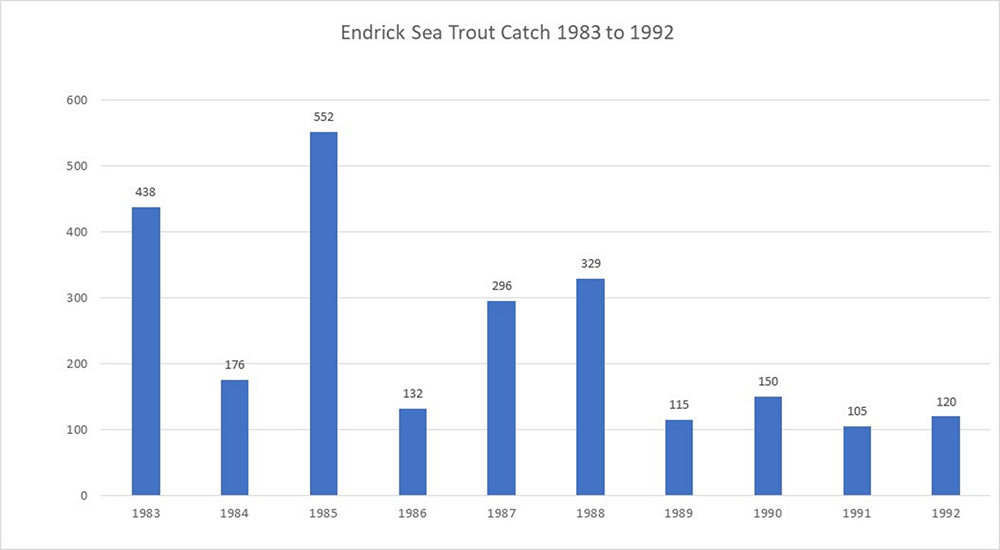
The graph above shows the fairly steady decline in sea trout catches on the River Endrick through the nineteen eighties and into the nineties. It is worth noting that the significant, and in many cases dramatic, decline in catches of sea trout experienced in the Loch Lomond system, including Endrick Water as the primary spawning tributary, and more widely on the west coasts of both Scotland and Ireland, from the late eighties onwards, coincided with the rapid growth of salmon farming proximate to those areas, and the associated increase in sea lice numbers.
Although the spring of 1991 was dry, there were several spates on the Endrick during June and a few sea trout had been caught, even as far upriver as the Dam. My first sea trout of the season were taken on the Dam on the night of 4th July, a brace of fresh two pounders, both with sea lice attached.
In the third week of July, I took a break from the Endrick, spending a rare week with my wife and children on Speyside, where I fished the Strathspey Angling Improvement Association water for the first time. Heavy showers throughout the week kept the Spey running at about 6 inches above summer level, a borderline height for night fishing, but I discovered some lovely pools, e.g. Poll Caich, the Saddle, Bushes, Auchernack, Little Stream, Upper and Lower Bends, Tarric Mor and, on the lower beat, the Lurg.
On the first night of my holiday I had two lovely fresh sea trout of 3½lb and 2lb from the Bushes on a Mallard, Silver and Claret, dressed on a lightweight Aberdeen hook, size 6. Following an unsettled week, weather-wise, the same fly accounted for a second brace of sea trout, both over two pounds, caught in Poll Caich on the last night of my week’s fishing. An excellent introduction to the River Spey, where I was to spend many a night chasing sea trout in seasons to come (See Chapter VII).
Back on the Endrick, the level remained low until late September and very few sea trout were caught. I fished infrequently. A good spate on the 22nd and an even better one on the 24th revived the river and brought a late run of sea trout into the Dam. I had four sea trout and a grilse in two nights fishing before the end of the month.
On the whole, 1991 had been a very poor season on the Endrick. Due to the long dry summer, I fished less often than in previous years. The run of sea trout was very late and the grilse were scarce. It had been one of my worst seasons to date, with only 2 salmon and 14 sea trout to my credit, four of those taken on the Spey. Seeking pastures new, I had applied to join both Comrie and Crieff Angling Clubs on the River Earn.
Chapter II – On the Earn at Comrie
First edition printed hardback copies of SEA TROUT NIGHTS may be purchased at Coch-y-Bonddu Books