
VI
On the Border Esk
I had spent two decades in search of sea trout on the Rivers Endrick, Allan and Earn, eventually achieving a moderate degree of success, or at least satisfaction, on all three. But I have always enjoyed the exciting prospect of fishing new waters, with all the research, the planning, the preparation, the anticipation, the exploration, and the eventual small triumphs that it entails. In 2003, for that excitement I looked southwards, to the Border Esk, long renowned as one of the very best sea trout rivers in the land.
The Border Esk is formed by the meeting of the Black Esk and White Esk near Bailiehill. On its way to Langholm, the Esk is joined by tributaries Meggat Water, Ewes and Wauchope and, just downstream of Langholm, by the Tarras Water. A mile or two below Canonbie, the Esk meets its major tributary, the Liddel, a good salmon and sea trout river in its own right. At Scotsdyke, the Esk, hitherto a Scottish river, enters England and flows on past Longtown to meet the Solway Firth near Gretna. While famed primarily for its sea trout, the Border Esk also has a good run of salmon through the latter part of the season. Much of the available fishing along the Scottish banks of the Border Esk and Liddel is owned by Buccleuch Estates and was run for many years by the estate. The Esk and Liddel Fisheries Association waters, extending to some twenty miles of the Border Esk and Liddel, were made available to both local and visiting anglers through day, weekly and season permits at very reasonable prices, while a few of the prime beats were let separately by the week.

The former association beats, managed since 2011 by the Border Esk & Liddel Angling Club, include some of the finest fly fishing water on the middle Esk and the middle and lower Liddel. The angling club is a not for profit association open to locals and visitors alike, the objects of which are to promote the sport of angling and in particular protect, improve and develop the Rivers Esk and Liddel, from their confluence to their head waters, and all the tributaries as a facility for fishing; to help to maintain these rivers and improve biodiversity for the benefit of the public and to promote enjoyment of the river by the general public and, in particular, to take specific action to promote the sport of angling amongst young people and people with disabilities. In addition, the club recognises the contribution angling can make to the economy of local communities. To this end they have engaged with a range of local businesses to discuss what the club might do to encourage tourists and visitors to the area.

It is perhaps worth noting here the ongoing controversy over the attempts, since 2005, by the English Environment Agency to impose an English rod licence on anglers fishing the Scottish beats of the Border Esk. In protest at this wholly inappropriate, and legally questionable, action by the Environment Agency, many Esk fishers, to their credit, refused to take permits on the river. Others took permits and registered their protest by refusing to buy an English rod licence. It is to be hoped that a reasonable compromise, now long overdue, can be reached on the matter and that normality might soon be restored to this once great sea trout river.
At one time the Esk and Liddel Fisheries beats might produce around 5000 sea trout in a season, many caught on worm in high water, others taken on the night fly during the short summer nights of June and July, with the added bonus, towards the end of the season, of up to 500 salmon. For reasons that are not clear, catches of sea trout here, like those of other Solway rivers, have declined in recent decades, with the Border Esk seeing a particularly steep and dramatic drop in catches from 1989 (see graph below). The Buccleuch Estate beats now produce somewhere between 500 and 1000 sea trout per season and around 200 salmon. Given the right conditions, June and July can still provide some excellent night fishing.
My first taste of Border Esk sea trout fishing came in the summer of 2003. Prior to this first visit, I had corresponded with Iain Bell, then Buccleuch Estates Fishery Manager and head bailiff on the Esk and Liddel Fisheries, who had been extremely helpful in organising my fishing permit and providing very detailed information on the various pools on the two rivers, how and when to fish them and so on. Midnight, Sunday 6th July, found me at the head of Tommy’s Pool, eagerly awaiting the starter’s gun. Iain had written, “I have seen Tommy’s black with fish, usually from the boulder toward the tail off the right bank”. I could hardly wait to begin.
The river was very low, with glit starting to appear in the slacker water and back eddies. A few heavy rain showers were badly needed to freshen the river and perhaps bring a run of fish up from the Solway. The night was dark, mild and very still. Tommy’s is a lovely sea trout pool, with a narrow neck on a slight left hand bend opening into a fairly narrow and deep top half which broadens after about fifty yards into the main body of the pool, continuing in an unbroken flow, deep in parts, on down to a likely looking tail.
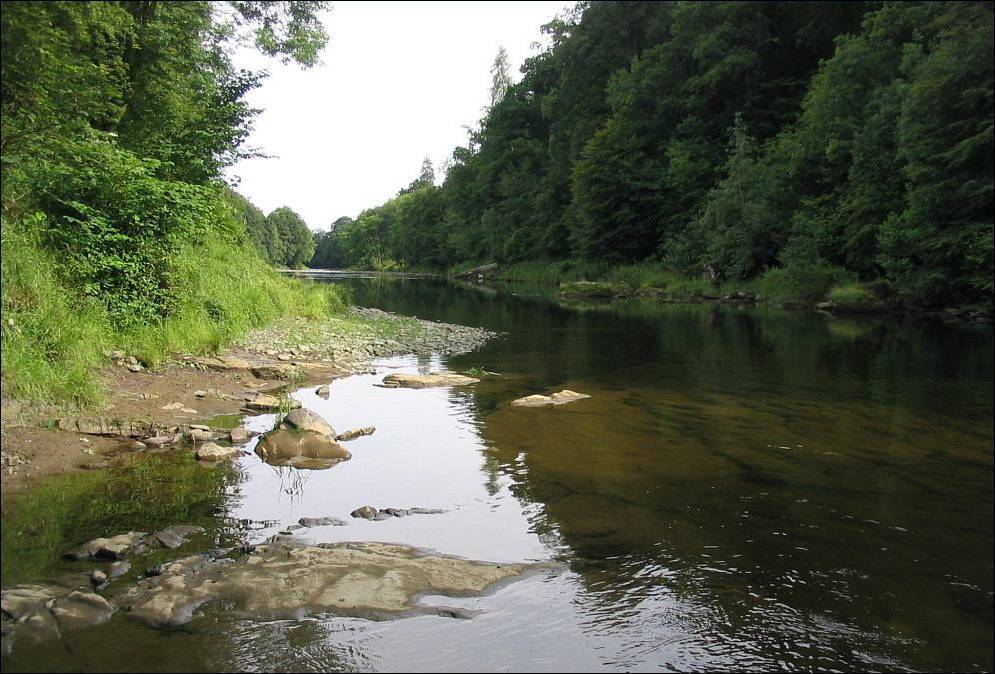
The pool is enclosed on both sides by heavy tree cover, which rises very steeply on the right bank to a height of perhaps a hundred feet. A quite dramatic, and often very dark, setting for a night’s fishing. At this low water level, there was little flow in the main pool, so I decided to make a start at the tail, fishing a cast of two size 8 flies on a floating line, casting towards the boulder near the far right bank, and below, where the flow quickened over a shallowing riverbed.
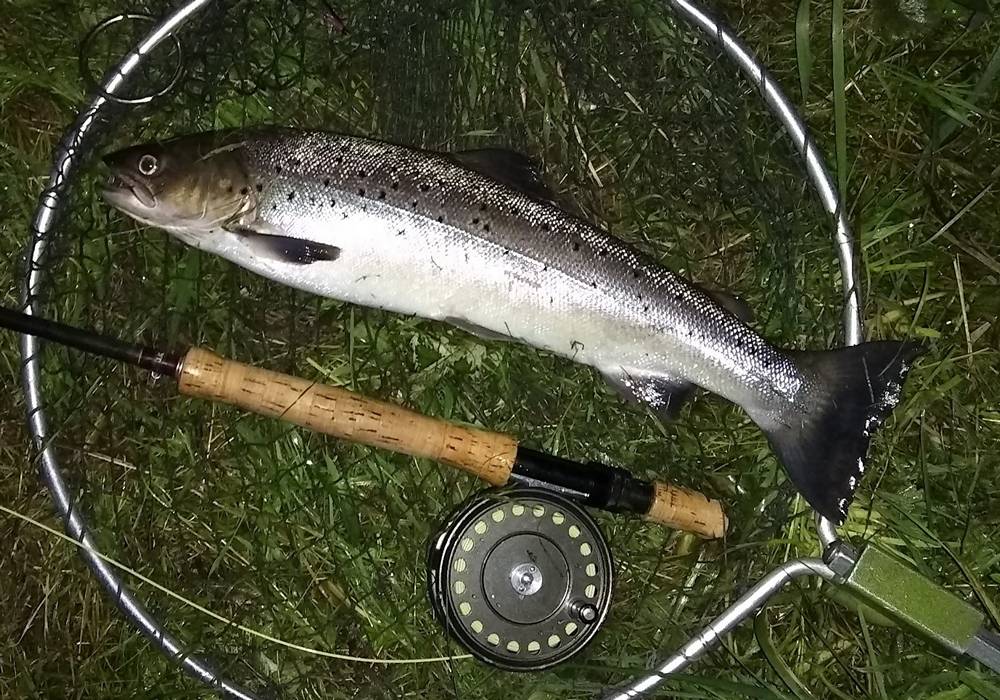
Care was needed in wading over the uneven rock shelves underfoot. Sea trout were moving on and off throughout the night, some hefty fish among them. Having had no luck with the floater, at one o’clock I changed to an intermediate line, fishing a size 10 Black and Silver spider on a dropper above a 1¼ inch black Needle Fly on the tail. At 1.30 a.m., fishing the well sunk flies ever so slowly across the deep channels in the main body of the pool, I had a strong take. The hooked fish ran immediately towards me. I hand-lined as fast as I could to keep up with it but it was lost after a brief fight. I had a second strong pull in the same place at two o’clock …. then nothing. I tried everything, including a surface lure, to no effect. As dawn approached at 3.30 a.m., I moved, in a last gasp effort, back up to the narrow neck of the pool where, after only a few casts, much to my surprise and delight, I hooked a very lively sea trout. After an exciting few minutes, I managed to net it among the rocks. It had taken the small black spider on the dropper. I knocked it on the head, a fair reward for a hard night’s work – a lovely fresh sea trout of 2¼ pounds, my first from the Border Esk.
It rained that day but not enough to raise the river levels. Iain Bell had dropped in to our rented cottage around lunchtime for a blether about the fishing. He suggested one of two likely places that might produce a fish in the low water. That evening, I plumped for Burns Stream and Flat, thinking I may be able to start just a wee bit earlier in the fast run at the top end without harming my later chances on the slower flat below. I arrived early at the excellent fishing hut with not another fisherman in sight. It was again a nice night with plenty of cloud cover and a light upstream westerly wind.
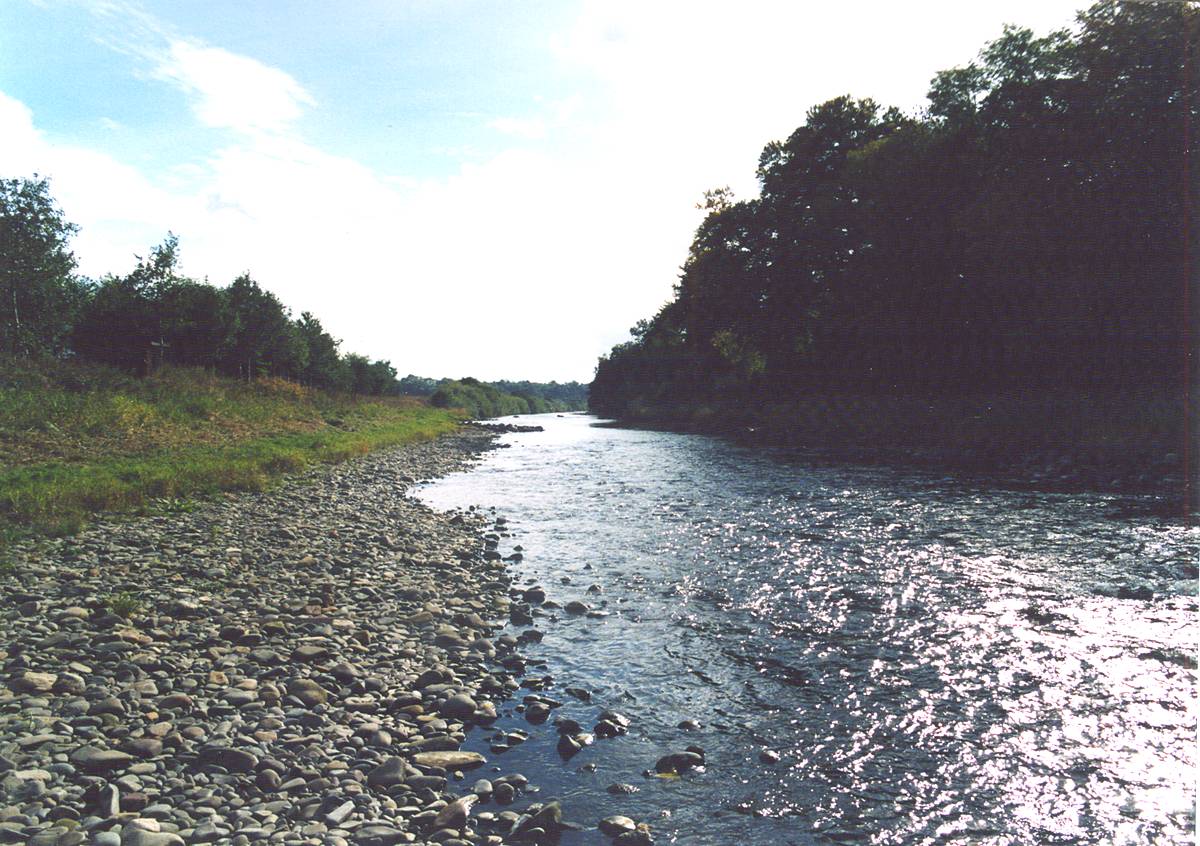
I was encouraged by one or two sea trout showing at the tail of the stream as I made a start, at dusk, well up at the top of the stream. I fished slowly and carefully down to the most likely looking spot, where the stream is funnelled between two croys before broadening into the top end of the flat, which runs to a depth of only two or three feet at this height of water. At 11.15 p.m., just below the far croy, I was taken by surprise by a solid take to my tail fly, a slim Mallard and Magenta, dressed on a lightweight silver Mustad Aberdeen sea hook. A very lively fight ensued, proper reel-screaming stuff, before a very fresh, bright three pounder was brought to the net. I think this fish may have been waiting at the tail end of the stream, getting ready to run upriver on the fall of darkness. After only another fifteen minutes, I hooked and lost a second fish and had one or two further tentative pulls as I fished down towards the nice looking tail of the flat, before a heavy, persistent drizzle began to fall, putting an end to all fish activity. By half past one the pool was quiet and the rain wet. Content with my catch, I decided on an early night.
The following night, I thought I’d give the Lower Liddel a try. A fair old hike from Park House Farm brought me to the Dam Foot, to find a pair of otters at play in the top pool, above the sharp right hand bend in the river, where the main pool begins. This is a very impressive long deep pool with a sheer tree-covered cliff on the English side. It would be a good pool to fish in slightly higher water, particularly in the long, wide, shallow tail, but tonight the flow through the pool was slower than I would have liked. I caught a half pound herling in the run-in to the pool around 11 p.m. before fishing my way downstream to the junction with the Esk, where I had a second herling in the pool at the very bottom limit of the beat. Another long walk back up the riverside path on the left bank of the Esk brought me to Burns Stream shortly after 3 a.m., in time to see an angler take a two pounder just as the day was dawning.
The next day Kathy and I took a walk down the track to the Willow Pool, then up the right bank of the Esk as far as the fishing hut at the Skelly Hole, below which we found again some lovely fly water stretching all the way down to the bottom of the Canonbie beat, just above Bell’s Weir. It seemed that each new section of the river I came across looked better than the last.

The Esk and Liddel fishery really does present the angler with enough variety and interest to keep him busy for many, many seasons, all at a very affordable cost. That evening, I fished from the Skelly Hole all the way down to the tail of the long flat below, where I found one or two deep pockets in the red sandstone riverbed which seemed to hold sea trout at night, perhaps providing resting places for fish running upstream after dark from the Willow Pool. In this stretch I caught one sea trout just over a pound and one herling, both hooked on a size 8 Mallard and Silver. I missed a further two or three.
Thursday night on the Mill Pool produced only one herling and one or two others missed. So Friday night found me once again down at the Skelly Hole, which was unusually quiet for a Friday night, with not another fisher in sight. It was a lovely mild, calm night, though not as humid as the previous evenings, with good high cloud helping to obscure an occasionally visible full moon. There was no sign of sea trout as I made a start just above the fishing hut but I hoped that one or two might move upstream out of the Willow pool during the course of the night. On my second run down through the pool, sometime after midnight, I hooked a very fresh and lively sea trout of just under two pounds on a 1¼ inch black and white Needle Fly. This was followed at 1 a.m. by a slightly larger and stronger fish of 2¼ pounds, which had also taken a fancy to the Needle Fly. I fished on till 2.30 with a pale hint of daylight tinting the eastern sky. With no further offers, I made my way back up the riverside path to the car. A very good night!

It was a rather different river on the Saturday night. The parr were very active at dusk, promising a good stock of fish for the seasons ahead, but as a full white moon rose above a misty midnight river, the activity ceased abruptly. As the mist rolled downstream, the temperature of the air dropped well below that of the river, which now felt warm to the touch. I was casting, with little hope, into the reflection of the moon, which highlighted only a very occasional movement in the tail of the pool fifty yards below. I fished on till one o’clock before giving up, beaten by a full moon in a clear starry sky. I followed my moonshadow back up the riverside path to the car, reflecting contentedly on my first week on the Border Esk. In difficult conditions of very low water, I had caught five sea trout for a total of ten pounds, the best three pounds, all lovely fish not long in from the Solway, plus a few herling. Two of them had taken a Needle Fly – the first, but not the last, Esk sea trout to fall for its charms.
I fished on quite a few more nights, on a variety of pools, over the following three weeks, whenever the river was running clear and at a decent height, i.e. up to a maximum of about nine inches above summer low level. I had had a good season, ending my first year on the Esk and Liddel Fisheries with 14 sea trout. We had invested in a small touring caravan which we based at Camelot Caravan Park near Longtown, an ideal location minutes away from the Canonbie beat of the Esk. I fully intended to renew my Esk and Liddel season permit for the next season and to make the most, over the coming seasons, of the convenience of the caravan during the main sea trout months of June and July. I would be unlikely to have time to fish on the Earn at Crieff, so I decided to give up my membership of the Crieff Club in 2004. But I would pay one last visit to the Cement Dyke for old times’ sake, as my diary records:
By August, the best of the night fishing is normally over on the Earn but, in the season of 2003, there was no “best” and, following a hard and unproductive early season, I had forsaken its familiar streams for pastures new, with some pleasing results on the Border Esk. Reluctant to give up on her altogether, though, a recent less than optimistic return visit and the dubious encouragement of a lost fish had, even at this late stage, given renewed hope, enough to justify one more night, although, in truth, nothing more than the most flimsy of excuses is needed to draw me to a sea trout river on a summer night.
A forty five minute drive brings me to the usual parking place at the Coup, within half a mile of the Dyke. I hurriedly put up the rod in the fast failing light, unaccustomed to such an early start. The attentions of a few midgies prompt a spray of Skin so Soft. I am not yet wholly convinced of its effectiveness but, if nothing else, I smell nice! A quick check on more important items – car keys, fly boxes, spools of nylon, LED torch, scissors, eighteen inch Gye net, no need for a priest – and I take the path to the river, now slightly overgrown through disuse yet still familiar even on the darkest of nights. The night is calm and clear, the warm air heavy with summer scent as I near the river, my way lit by a full moon still low in the southern sky. A fallen tree, as yet uncleared, blocks my path and I have to crawl under – I must remember that on the way back.
Ahead of me, a motherly mallard flaps her way upriver towards my pool. The Cement Dyke is more of a glide really, perhaps a hundred yards long – it will be more than enough to keep me fully occupied for a couple of hours. It’s a night for midgies, moths and bats. The parr are active and the bank of cloud looming on the horizon promises to obscure the moon as I make a quiet start in the faster stream well above the hot spot, where the sea trout like to lie at ease under the alders and willows on the far bank, in a gentle glide four to five feet deep. Things look hopeful. An indignant heron stalls in mid-flight overhead, squaarking in loud protest, unaccustomed to human intrusion on his watery domain. I can’t avoid the attentions of some small trout as I wade, knee deep, slowly and carefully towards the deeper water. I begin to concentrate just a bit more as the increased current catches my line, swinging it round in a nice arc over the width of the stream. I become aware of a series of waves approaching from the far bank. I watch as they continue upstream, though it is now too dark to make out the culprit, most likely a travelling otter. Thankfully, he didn’t stop to explore my pool, as some do, popping a curious nose up within a rod length to gauge the quality of the competition.
I settle back in to the rhythm of cast, swing, retrieve, lift … yes, that was a good pull, not a parr that time…. the otter may have stirred the sea trout up. I hear a loud spaloosh a hundred yards downriver. I concentrate. A bow wave on the smooth surface of the glide focuses my full attention on the next half dozen casts. Just towards the end of the swing I feel a slight pull and I can make out a swirl on the dark surface twenty yards below. I immediately recast and, when the pull comes again, I am ready for it and lift the rod into a good sea trout. I bring it to the net as quickly as I can, a good strong fish of two and a half pounds just starting to colour. It has taken the slim stainless steel Needle Tube Fly on the tail. I quickly return the fish before struggling with the size fourteen treble stubbornly caught in the net. It is eleven o’clock. Not a bad start!
I go in again just above where I hooked the fish. A mist creeps upriver as the moon makes a brief reappearance but the night air is still warm so I decide to persevere. A good decision. The mist goes as suddenly as it came and within half an hour the sky is again overcast and dark. The second sea trout of the night, slightly larger and stronger than the first at three pounds, takes me by surprise at midnight. It takes a bit longer to bring to the net, firmly hooked in the lower jaw. It too is safely returned. Well satisfied with the best night I have had on the river all year, I sit for a while on the bankside log and enjoy the still of the night, reflecting on the ups and downs of a decade spent in search of Earn sea trout, before making my way back along the riverside path towards the car. I had bid, I hoped, a fitting farewell to the Earn.
Sadly, the early promise of my first season on the Border Esk would not be realised over the next two seasons. Despite a few good spates in the June of 2004, the sea trout failed to appear. It had been, according to Iain Bell, the worst June on record. Iain suspected a connection between the poor sea trout run that year and the foot and mouth outbreak of 2001. There is a possibility that disinfectant chemicals entering the river system during the period of the outbreak may have had an adverse effect on ova and fry in 2001, and consequently reduced the number of smolts migrating to sea during 2002/3. If so, we would hopefully see an improvement in a year or two.
A conversation I had one afternoon, at Crookholm on the River Liddel, with a long time regular on the river, was not encouraging. He thought the poor runs that year signalled the beginning of the end of sea trout fishing on the Esk and Liddel (the poor man’s Esk, as he put it). He compared the current difficult fishing – with the water level at the top of the red painted spinning mark on the rock above Penton bridge, he had caught four small fish that day, around 1¼ pounds, with twice that missed or lost on a Size 2/3 Mepps, and a few days ago he had a catch of eight sea trout – with the bonanza years of the past when the rivers would be full of sea trout, the last good year being in 2000. He gave me some useful tips on how and when to fish the Liddel, which was fishable with fly when above the top of the spinning mark at Penton Bridge down to a couple of inches below, when the river might appear, to the inexperienced eye, to be carrying too much colour.
By the time you judged that the river had cleared nicely to a perfect fly height, it would often be too late and you would have missed your best chance. He did think that a really big flood in June was needed to clean the river bed, on both the Esk and Liddel. He was not optimistic about night fishing on the Liddel, where there were few night casts – he didn’t recommend the tail of the Black Kist; the Horse pool used to be good but had been spoilt by stones placed in the tail; Meggie’s Ford did not hold fish. He did, however, recommend the tail of Dormont as one of the few night casts worth trying.
Over the last weekend in June, a few fish were caught in high water during the day, both on Esk and Liddel, but the night fishing had yet to get under way. I fished Monday night, 28th June, at the Skelly Hole till 1.30 a.m. There was no sign of fish but I hooked a bat and had an otter for company – I hoped that the otter wasn’t going hungry!
Several sea trout were reported in early July, most taken on worm, spinner or fly during the daytime. The June fishing had been truly dire, however. I heard that John Park, of McHardy’s of Carlisle, a very keen and accomplished regular rod on the Dead Neuk and Little Moat section of the river at Canonbie, had fished on twenty consecutive nights in June without a fish! With nothing to show for my own efforts, it seemed I was in good company.
On Tuesday 6th July, following heavy rain the day before, I had an hour’s fishing at the Wires below Canonbie, with the river still running fairly dirty at about the level of the spinning mark. There was no sign of fish and very few other fishers. On running back via Penton Bridge, I had the good fortune to meet Iain Bell, who offered to show me the access points and the fishing on the upper part of the lower Liddel beat. He and Peter Kinstray had recently done a lot of good work in opening up the access to the upper pools such as the Pot and it did look good that day, running at a good fly height, at or slightly above the red spinning mark at Penton. On returning to Penton bridge, Iain ran me into Sheilingmoss farm to show me how to get to Clinty and Blaney, two of the best pools I had yet seen on the Liddel. As on the Esk, each stretch of the Liddel I saw seemed better than the last. The upper pool, Clinty, was difficult to fish with fly, being very deep and rocky, but looked good for worm and spinner. The recently retired Sheilingmoss farmer, Walter Leslie, told me he had had 13 fish in the previous ten days on worm, from Clinty and Penton. That day he had had one about a pound on worm and a six pounder the previous Saturday, both from Clinty.
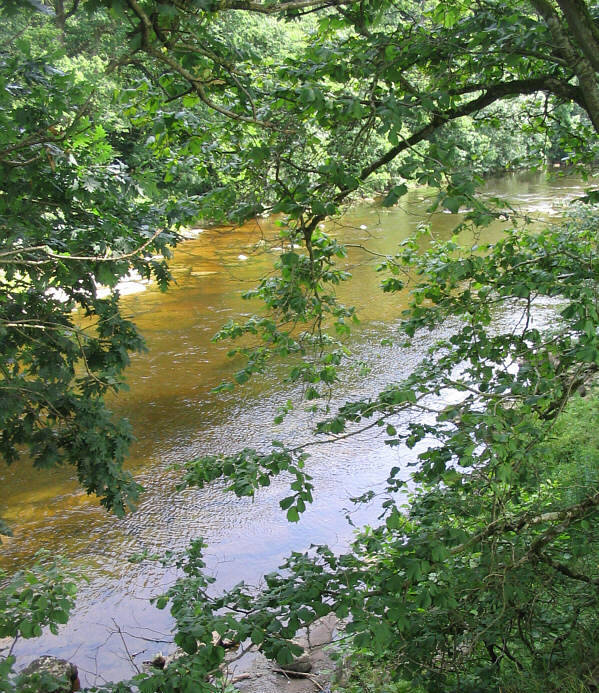
On a later visit to Clinty I met another angler fishing worm. He had caught a fish from one of the small runs above the Clinty fall. He told me that he had fished this stretch of the Liddel for many years, now mainly with worm, and had seen his season’s catch fall from his best of 130 to less than ten last year, the drought year. In 2000, the year before the Foot and Mouth outbreak, he had caught around 50. So reasonable catches are still possible, though not what they once were. The average size of the Liddel sea trout is about 1¼ to 1½ pounds. He kindly gave me a guided tour of the whole Clinty stretch pointing out the main lies and how to fish them with the worm. It’s a lovely pool, fishable in all heights of water with the appropriate method – worm, spinner or fly – worm being the most productive overall, even in quite low water. A Mepps spoon, size 2, would also be good in a big water.
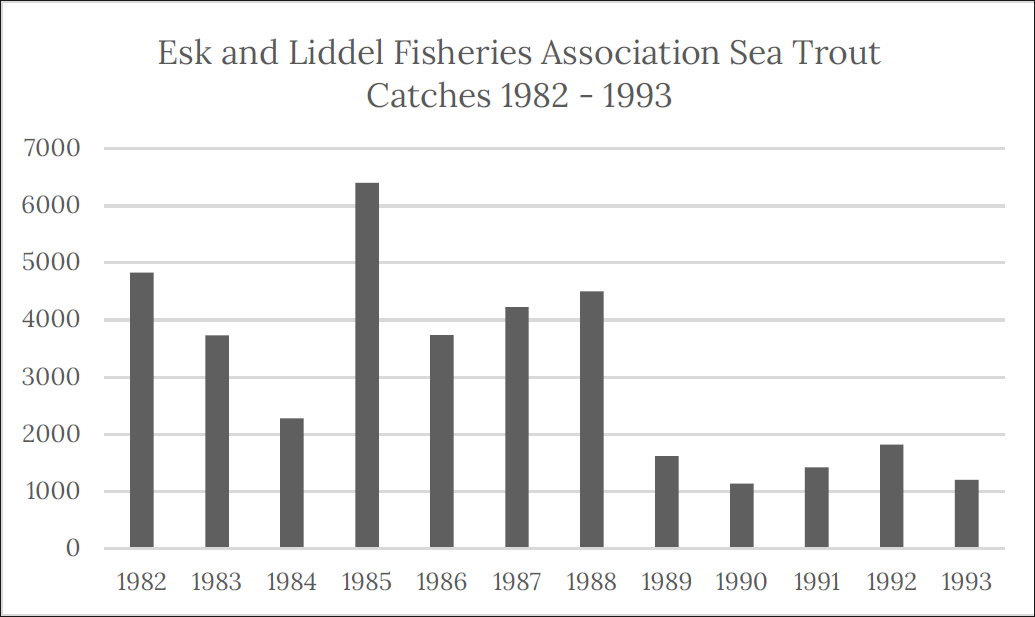
The graph above shows the sea trout catches reported by permit holders on the Esk and Liddel Fisheries Association beats (i.e. the waters now controlled by the Border Esk and Liddel Angling Club) for the period 1982 to 1993. This does not include sea trout caught on the Buccleuch Estates private beats of the Border Esk or on the English beats of the Border Esk and Liddel, each of which might record up to a further 1000 sea trout per season during that period. Note the sharp drop in catches in 1989. Since that year, sea trout catches have remained below 2000 per season on the association beats. Since its formation in 2011, The Border Esk and Liddel Angling Club has seen a wide fluctuation in annual sea trout catches, with the best of recent years, 2012, seeing a catch of 961. A good season would now see upwards of 500 sea trout recorded on the club water. It is worth noting, however, that the fishing effort, in terms of rod/days/nights spent on the river, over recent seasons has been significantly lower than it was in the past.
Sea trout runs would appear to have been in general decline in many British rivers since the late nineteen eighties. The most dramatic, and catastrophic, decline in sea trout stocks occurred on the west coasts of Scotland and Ireland, coinciding with the rapid growth of salmon farms from around the mid nineteen eighties. At one time, some of the best of our Scottish sea trout fishing was to be found on the great sea trout lochs of the north west highlands, on Lochs Maree, Shiel, Eilt, Stack, More and Hope and on the great loughs of western Ireland. Each year, on every summer tide, large shoals of sea trout would run the short rivers to reach the lochs, where they would spend the summer months before making their way up the spawning streams in the autumn.
When in the lochs, the sea trout could be caught during the day. Good catches would be taken on a team of wet flies, fished, loch style, in front of a drifting boat, held steadily on age old drifts by skilled boatmen, while an irresistible dapped fly, fished on a good wind, might bring the better sea trout up from the deeper water. Sadly, the fishing on the great sea trout lochs is not what it once was. Stocks of sea trout have collapsed in recent decades. Today, few fishermen make the annual pilgrimage to the west highlands in search of sea trout. Catches on the once famous sea trout lochs and rivers are a mere fraction of what they were. Boats on the lochs lie idle, hotel rooms empty.
A scientific study on the sea lice problem associated with the salmon farms [“Patterns of Sea Lice Infestations on Scottish West Coast Sea Trout: Survey Results 1997 – 2000” published by The Association of West Coast Fisheries Trusts] reported:
“In areas with epizootics (outbreaks of disease affecting many fish at one time), lice can directly cause the mortality of 30% to 50 % of all migrating sea trout smolts and 48% to 86% of all wild salmon smolts..… Studies in Norway, Ireland and Scotland estimate that, in salmon farming areas, most sea lice larvae are produced from farmed salmon, due to the far greater numbers of farmed hosts relative to wild hosts. This is reflected in significantly higher lice infestations on wild sea trout in salmon farming zones compared to farm free areas in Ireland and Norway. Similarly, in Scotland the highest burdens found on sea trout occurred in the salmon farming zone of the west coast. Consequently, in Norway, western Ireland and western Scotland, lice infestations are regarded as a major factor in the decline of wild salmon and sea trout populations….”
The catastrophic impact of salmon farming on stocks of wild sea trout on the west coast of Scotland is now widely accepted. A recent report, in 2017, by Dr Andrew F. Walker MSc PhD on the Collapse of Loch Maree Sea Trout stated:
“Nevertheless, it can be concluded that the introduction of salmon farming in Loch Ewe close to the River Ewe’s estuary played a prominent part in the changes in sea trout stock dynamics in the River Ewe system, leading to the collapse of the angling fishery in Loch Maree. The rapid change in sea trout stock structure there in the late 1980s was consistent with many other badly affected sea trout fisheries throughout the West Highlands and Islands following the development of local intensive coastal salmon farming.”
There can be little doubt as to the extent and nature of the problem. While the Scottish Government, a strong supporter of the salmon farming industry, continued to turn a blind eye to the unfolding environmental catastrophe, it seemed clear to many of us that the sea lice problem associated with the salmon farms had been a major contributory factor in the decline of sea trout stocks on many west coast rivers and lochs. It is to be hoped that stricter controls combined with improved production techniques and a growing environmental awareness on the part of salmon farmers, fishery owners and politicians might one day halt, and perhaps even reverse, this sad decline and that the sea trout, and the fishermen, might one day return to the West Highlands.
In the meantime, there had been a general, and perhaps more baffling, decline in sea trout stocks also in areas where no salmon farms existed, for example in the rivers flowing into the Moray Firth and Solway Firth. In the summer of 1989, the Solway rivers appeared to suffer a particularly dramatic collapse in sea trout runs. Indeed, the total Scottish sea trout rod catch shows a similar calamitous fall at around the same time, the 1987 total rod catch of 55,112 sea trout falling to 48,386 in 1988, 43,285 in 1989 and 28,060 in 1990, a fall of almost 50% in that three year period. The downward trend in Scottish sea trout rod catches has continued fairly steadily ever since, to a depressingly low total of 16,899 in 2019. Why, we might ask, are our sea trout stocks now in such general decline? It has become clear that, despite their amazing resilience, our sea trout face a multitude of threats to their very survival, in both their marine and freshwater habitats.
I have noted the grave problem of sea lice infestation associated with the growth of salmon farming in the north west of Scotland and in the west of Ireland, undoubtedly a major factor in the declining fortunes of our sea trout. We may cite further problems in the marine environment. Gradually rising sea temperatures, associated with climate change, are thought to affect the availability and location of many of the prey species on which sea trout, and other fish species, depend. The over-fishing of particularly important prey species such as sandeels around our coasts has similarly reduced food availability, not only for fish but also for many of our seabirds.
The uncontrolled growth in populations of both grey and common seals around our coastline over the past few decades has posed a severe predatory threat, while a similar increase in the numbers of protected species of avian predators, in particular mergansers, goosanders and cormorants, poses an equally serious threat to young salmon and sea trout in the river environment. Sea trout continue to be netted around our coasts, albeit at a reduced number of locations, now concentrated along the north east coast of England.
Afforestation in the upper catchments of our rivers has led to problems of both high levels of acidification and increased run-off of rainwater, resulting in excessive erosion in some parts of the river and excessive deposition in others, both of which may have an adverse impact on sea trout and salmon spawning streams. Such large and sudden variations in river flows are likely to be exacerbated by climatic change which may alter the flow regimes of rivers, resulting, for instance, in extended drought in summer but milder, wetter winters causing big winter floods.
While many historic barriers to sea trout and salmon migration, such as dams and weirs dating from early industrial times, have been gradually removed or modified, others are now appearing in the form of mini hydro-electric schemes, tidal barriers etc. which hinder both the upward migration of salmon and sea trout and the downward migration of smolts in the springtime.
It might be alleged that predation by anglers and poachers poses a threat to stocks of salmon and sea trout. In earlier years, when it was common practice to kill rod caught sea trout for the table, and by some for sale, excessive catches by anglers may have had some impact on numbers of sea trout in some rivers, despite generally healthy stocks at the time. In recent years, however, with more fragile stocks of migratory fish, there has been a transformation in the attitude of anglers to the killing of trout and salmon, so much so that the vast majority of salmon, sea trout and brown trout caught today are returned safely to our rivers and lochs. It is now increasingly rare for a sea trout or salmon to be killed. It would be wrong, therefore, to think that angling now has an adverse impact on wild fish stocks. Nothing could be further from the truth. Angling, as practised today in Scotland and more widely in the British Isles, has no negative impact on stocks of wild fish or their habitat. Indeed, the very opposite is true. Anglers and anglers’ organisations contribute greatly to the conservation of fish stocks and the protection, maintenance and improvement of their natural habitat. Poaching has also been much less of a problem in recent times, due partly to reduced runs of migratory fish and partly to legislation banning the sale of rod caught, and at the same time of course poached, game fish.
Biologists have warned that the introduction of non-indigenous fish species into sea trout rivers, in particular the stocking of farmed brown trout, may be detrimental to native stocks, migratory fish and the river habitat in general. Such an introduction may only be warranted where, for example, a river is recovering from an incidence of severe pollution that may have wiped out the natural stock. In general, in a healthy river with a good stock of wild fish, artificial stocking is likely to be counter-productive and might, in the long term, have a serious, and perhaps irreversible, adverse effect on the river and its truly wild, and very valuable, fish stocks. Stocked fish, particularly if stocked in numbers and sizes incompatible with the river habitat, can represent a serious threat to wild fish. The stocking of fish derived from a non-indigenous source might, over a period of time, dilute the wild gene pool, which has adapted over millennia to the local conditions. Larger stocked fish tend also to eat or at least displace smaller wild fish. The stocked fish, now the more dominant on the spawning redds, are less likely to spawn successfully. Consequently, with many of the indigenous fish forced out, resulting in a less viable breeding population, wild trout and sea trout numbers gradually fall.
Finally, while much of the pollution of our rivers from industrial sources has been reduced dramatically in recent decades, pollution from other sources has increased. Agricultural insecticides, pesticides and fertilisers, including slurry, have found their way, in ever higher concentrations, into our rivers, with their seriously adverse impact on both fish and invertebrate life. Despite advances in sewage treatment, the growth in the size of human settlements on our river banks has been associated with a general increase in river pollution in recent times, while the increased demand for water, for both human and agricultural use, has led to increasing water abstraction and lower river flows throughout the increasingly hot and dry summer months.
With all this and more to contend with, one wonders how the sea trout has survived at all. Given the political will, however, many of the above problems could be addressed, affording a degree of protection to increasingly fragile stocks of this most valuable game fish.
In early July, 2004, it certainly seemed that, whatever the cause, there was a severe dearth of sea trout in the Border Esk. Even the Solway netsmen were having a lean time by all accounts. I was optimistic, though, that the sea trout would appear at some time in July. If the weather improved and the river settled to summer level, with warmer night temperatures, things were sure to improve.
On the evening of Thursday 8th, the Esk was dropping slowly after a good rise a day or two earlier and was running clear at about 6 to 8 inches above summer level. I was first to park at the Skelly Hole car park at half past nine and only one other angler arrived while I was setting up the rod. He, too, had had a poor season so far with no sea trout caught. I decided to walk down to the “New Bit” before dark – a sea trout had been taken here last evening in daylight – and when I arrived, the stream looked inviting so I fished down from the fast stream towards the tail where the big stone sits midstream. It is a nice stream but quite shallow, though with some depth on the far side under the bank. After only a short time I had a strong take on the far side about two thirds of the way down the run. The fish, a nice fresh hen sea trout of 2 pounds 14 ounces, fought strongly but was eventually netted. It had gone for the size 8 Ginger Pearl on the dropper. It was twenty past ten. By eleven o’clock it was dark and, with the river running fairly high, I changed to bigger flies, size 6, with a silver stoat/yellow hackle on a silver Mustad hook on the tail and a palmered Ginger Pearl on the dropper.
At 11.15 I was delighted when another good fish took, again on the far side but a yard or two further down than the first. This fish, another fresh hen fish of 3 pounds 10 ounces, fought even more determinedly than the first with several long strong runs across the pool ending in a leap clear of the water, pound for pound one of the strongest fish I have hooked. After what seemed like a good five minutes, I was relieved to draw the beaten fish over the Gye net. It had taken the Silver Stoat. What a night – 2 lovely sea trout, both a more than respectable size for the Esk, in an hour.

At last I had struck silver! I fished on below the Skelly Hole till half past two but with no more luck. I heard later that several fish had also been caught that night in the Dead Neuk and Little Moat, which are among the most productive night pools on the river and account for a high proportion of the Esk and Liddel sea trout catch. So it seemed that, at long last, the sea trout had arrived.
On the evening of Tuesday 13th, I arrived at the Dubh Pool to find the run out of the Grey Stane occupied by an angler on the far bank, so I started at the middle run on the Dubh, fishing a Ginger Pearl and Dark Mackerel in size 8. I had one tentative pull half way down but saw no fish move, although I heard the fisher above hook one or two fish.
I then moved down to Tommy’s Pool about midnight and fished my way slowly down its length, having changed to a one and a half inch black and yellow Needle Fly on the tail and a bushy Black Palmer on the dropper, as it was now very dark. Light but fairly steady rain persisted most of the night but it remained fairly mild, good conditions generally. Having had no offers and heard only two fish move, as a last resort I tied on a needle wake lure and backed up through the pool from the tail. At 2 o’clock, I had reached half way up the pool and was on the point of packing in when I was surprised and delighted by a solid take. The fish fought well but was eventually slipped over the net and brought to the bank. I was debating whether to return the fish, a nice deep, fresh sea trout of about three pounds, when the fish made the decision for me, jumping out of the net and slipping quietly down the steep grassy bank and disappearing back into the night. I had a few more casts before making my way up through the field to the car, pleased with my last minute success. This was only my second fish from the Esk on a surface lure – both taken late on very dark nights.
On Wednesday, 21st July, I fished the Esk below the Skelly Hole. The night began clear and it looked as though it might turn cold but it soon clouded over, providing just about perfect sea trout fishing conditions. Conscious of my earlier success in taking two lovely fresh fish from the run down at the New Bit before full darkness, I waded into the top of the run about ten o’clock and began to fish carefully down towards the first bush, where, after a missed offer, I was rewarded with a half-pound herling which took the tail fly, a size 8 Mallard, Magenta and Silver. The colour began to drain from the riverbank foliage as I moved slowly towards the productive tail of the run, casting as near to the far bank as I dared and occasionally getting caught up in the grass or bushes. At about half past ten, I had a solid take under the second bush. The Hardy Perfect screamed sweetly as the first long downstream run took me down to the backing in no time. A good fish, surely. A brief but lively fight followed before I drew the fish towards me in the half light. To my surprise, the sea trout weighed only about a pound but had fought like a fish twice its size. I didn’t even need the net. I drew the sea trout to hand, removed the fly, again the Mallard and Silver, firmly lodged in the scissors and returned it. A small fish but a sea trout, rather than a herling, well-marked with distinctive black spots.
Eager to repeat the exercise, I started in again a few yards further up the run and worked my way again towards the tail. My expectation mounted as I approached the third bush. This is the lie from which I had taken the three and a half pounder earlier in the month with the river running six inches higher. Again, at 10.45 p.m., I had another good take. A short run and leap were followed by a long, strong run upstream under the far bank. A second leap revealed a silver flank gleaming in the half light. A fast run across the stream towards me made it difficult to keep in contact. I reeled in furiously, regained some control and, after a lively battle at close quarters, I managed to draw the beaten fish over the net. Again I was surprised by the size of the fish. At one and a quarter pounds, it too had fought well above its weight. I removed the fly, this time the size ten Ginger Pearl on the dropper, and held the fish gently in the current. It soon recovered and swam slowly off to complete its upstream journey. It was quite dark, the new moon hidden behind high clouds, when I moved up to the shallow flat below the Skelly Hole, a productive spot for me last season but disappointing so far this year. I changed the tail fly for a small black and silver Needle Fly but had no further offers, although one or two fish swam past me on their way upstream at about 12.30 a.m.
That season drew to a close uneventfully. It had been a poor season for me, with only half the number of sea trout caught in the previous year. The following 2005 season on the Border Esk would be remembered more for the controversial attempts by the English Environment Agency to impose a rod licence on Scottish anglers, fishing the Scottish banks of the Border Esk and Liddel, than for the quality of the sea trout fishing, which continued to deteriorate through 2006, a year that saw one of the lowest sea trout catches ever recorded on the river. Yet I had enjoyed my fishing on the Border Esk, and would return to its clear streams in later years, but a new chapter, in my fishing and my life, was about to begin many miles to the north.
Chapter VII – On the River Spey
First edition printed hardback copies of SEA TROUT NIGHTS may be purchased at Coch-y-Bonddu Books